English Essay: My Favourite Book
The english essay favourite book topic asks for something personal: not a summary of a story, but the reasons why one book matters to you. Examiners love this topic because it separates memorised essays from honest ones, and the best essays sound like a real student talking about a real book. This article gives you an outline, a full model essay and exam tips, so you can write sincerely about a book you truly enjoyed. More study help is on the [Solved Notes](/solved.html) page and in the [books](/books.html) collection.
What Makes a Book a Favourite?
A favourite book is not necessarily the longest or most famous book; it is the book you return to again and again because it teaches you something or makes you feel something. It may be a book of stories, a biography of a great person, or a book about science and nature. What matters is that you can explain why you like it: the characters feel real, the language is beautiful, or the lessons help you in daily life. An essay that says I like this book because it is interesting, without giving reasons, will always score low.
Before writing, ask yourself three questions about your book. First, what is the book about in two sentences? Second, which part or character impressed you most, and why? Third, what did you learn from it that changed your thinking or behaviour? Your answers to these three questions become the three body paragraphs of your essay, and suddenly the essay writes itself. Honesty is your greatest strength here: write about a book you have actually read, even if it is simple, rather than pretending to love a difficult book you never opened.
- Name of the book and its author
- What the book is about, briefly
- Your favourite character or part
- Lessons you learned from it
- Why you recommend it to friends
Essay Outline: My Favourite Book
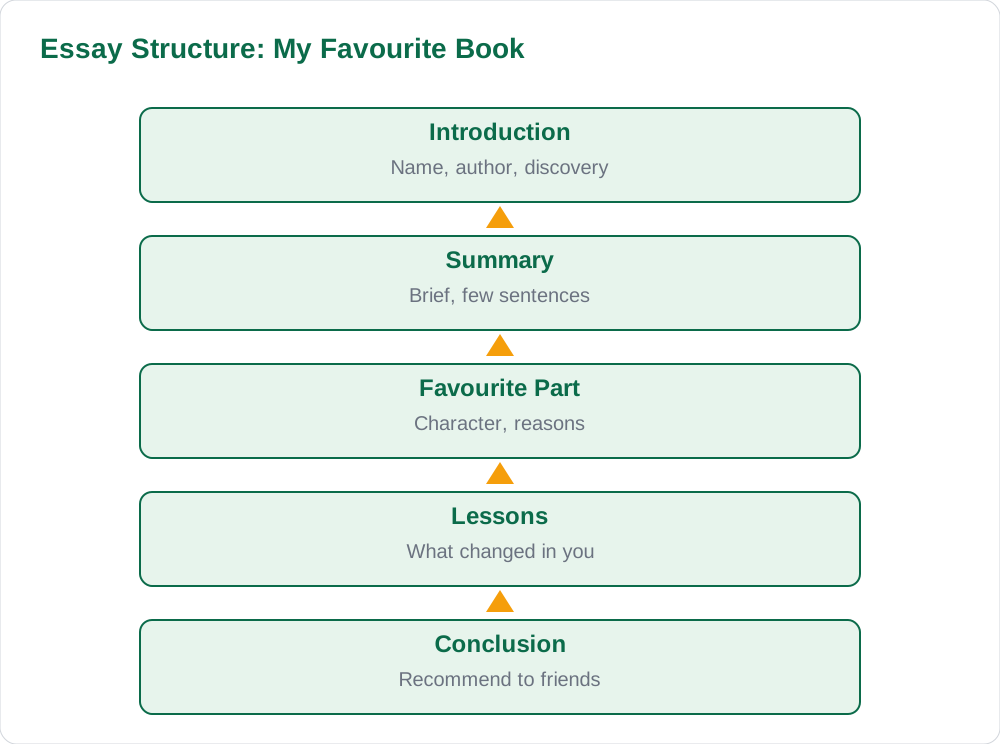
Structure this essay as introduction, summary, favourite part, lessons, and recommendation. The introduction names the book and says how you found it, perhaps as a gift or from the school library. The summary paragraph must be short, only three or four sentences, because the essay is about your feelings, not a retelling of the whole story. The next two paragraphs carry the real marks: your favourite part with reasons, and the lessons you learned. End by recommending the book to other students and saying why they would enjoy it too.
Do not retell the entire story chapter by chapter, and do not reveal the ending in full detail if it would spoil the book for the reader. A good book essay is like a recommendation to a friend: enough detail to create interest, plus honest personal reasons. Use phrases such as I was impressed by, I learned that, and I recommend this book because, which naturally produce the personal voice examiners want.
- Introduction: name, author, how you found it
- Body 1: short summary in a few sentences
- Body 2: favourite character or part, with reasons
- Body 3: lessons learned and change in you
- Conclusion: recommendation to other students
Model Essay: My Favourite Book
My favourite book is a small book of inspiring stories and biographies that my teacher gave me as a prize, and I have read it many times with great pleasure. It contains short, simple stories about honest, brave and hardworking people who faced difficulties with patience and never gave up. The language is easy, the stories are short, and every story ends with a lesson that a student can understand and apply in daily life. I keep this book on my study table, and whenever I feel tired or disappointed, I open it at any page and find new courage.
The part I like most is the story of a poor student who studied under a street light because his home had no electricity, yet he worked so hard that he became a successful teacher. This story impressed me deeply, because it taught me that excuses never help and hard work always pays in the end. I often think of that student when I feel lazy about homework, and his example pushes me to open my books again. The book also teaches honesty, kindness to others and respect for parents and teachers, and these lessons are more valuable than any examination marks.
Model Essay: Conclusion and Useful Vocabulary
This book has changed my thinking in a real way. Before reading it, I believed that success depended on wealth and luck, but now I understand that patience, discipline and sincere effort matter far more. I have started managing my time better, helping my younger brother with his lessons, and speaking politely even when I disagree with someone. In conclusion, I recommend this book to every student, because it is short, interesting and full of lessons for life. A good book is a true friend, and this book has become one of my best friends, guiding me quietly every day.
Useful vocabulary includes: biography for the life story of a person, character for a person in a story, impressed for deeply affected, and recommend for advising others to read something. Use the present tense when describing what the book teaches, and the past tense when retelling a story event. Avoid copying long quotations from the book; one short sentence, explained in your own words, is enough and sounds more honest.
- biography — the life story of a real person
- character — a person in a story
- impressed — deeply affected in a good way
- recommend — advise others to try something
- inspiring — giving courage and hope
Exam Technique for This Essay
Good essays are planned before they are written, and this topic is no exception. Spend the first five minutes making a short outline on the rough-work page: introduction, three or four body points in a sensible order, and a conclusion. This small habit prevents repetition, keeps your ideas in order, and helps you finish on time. In the examination hall, write neatly, leave a clear space between paragraphs, and check your spelling at the end if time allows. A clean, well-organised answer always scores better than a longer, confused one, even when both students know the same facts.
Practise by writing this essay once at home without looking at your notes, then compare your draft with the outline in this article and improve the weak paragraphs. Learn five or six useful words for this topic and use them naturally, not forced into every sentence. Avoid copying long sentences you do not understand, because examiners reward clear, original English. Read your essay aloud once before submitting it in practice: if a sentence sounds strange when spoken, rewrite it in simpler words. With one careful practice essay a week, your speed, confidence and marks will all improve steadily.
- Write about a book you have really read
- Keep the summary short; feelings carry the marks
- Give reasons, not just I like it
- Add one personal change the book caused
- Recommend the book in the conclusion
AI Help: Muse AI
Muse AI is Meta's personal AI assistant, and it can help you learn in simple, clear language. For example, ask Muse AI to help you describe your favourite character in simple words or to suggest a strong reason for recommending your book.
Join Muse with invite code LTGSWD — in the Muse app, go to Settings > Redeem token and enter the code. Disclosure: LTGSWD is the author's Muse invite code. Muse AI does not give official STBB answers — always verify against your STBB book and your teacher. Always verify against your Sindh Textbook Board book and your teacher before using anything in classwork.
5 key points you must know
- A favourite-book essay needs reasons, not a full retelling.
- The summary should be only a few sentences.
- Your favourite part and its reasons carry the most marks.
- Honesty about a simple book beats pretending about a famous one.
- A recommendation gives the essay a natural conclusion.
Frequently asked questions
What if I have not read any book fully?
Choose the book you have read most of, even a school textbook story or a library storybook, and write honestly about the parts you remember. Do not invent a plot for a famous book you never opened, because examiners can tell. A sincere essay about a simple book scores better than a false one.
How much of the story should I retell?
Only three or four sentences. The essay is about why you like the book, so spend most of your words on your favourite part, the lessons and the recommendation. Retelling the whole story wastes space and loses marks.
How long should this essay be in the examination?
For Classes 9 and 10, about 250 to 300 words is a safe length. That is usually five to seven paragraphs: one introduction, three or four body paragraphs and one conclusion. Quality matters more than length, so do not pad your essay with repeated sentences just to make it longer.
Can I change the model essay in my own words?
Yes, and you should. Use the model essay as a guide for structure and ideas, then rewrite it in your own simple English. Examiners reward original writing, so keep the outline, change the examples where you can, and add one personal observation from your own life. You can find more study guides on the blog page.
Solved notes — preview free
These guides work best with the solved exercises. Preview the solved notes free on this website — 119 solved notes for Classes 6–10 in Sindhi, Urdu, English and Arabic medium. Or browse the full solved notes catalogue for your class and medium. New solved notes are added regularly — check the catalogue for coming-soon books.