English Essay: Discipline in Student Life
The english essay discipline topic is a favourite of examiners because discipline is the habit that turns talent into success. Discipline means obeying rules, managing time and controlling oneself, whether at home, in school or in the examination hall. This article gives you an outline, a full model essay and exam tips, so you can write about discipline with real examples from student life. Related material is available on the [Solved Notes](/solved.html) page and in the [books](/books.html) collection.
Discipline Is Freedom, Not Punishment
Many students think discipline means punishment, but true discipline is a gift you give yourself. A disciplined student wakes on time, completes homework before play, and enters the examination hall calm and prepared, while an undisciplined student rushes, forgets books and panics. Discipline saves time instead of wasting it: a fixed timetable for study, play, rest and prayer removes daily confusion about what to do next. Armies, sports teams, hospitals and schools all run on discipline, because no large group can succeed when everyone acts on sudden wishes.
Discipline also builds character and respect. A student who listens quietly in class, speaks politely to teachers and stands in queue without pushing shows good manners and earns the trust of others. At home, discipline means helping parents, keeping your room tidy and respecting elders. In the examination hall, it means honest work, silence and following instructions. These small daily acts, repeated for years, shape a person who can be trusted with bigger duties in adult life, and that is why teachers value discipline as much as intelligence.
- Home: timetable, helping parents, respect
- School: punctuality, listening, good manners
- Playground: rules, fair play, teamwork
- Exam hall: honesty, silence, instructions
- Life: character, trust, success
Essay Outline: Discipline in Student Life
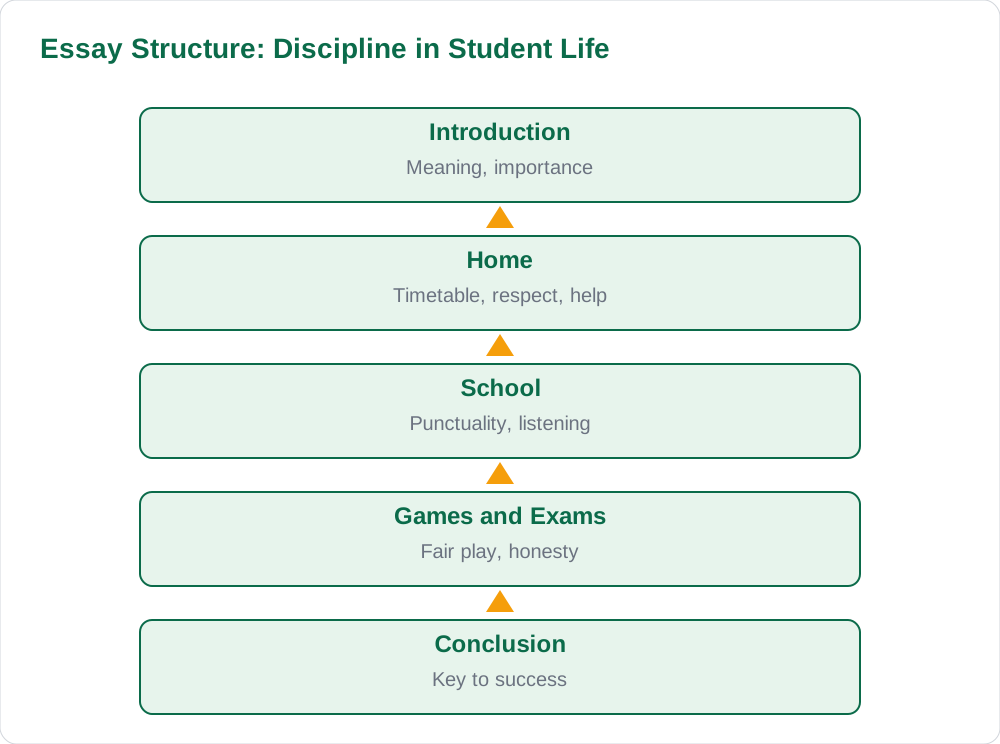
Structure this essay by places: home, school, playground and examination hall, ending with a conclusion about success. This place-by-place structure gives you four ready paragraphs, each with its own examples, so you will not repeat yourself. Start with a definition of discipline and a short statement of its importance. Then move through home and school, where most of student life happens, before covering games and examinations. End with the message that discipline is the key to success in every field.
Use concrete verbs to make discipline visible: wake, complete, listen, queue, obey, manage. Vague essays say discipline is very important again and again; strong essays show a student waking on time, finishing homework, and sitting quietly in the examination hall. One example per paragraph is enough if it is specific and honest, and it will make your essay feel real rather than memorised.
- Introduction: meaning and importance of discipline
- Body 1: discipline at home
- Body 2: discipline at school
- Body 3: discipline in games and examinations
- Conclusion: discipline as the key to success
Model Essay: Discipline in Student Life
Discipline is the habit of obeying rules, managing time and controlling oneself, and it is the key to success in student life. A disciplined student follows a timetable: he wakes up early, offers prayers, revises lessons, goes to school on time and completes homework before play. At home, discipline means respecting parents and elders, helping in household work and keeping books and belongings in order. Such a student never wastes time in useless activities, because he knows that time lost can never be recovered, and every hour used wisely brings him closer to his goals.
At school, discipline shows itself in punctuality, attention and good manners. A disciplined student reaches school before the bell, listens to teachers quietly, stands in queue, and speaks politely to classmates and teachers. On the playground, discipline means following the rules of the game, accepting the referee's decision and playing fairly even when losing. In the examination hall, discipline means honest work, complete silence and careful obedience to instructions, because cheating may give marks once but destroys character forever. A student who practises discipline in these small matters grows into a responsible citizen whom everyone trusts.
Model Essay: Conclusion and Useful Vocabulary
In conclusion, discipline is more valuable than talent alone, because talent without discipline is wasted, while ordinary ability with discipline achieves great results. History shows that great leaders, scientists and sportsmen all reached success through regular habits and self-control, not through sudden luck. I therefore try to follow a daily timetable, respect my teachers and elders, and work honestly in every examination. If every student adopts discipline, our schools will become peaceful, our results will improve, and our country will gain honest and hardworking citizens for its future.
Useful vocabulary includes: punctuality for being on time, timetable for a fixed plan of the day, self-control for managing one's own wishes, and citizen for a member of a country. Use the phrase key to success naturally in the introduction or conclusion, but do not repeat it in every paragraph. Pair discipline with a verb each time: practise discipline, follow discipline, maintain discipline, so your sentences stay varied and correct.
- punctuality — the habit of being on time
- timetable — a fixed plan for the day
- self-control — managing one's own wishes
- citizen — a member of a country
- obey — to follow rules or instructions
Exam Technique for This Essay
Good essays are planned before they are written, and this topic is no exception. Spend the first five minutes making a short outline on the rough-work page: introduction, three or four body points in a sensible order, and a conclusion. This small habit prevents repetition, keeps your ideas in order, and helps you finish on time. In the examination hall, write neatly, leave a clear space between paragraphs, and check your spelling at the end if time allows. A clean, well-organised answer always scores better than a longer, confused one, even when both students know the same facts.
Practise by writing this essay once at home without looking at your notes, then compare your draft with the outline in this article and improve the weak paragraphs. Learn five or six useful words for this topic and use them naturally, not forced into every sentence. Avoid copying long sentences you do not understand, because examiners reward clear, original English. Read your essay aloud once before submitting it in practice: if a sentence sounds strange when spoken, rewrite it in simpler words. With one careful practice essay a week, your speed, confidence and marks will all improve steadily.
- Structure by place: home, school, games, exams
- Show discipline with concrete actions, not praise
- Use one example per paragraph
- Link discipline to success in the conclusion
- Avoid repeating very important in every sentence
AI Help: Muse AI
Muse AI is Meta's personal AI assistant, and it can help you learn in simple, clear language. For example, ask Muse AI to help you write a daily timetable or to explain discipline at school in simple words.
Join Muse with invite code LTGSWD — in the Muse app, go to Settings > Redeem token and enter the code. Disclosure: LTGSWD is the author's Muse invite code. Muse AI does not give official STBB answers — always verify against your STBB book and your teacher. Always verify against your Sindh Textbook Board book and your teacher before using anything in classwork.
5 key points you must know
- Discipline means obeying rules and managing time.
- A timetable removes daily confusion and saves time.
- Discipline at school shows in punctuality and manners.
- Honest work in examinations protects character.
- Talent without discipline is wasted.
Frequently asked questions
How is discipline different from punishment?
Punishment is imposed by others, while discipline is a habit you choose yourself. A disciplined student follows a timetable and rules willingly, not from fear. Explain this difference in your introduction to show mature thinking.
Can I use my own timetable as an example?
Yes, briefly. Mention waking early, completing homework before play, or revising daily, without listing every hour of your day. One or two personal examples make the essay honest and believable.
How long should this essay be in the examination?
For Classes 9 and 10, about 250 to 300 words is a safe length. That is usually five to seven paragraphs: one introduction, three or four body paragraphs and one conclusion. Quality matters more than length, so do not pad your essay with repeated sentences just to make it longer.
Can I change the model essay in my own words?
Yes, and you should. Use the model essay as a guide for structure and ideas, then rewrite it in your own simple English. Examiners reward original writing, so keep the outline, change the examples where you can, and add one personal observation from your own life. You can find more study guides on the blog page.
Solved notes — preview free
These guides work best with the solved exercises. Preview the solved notes free on this website — 119 solved notes for Classes 6–10 in Sindhi, Urdu, English and Arabic medium. Or browse the full solved notes catalogue for your class and medium. New solved notes are added regularly — check the catalogue for coming-soon books.