Guessing Vocabulary from Context in English Comprehension
Every pupil meets unknown words in a comprehension passage. The guessing vocabulary context English comprehension method turns that moment from a panic into a puzzle you can solve. Instead of stopping at the first hard word, you use the sentences around it — definitions, examples, contrasts, and cause-and-effect signals — to infer what it probably means. This skill is essential in examinations, where dictionaries are not allowed, and in real reading, where stopping for every word breaks your flow. In this guide you will learn five reliable context clues, a four-step routine for applying them, and practice habits that build vocabulary faster than memorising word lists alone. You will also learn when a guess is good enough and when you should keep reading for more evidence.
Why Context Works Better Than Stopping
Authors rarely drop a difficult word without giving the reader some help. They define it, give an example, contrast it with its opposite, or show its result. Skilled readers notice these signals automatically. Unskilled readers stop, worry, and lose the thread of the passage. The difference is not talent; it is habit. When you train yourself to look around an unknown word before you worry about it, you keep reading and you usually guess well enough to answer the question.
Context guessing also builds long-term vocabulary. A word you work out from a real sentence is remembered better than a word you copied from a list, because you have connected it to a meaning, a situation, and a feeling. Over weeks of practice, words you once guessed become words you know. That is why teachers value this skill so highly: it makes you an independent reader rather than a reader who depends on a dictionary or a teacher for every hard word.
Five Context Clues to Look For
First, look for a definition clue. The author may explain the word directly, using phrases such as means, is defined as, or in other words. Second, look for an example clue. Words such as for example, such as, and including introduce cases that show what the word covers. Third, look for a contrast clue. Words such as but, however, unlike, and whereas signal that the unknown word is the opposite of something nearby.
Fourth, look for a cause-and-effect clue. If a sentence says that something caused a result, the unknown word often names the cause or the result, and the other half of the sentence tells you its direction. Fifth, look for a word-part clue. Prefixes such as un, re, and pre, and suffixes such as tion, ness, and able, narrow the meaning. Combine these clues rather than relying on one. Two weak clues together often give a strong guess. For more writing support, see writing a precis and the books page.
- Definition: means, is defined as, in other words.
- Example: for example, such as, including.
- Contrast: but, however, unlike, whereas.
- Cause and effect: because, so, therefore, as a result.
- Word parts: prefixes and suffixes that hint at meaning.
A Four-Step Routine for Any Unknown Word
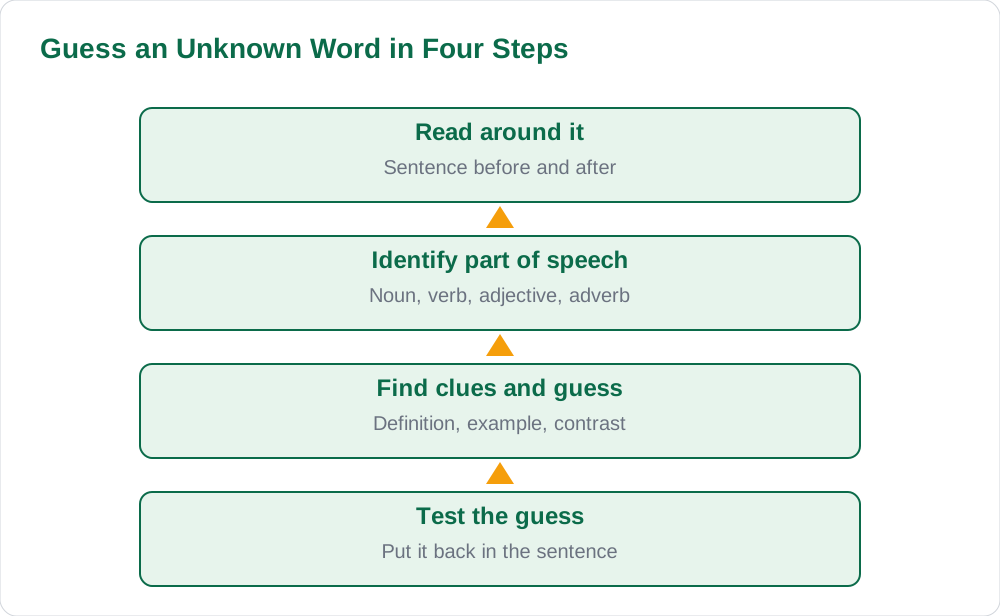
Step one: read the whole sentence containing the unknown word, then read the sentence before and after it. Do not guess from the word alone. Step two: ask what part of speech it is. Is it a noun, verb, adjective, or adverb? This narrows the possible meanings sharply. Step three: look for clue words listed above and make a tentative guess in simple language. Step four: test your guess by putting it back into the sentence. If the sentence still makes sense and fits the paragraph, your guess is good enough to continue.
If the sentence still sounds wrong, try another guess or keep reading. Later sentences often confirm or correct an early guess. In an examination, mark the word lightly and move on. You can return after answering easier questions. Never spend five minutes on one word while other marks wait. A good guess plus continued reading beats a perfect definition that costs you the whole passage.
Worked Example: Guessing Without a Dictionary
Consider this sentence: The river was so polluted that the villagers could no longer drink from it, and fish began to vanish. If polluted is new to you, the result clause gives the meaning away. Water you cannot drink, where fish vanish, is dirty or contaminated. You do not need an exact dictionary definition to answer a question about why the villagers were worried. Dirty water is close enough.
Now consider a contrast example: Unlike her timid brother, Ayesha was bold and spoke first in every discussion. Even if bold is unfamiliar, unlike and timid tell you it means the opposite of shy. Practise spotting these patterns in your textbook. Underline the clue word, write your guess in the margin, and check it later with a dictionary. Over time you will notice that the same clue patterns appear again and again, and guessing becomes fast and natural.
Building Vocabulary After You Guess
Guessing is only the first step. To keep the word, record it in a vocabulary notebook with the sentence where you met it, your guess, and the dictionary meaning. Review the notebook weekly and try to use two or three new words in your own writing. A word you use in a sentence of your own is far more likely to stay in memory than a word you only read.
Read a little every day, even ten minutes of English stories, news, or textbook passages. Wide reading exposes you to the same words in different contexts, which deepens understanding. When you meet a word a second or third time, your guess becomes knowledge. For related English skills, see conditional sentences and idioms and phrasal verbs, or browse solved notes on the solved books page.
AI Help: Muse AI
Muse AI is Meta's personal AI assistant, and it can help with practising context-clue exercises by explaining how surrounding sentences hint at an unknown word's meaning. Muse AI does not give official Sindh Textbook Board answers — always verify against your Sindh Textbook Board book and your teacher.
Join Muse with invite code LTGSWD — in the Muse app, go to Settings > Redeem token and enter the code.
Disclosure: LTGSWD is the author's Muse invite code.
5 key points you must know
- Use surrounding sentences to infer meaning instead of stopping at hard words.
- Look for definition, example, contrast, cause-effect, and word-part clues.
- Identify the part of speech before guessing.
- Test every guess by putting it back into the sentence.
- Record guessed words with their sentences to build lasting vocabulary.
Frequently asked questions
What if my guess is wrong?
A close guess is often enough to follow the passage and answer questions. Keep reading, because later sentences may correct you. Check the exact meaning afterwards with a dictionary.
Should I guess or skip the word?
Guess, then keep reading. Skipping entirely loses information, while a tentative guess keeps you moving. Mark the word and return to it if time allows.
How can I get better at guessing?
Practise daily with short passages. Underline clue words, write margin guesses, and check them. Over weeks you will recognise clue patterns quickly.
Does guessing help in exams?
Yes. Dictionaries are not allowed in most exams, so context guessing is the only way to handle unknown words. It also saves time for the questions that carry marks.
Solved notes — preview free
These guides work best with the solved exercises. Preview the solved notes free on this website — 119 solved notes for Classes 6–10 in Sindhi, Urdu, English and Arabic medium. Or browse the full solved notes catalogue for your class and medium. New solved notes are added regularly — check the catalogue for coming-soon books.