Dua for Travelling: Words and Meaning

Travel brings excitement and risk at the same time. A journey to school, to another city, or to visit relatives depends on vehicles, roads, weather, and the care of others. Muslims begin travel with a dua that thanks Allah for transport, admits human weakness, and remembers the return to Allah. This article explains the safar dua in simple words, its meaning, and safe habits that go with it. Always check the exact wording with your Islamiat book and your teacher.
The Words of the Safar Dua and Their Meaning
The well-known safar dua begins: Subhanalladhi sakhkhara lana hadha wa ma kunna lahu muqrineen, wa inna ila rabbina lamunqaliboon. In simple English this means: Glory be to the One who has made this transport subservient to us, though we could not have controlled it ourselves, and indeed to our Lord we shall return. The first part praises Allah. The middle part admits that humans cannot control animals, vehicles, or roads by their own power. The last part reminds us of the final return to Allah.
This dua is longer than many daily duas, so students should learn it in parts. Learn the meaning first, then practise one phrase at a time over several days. Younger children can start with SubhanAllah and a short prayer for a safe journey, then learn the full form as they grow. Do not rush memorisation without understanding, because the meaning is what makes the journey mindful.
Why Travel Needs Remembrance
At home we feel safe and in control. On the road we depend on a driver, a vehicle, traffic, and weather we cannot control. The safar dua turns that dependence into trust in Allah. It also prevents arrogance: a fast car or a smooth road does not make a traveller independent of Allah. Remembering this keeps travellers humble, patient, and careful, which itself improves safety.
Travel also changes routine. Prayer times, food, rest, and manners need planning on a journey. The dua at the start sets a good tone for the whole trip. A traveller who begins with Allah's name is more likely to pray on time, treat fellow passengers kindly, and avoid arguments on the road. In Islamiat lessons, travel is therefore taught as both a practical matter and a spiritual one.
Practical Safety Habits for Every Journey
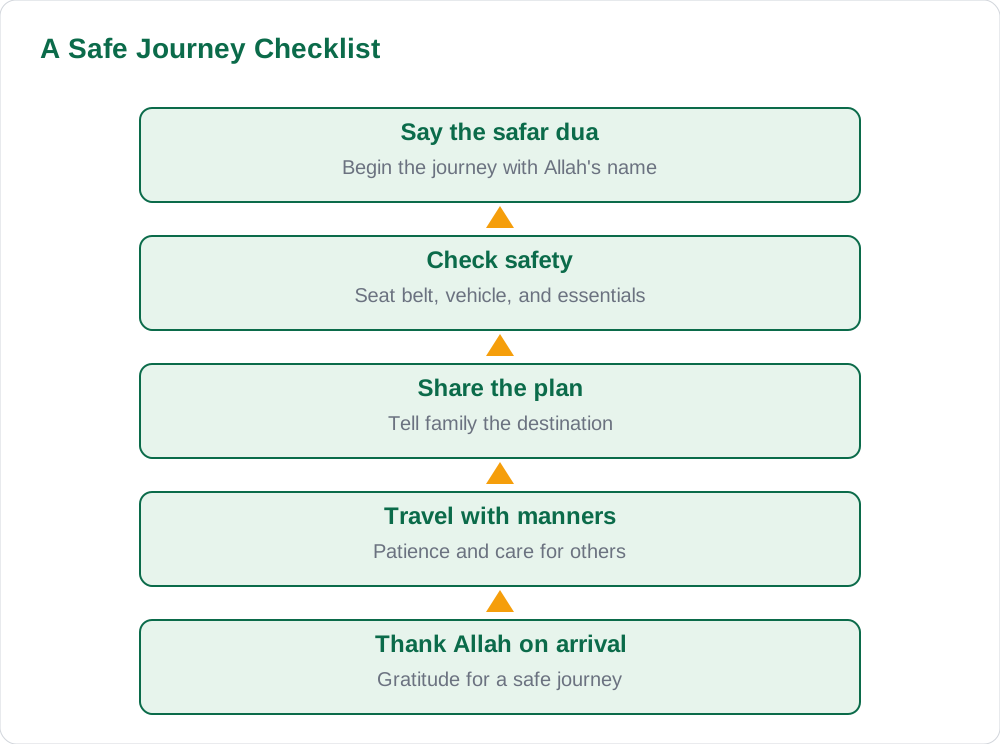
Say the dua before leaving, then follow real safety steps. Wear a seat belt, keep children seated, avoid using a phone while driving, and do not overload a vehicle. Check fuel, tyres, and lights for longer trips, and keep water and a phone charged. For school trips, students should listen to teachers, stay with the group, and carry identification if asked. Prayer does not replace safety; prayer and safety work together.
Plan the journey with family. Tell someone your destination and expected return time, especially for intercity travel in Pakistan. Keep important numbers ready, respect local rules, and help elderly or younger travellers. If travel is delayed, stay patient and use the time for useful reading or quiet remembrance. A calm traveller handles problems better than an angry one.
Gratitude for Transport
Modern transport is easy to take for granted. A bus, a rickshaw, a train, or a family car all rely on fuel, engineering, roads, and many workers. The safar dua thanks Allah for making these means available to weak humans. Students can connect this to science and social studies: engines, roads, and public transport are human achievements, but the materials, energy, and safety all come from Allah's creation and permission.
Gratitude also means caring for shared transport. Do not damage seats, litter inside vehicles, or disturb other passengers. Thank the driver when appropriate, and offer a seat to someone who needs it more. These small manners turn travel into good character practice. For related learning, see the solved notes and the book lists.
Teaching the Safar Dua to Children
Practise the dua before real trips, not only in class. Say it together before leaving home, then let the child lead on the next trip. Break it into short phrases, repeat each phrase, and explain its meaning in simple language. A short travel checklist can help: dua, seat belt, water, prayer plan, and good manners. Children remember better when learning is tied to a real journey they enjoy.
Teachers can ask students to write a short paragraph about a journey: where they went, what dua they said, and one safety habit they followed. This links Islamiat to writing skills and real life. Families can also use the return journey to say the dua again and thank Allah for safe arrival, completing the habit at both ends of the trip.
AI Help: Muse AI
Muse AI is Meta's personal AI assistant, and it can explain study topics in simple words, summarise a lesson, and help you practise what you have learned. For this topic, you can ask Muse AI to help you make a simple travel checklist based on the safar dua and safety habits in this article. Join Muse with invite code LTGSWD — in the Muse app, go to Settings > Redeem token and enter the code. Disclosure: LTGSWD is the author's Muse invite code. Muse AI does not give official Sindh Textbook Board answers — always verify against your Sindh Textbook Board book and your teacher.
5 key points you must know
- The safar dua praises Allah for making transport available to us.
- It admits humans cannot control travel by their own power.
- It reminds travellers of their return to Allah.
- Prayer must go with real safety habits like seat belts and planning.
- Children learn the dua best by practising it before real trips.
Frequently asked questions
What is the safar dua?
It begins Subhanalladhi sakhkhara lana hadha wa ma kunna lahu muqrineen, wa inna ila rabbina lamunqaliboon, praising Allah for transport and reminding us of our return to Him.
How can children learn this longer dua?
Learn the meaning first, then practise one short phrase at a time over several days, and say it together before real journeys.
Does saying the dua mean we can ignore safety?
No, prayer and safety work together. Wear seat belts, check the vehicle, plan the route, and follow road rules.
When should the safar dua be said?
At the start of a journey, when boarding transport or leaving home, and gratitude can be expressed again on safe arrival.
What manners matter during travel?
Patience, care for fellow passengers, keeping vehicles clean, offering seats to those in need, and praying on time where possible.
Solved notes — preview free
These guides work best with the solved exercises. Preview the solved notes free on this website — 119 solved notes for Classes 6–10 in Sindhi, Urdu, English and Arabic medium. Or browse the full solved notes catalogue for your class and medium. New solved notes are added regularly — check the catalogue for coming-soon books.