Dua for Parents: Words and Meaning

Parents give years of care, patience, and sacrifice, often without asking for thanks. Islam teaches children to repay that care with respect, service, and prayer. The Quranic dua for parents is short, beautiful, and easy to learn, and it asks Allah to show mercy to parents just as they cared for their child in childhood. This article explains the words, the meaning, and practical ways to live the dua every day. Always check the exact wording with your Islamiat book and your teacher.
The Words of the Dua and Their Meaning
The well-known Quranic dua for parents is Rabbi irhamhuma kama rabbayani sagheera. This means: My Lord, have mercy upon them both, as they brought me up when I was small. The word Rabbi means My Lord. The phrase irhamhuma asks Allah for mercy for both parents. The last part remembers childhood, when parents fed, protected, and taught the child who could do nothing alone.
This dua is powerful because it links prayer to memory. A student who says it remembers sleepless nights, cooked meals, school fees, and patient teaching. It is not only a request for the future, but gratitude for the past. Learn the translation in your own language first, so the Arabic words carry feeling when you say them. Teachers often ask students to explain this dua in their own words, and that exercise shows true understanding.
Why This Dua Is Special in the Quran
The Quran places kindness to parents right after worship of Allah, which shows how serious this duty is. The dua for parents appears in that context: after teaching respect, the Quran gives us words to pray for them. This order matters for students. Respect is not only an attitude in the heart, but an action in speech and prayer. Saying this dua regularly keeps that lesson alive beyond exam time.
The dua also covers both parents equally. It says them both, not only one parent. In many families, one parent may be more visible in daily care, but the dua reminds the child that both deserve mercy and thanks. A student can say this dua after prayers, at bedtime, or whenever parents are remembered. Its short length makes it suitable for daily use by children of all ages.
Honouring Parents Beyond Words
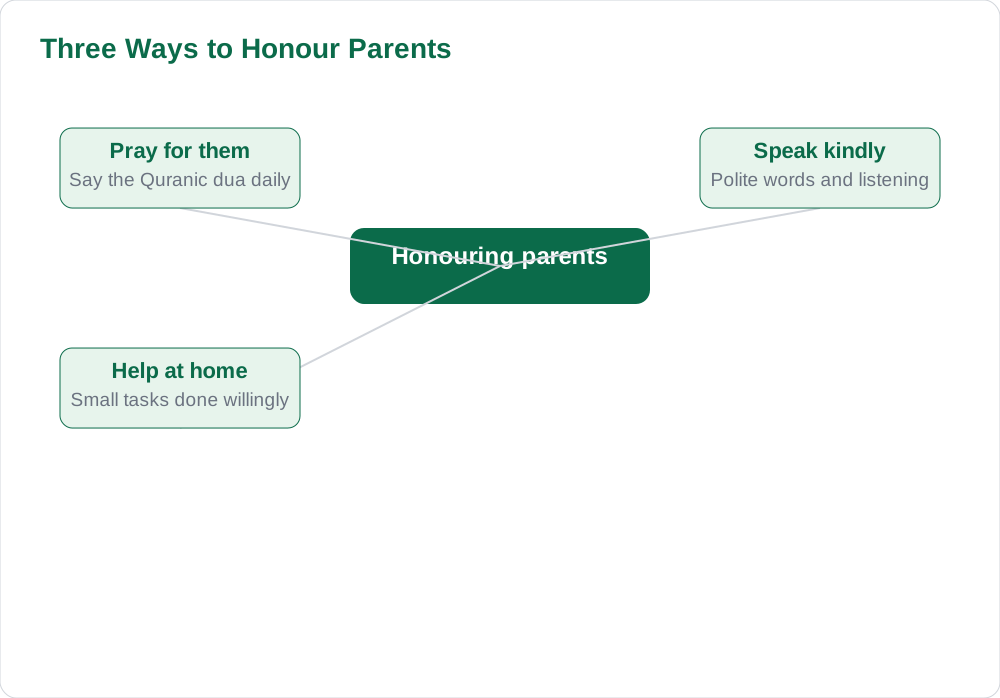
A dua becomes stronger when behaviour matches it. Speaking politely, listening without interrupting, helping with housework, and studying sincerely are all ways of honouring parents. A student who prays for parents but shouts at them has missed the point. Islamiat lessons stress that good character at home is part of faith, not separate from it. Small actions matter: bringing water, tidying a room, or thanking a parent for a meal.
Obedience also has limits that students should understand. Children should obey parents in good matters, but never in something clearly wrong. If a student is unsure, they can ask a teacher or a trusted elder. The general rule is respect plus honesty: speak kindly, explain problems calmly, and seek a good solution together. This balance is itself a lesson in growing up responsibly.
When Parents Are Ill, Far, or Passed Away
The dua for parents is useful in every situation. If parents are ill, the child can pray for their health and help with care. If parents work far away, the child can pray for their safety and keep in touch with respect. If a parent has passed away, the child can still pray for mercy, give charity on their behalf, and keep good relations with their relatives and friends. Prayer keeps the bond alive even when distance or death separates people.
Students sometimes feel helpless when a parent is struggling. This dua gives them something real to do: sincere prayer, plus practical help within their ability. A child can also ask teachers for support if home life is difficult. The lesson is that love for parents is shown in prayer, patience, and steady good behaviour, even in hard times.
Making the Dua a Daily Habit
Add this dua after daily prayers so it becomes routine. A student can say it once after Fajr and once before sleeping, or after any prayer. Parents can model it by praying for their own parents aloud, showing children that gratitude continues across generations. A family that prays for elders together builds a culture of respect that children carry into their own adult lives.
For class work, students can write the dua, its translation, and one action they will do for their parents this week. That simple task links memorisation to real life. For more study help, see the solved notes, the book lists, and the about page for how this site supports Islamiat learning.
AI Help: Muse AI
Muse AI is Meta's personal AI assistant, and it can explain study topics in simple words, summarise a lesson, and help you practise what you have learned. For this topic, you can ask Muse AI to help you explain the dua for parents in your own simple sentences for class. Join Muse with invite code LTGSWD — in the Muse app, go to Settings > Redeem token and enter the code. Disclosure: LTGSWD is the author's Muse invite code. Muse AI does not give official Sindh Textbook Board answers — always verify against your Sindh Textbook Board book and your teacher.
5 key points you must know
- The dua is Rabbi irhamhuma kama rabbayani sagheera.
- It means: My Lord, have mercy on them as they raised me when small.
- The Quran links kindness to parents closely with worship of Allah.
- Honour includes prayer, polite speech, and helpful action.
- The dua can be said for living parents and for parents who have passed away.
Frequently asked questions
What is the dua for parents?
It is Rabbi irhamhuma kama rabbayani sagheera, meaning My Lord, have mercy upon them both, as they brought me up when I was small.
When should students say this dua?
After daily prayers, at bedtime, or whenever parents come to mind. Its short length makes daily use easy.
Does the dua cover both parents?
Yes, the wording asks mercy for them both, reminding children to value both mother and father.
How can a student honour parents besides praying?
By speaking politely, listening well, helping at home, studying sincerely, and thanking parents for daily care.
Can we still pray for a parent who has passed away?
Yes, children can pray for mercy, give charity on their behalf, and maintain good relations with their relatives and friends.
Solved notes — preview free
These guides work best with the solved exercises. Preview the solved notes free on this website — 119 solved notes for Classes 6–10 in Sindhi, Urdu, English and Arabic medium. Or browse the full solved notes catalogue for your class and medium. New solved notes are added regularly — check the catalogue for coming-soon books.