Dua for Knowledge: Words and Meaning

Students often ask Allah for good marks, but Islam teaches a deeper request: ask for knowledge itself, and for understanding that leads to good action. The short Quranic dua Rabbi zidni ilma is easy to learn and useful before study, before class, and before exams. This article explains its words, its meaning, and how it connects to honest study habits. Always check the exact wording with your Islamiat book and your teacher.
The Words of the Dua and Their Meaning
The dua is Rabbi zidni ilma. This means: My Lord, increase me in knowledge. Three short words carry a large meaning. Rabbi means My Lord, showing a personal relationship with Allah. Zidni means increase me, showing that learning is a gift we ask for, not only a skill we own. Ilma means knowledge, covering both religious learning and useful worldly learning when it is used for good.
This dua is short enough for young children, yet deep enough for older students. A child can say it before opening a book. A teenager can say it before a difficult subject. The point is humility: we admit that we do not know everything, and we ask Allah to open our minds. Teachers can ask students to explain the dua in one sentence, which quickly shows whether they understand it or only repeat it.
Knowledge and Understanding Are Not the Same
Memorising facts is not the same as understanding them. A student can repeat a definition without knowing how to use it. The dua for knowledge asks for real understanding, not only memory. In Islamiat, useful knowledge is knowledge that improves character and action. A student who learns honesty should become more honest. A student who learns science should use it to help people, not to harm them.
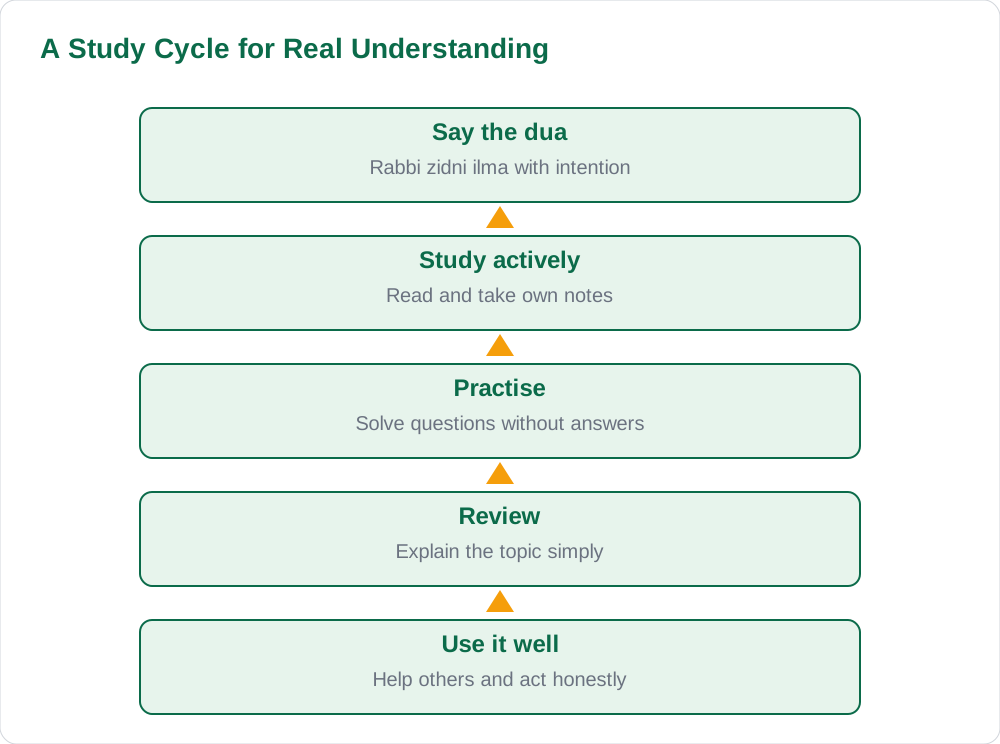
This is why study should include thinking, not only reading. After studying a lesson, ask yourself: what did I learn, why does it matter, and how can I use it well? Writing a short summary in your own words is a strong test of understanding. If you cannot explain a topic simply, you need to study it again. The dua supports this effort, but it does not replace it. Prayer and hard work go together.
When and How to Say This Dua
Say Rabbi zidni ilma before study, at the start of class, or before homework. Say it calmly, with the intention to learn sincerely. It can be said silently at school so that no one is disturbed. Pair it with a clear plan: what will I study, for how long, and what will I practise afterwards? A dua plus a plan is stronger than a dua alone, because intention becomes action.
Parents can encourage this habit by asking children what they learned, not only what marks they got. That question rewards understanding. At home, a short family moment before homework, with the dua and a tidy study space, can improve focus. The habit is small, but repeated daily it shapes a student's attitude to learning for years.
Study Habits That Match the Dua
Good habits honour the prayer for knowledge. Study in short focused blocks, take brief breaks, and review yesterday's lesson before starting new work. Write notes in your own words, solve practice questions without looking at answers first, and ask your teacher when you are stuck. These habits show respect for the knowledge you asked Allah to increase. A student who prays for knowledge but wastes study time with distraction is not fully living the dua.
Honesty in study also matters. Copying answers, cheating in exams, or presenting copied work as your own contradicts the spirit of seeking knowledge. Real knowledge must be earned honestly, even if the path is slower. Teachers value sincere effort, and honest learning builds confidence that lasts beyond one exam. For more study guides, see the solved notes and the blog listing.
Knowledge as a Responsibility
Islam teaches that knowledge brings responsibility. A student who learns something useful should share it kindly, help classmates who struggle, and use learning to serve family and society. Teaching a friend is itself a way of strengthening your own understanding. Knowledge used with arrogance harms its owner, while knowledge used with humility benefits everyone around them.
Students should also choose what they learn wisely. Useful knowledge includes Islamiat, languages, mathematics, science, and skills that help others. Time spent on harmful or wasteful content takes time away from beneficial learning. The dua Rabbi zidni ilma can guide daily choices: before study or screen time, ask whether this will truly increase useful knowledge. That one question improves many small decisions.
AI Help: Muse AI
Muse AI is Meta's personal AI assistant, and it can explain study topics in simple words, summarise a lesson, and help you practise what you have learned. For this topic, you can ask Muse AI to explain a difficult lesson step by step until you can repeat it in your own words. Join Muse with invite code LTGSWD — in the Muse app, go to Settings > Redeem token and enter the code. Disclosure: LTGSWD is the author's Muse invite code. Muse AI does not give official Sindh Textbook Board answers — always verify against your Sindh Textbook Board book and your teacher.
5 key points you must know
- The dua is Rabbi zidni ilma.
- It means: My Lord, increase me in knowledge.
- True knowledge includes understanding and good action, not only memory.
- Say it before study with a clear study plan.
- Honest study habits honour the prayer for knowledge.
Frequently asked questions
What is the dua for knowledge?
It is Rabbi zidni ilma, meaning My Lord, increase me in knowledge. It is a short Quranic prayer suitable before study.
When should students say Rabbi zidni ilma?
Before study, before class, or before homework, calmly and with sincere intention to learn.
Does the dua replace studying?
No, prayer and effort go together. The dua asks Allah for understanding, while focused study, practice, and review do the learning work.
What is useful knowledge in Islam?
Knowledge that improves character and helps others, including religious learning and useful worldly subjects used for good.
How can I test whether I truly understand a lesson?
Explain it in your own simple words without the book, and solve practice questions on your own. If you cannot, study it again.
Solved notes — preview free
These guides work best with the solved exercises. Preview the solved notes free on this website — 119 solved notes for Classes 6–10 in Sindhi, Urdu, English and Arabic medium. Or browse the full solved notes catalogue for your class and medium. New solved notes are added regularly — check the catalogue for coming-soon books.