Dua for Forgiveness: Words and Meaning

Everyone makes mistakes. A harsh word, a missed prayer, a copied answer, or an unkind act can leave a student feeling guilty. Islam gives a hopeful path back: sincere repentance, called tawbah, and seeking forgiveness, called istighfar. This article explains two well-known duas for forgiveness, their meanings, and how students can use them honestly every day. Always check exact wording with your Islamiat book and your teacher.
Istighfar: The Short Prayer for Forgiveness
The simplest form of istighfar is Astaghfirullah, meaning I seek forgiveness from Allah. It is short, so it can be said many times a day: after prayers, after a mistake, or during quiet moments. Repetition is not magic; it works when the heart means it. Saying Astaghfirullah slowly, with awareness of a specific mistake, is better than rushing it a hundred times without thought.
Students can use istighfar as a reset button. After arguing with a sibling, after wasting study time, or after breaking a promise, pause and say Astaghfirullah sincerely. Then take a practical step: apologise, fix the work, or make a better plan. Forgiveness in Islam pairs prayer with action. The prayer asks Allah for pardon, and the action shows that the person truly wants to change.
The Dua of Yunus and Its Meaning
The dua of Yunus is La ilaha illa anta subhanaka inni kuntu minaz zalimeen. This means: There is no god but You, glory be to You, indeed I was among the wrongdoers. Yunus called out with these words when he was in distress inside the belly of the fish, after leaving his people without permission. His prayer combines three parts: affirming Allah alone, praising Allah's perfection, and admitting his own wrong.
This structure is a model for repentance. First, remember who Allah is. Second, praise Him without blaming Him for the difficulty. Third, admit your own mistake honestly. Students can use this pattern when they apologise to people too: state the truth, take responsibility, and promise to improve. The dua of Yunus is therefore useful in hardship and in daily self-correction, not only in extreme trouble.
What Sincere Repentance Requires
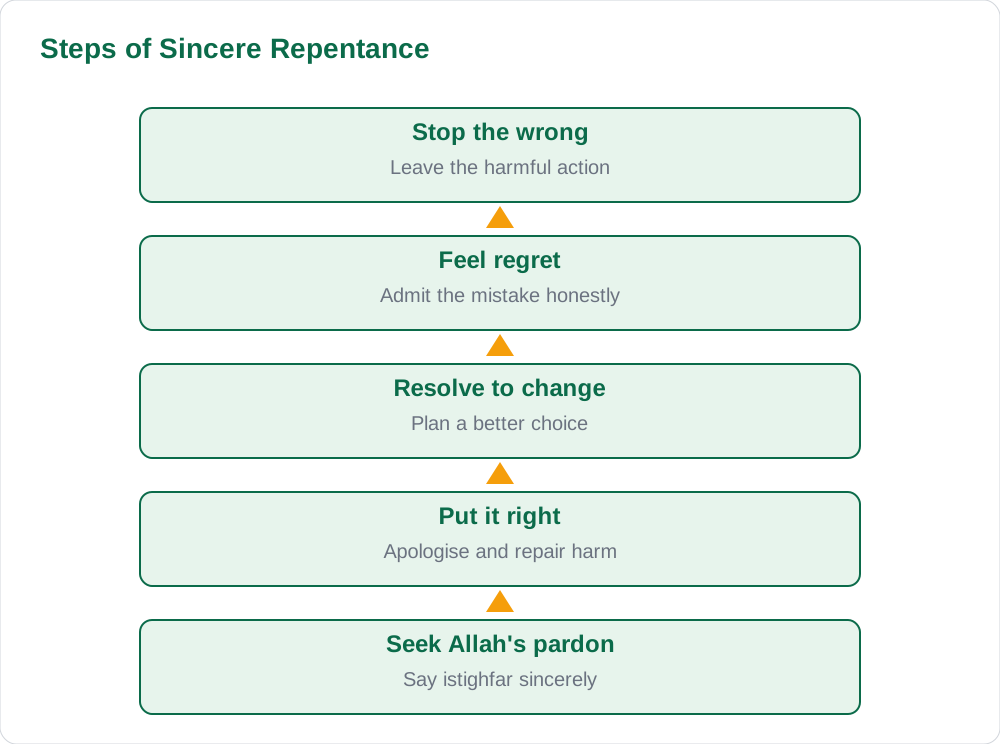
Scholars describe sincere tawbah with clear conditions: stop the wrong action, feel regret for it, resolve not to return to it, and put right any harm to others where possible. A student who cheated should stop cheating, feel sorry, plan honest study, and accept fair consequences. A student who hurt a friend should apologise and repair the friendship. Prayer alone, without stopping the wrong, is incomplete.
Repentance also needs hope, not despair. Allah's mercy is vast, and no mistake is too large for sincere return, except dying without faith. Students who feel overwhelmed by past mistakes should remember this hope and seek help from a teacher, parent, or counsellor if needed. Guilt that leads to change is healthy. Guilt that leads to giving up is not the goal of repentance.
Forgiving Others and Seeking Forgiveness
Seeking forgiveness from Allah goes with forgiving others. A student who wants Allah's pardon should also pardon classmates who apologise sincerely. Holding grudges harms the heart and damages class friendships. Forgiveness does not mean forgetting safety: if someone repeatedly harms you, seek help from adults and keep safe boundaries. But for ordinary mistakes and apologies, a forgiving attitude keeps school life peaceful.
Families can model this at home. Parents who apologise to children when they make a mistake teach that apology is strength, not weakness. Teachers who forgive a sincere student and allow a fresh start teach the same lesson. In this way, istighfar becomes a culture, not only a phrase: admit, apologise, improve, and move forward together.
A Daily Habit of Istighfar
Add istighfar after daily prayers, especially after Fajr and before sleeping. Say Astaghfirullah a few times slowly, think of one thing to improve tomorrow, and make a small plan. Do not turn it into a burden with huge counts that a child cannot sustain. A short, sincere habit done daily is better than a long habit abandoned after a week.
Students can also keep a private note of improvements, not a list of shames. Write one good change per week, such as speaking more kindly or revising daily. That record shows growth over time and keeps repentance positive. For more Islamiat guides, see the solved notes and the blog listing.
AI Help: Muse AI
Muse AI is Meta's personal AI assistant, and it can explain study topics in simple words, summarise a lesson, and help you practise what you have learned. For this topic, you can ask Muse AI to help you explain the meaning of istighfar in simple words for a class discussion. Join Muse with invite code LTGSWD — in the Muse app, go to Settings > Redeem token and enter the code. Disclosure: LTGSWD is the author's Muse invite code. Muse AI does not give official Sindh Textbook Board answers — always verify against your Sindh Textbook Board book and your teacher.
5 key points you must know
- Astaghfirullah means I seek forgiveness from Allah.
- The dua of Yunus admits wrong while praising Allah's perfection.
- Sincere repentance means stopping the wrong and resolving to improve.
- Put right harm to others where possible, including apology.
- Forgiving others goes with seeking Allah's forgiveness.
Frequently asked questions
What is istighfar?
Istighfar means seeking forgiveness from Allah, most simply by saying Astaghfirullah, meaning I seek forgiveness from Allah.
What is the dua of Yunus?
It is La ilaha illa anta subhanaka inni kuntu minaz zalimeen, meaning there is no god but You, glory be to You, indeed I was among the wrongdoers.
What makes repentance sincere?
Stopping the wrong action, feeling regret, resolving not to return to it, and putting right harm to others where possible.
Can a student seek forgiveness for exam cheating?
Yes, by stopping cheating, feeling regret, studying honestly, accepting fair consequences, and asking Allah for pardon.
Does seeking forgiveness mean forgetting safety?
No, forgiving ordinary mistakes is good, but repeated harm should still be reported to adults and handled with safe boundaries.
Solved notes — preview free
These guides work best with the solved exercises. Preview the solved notes free on this website — 119 solved notes for Classes 6–10 in Sindhi, Urdu, English and Arabic medium. Or browse the full solved notes catalogue for your class and medium. New solved notes are added regularly — check the catalogue for coming-soon books.