Dua Before Sleeping: Words and Meaning
Sleep is a small picture of rest and trust. Muslims end the day by remembering Allah, asking for His protection, and placing their night in His care. The short dua before sleeping is easy to memorise, and its meaning helps children understand why bedtime is not only about closing eyes, but about ending the day well. This article explains the words, the translation, and a calm routine that families can follow every night. Always check the exact wording with your Islamiat book and your teacher.
The Words of the Dua and Their Meaning
The well-known dua before sleeping is Allahumma bismika amutu wa ahya. This means: O Allah, in Your name I die and I live. The words sound strong because sleep is like a small death: we lose awareness of the world and wake up again by Allah's will. Saying this dua teaches trust. We admit that our life, our rest, and our waking are all in Allah's hands.
Children sometimes ask why the dua mentions death. A simple answer is that sleep reminds us how much we depend on Allah. We cannot guard ourselves while asleep, so we ask Allah to guard us. The dua is short, so even a young child can learn it in a few nights. Learn the meaning first in your own language, then practise the Arabic words slowly until they feel natural.
Why a Night Dua Matters
The day often ends with noise, screens, homework stress, or arguments. A night dua creates a clear ending. It tells the mind that the day is over and the night belongs to rest and to Allah. For students, this matters for learning too. A calm mind sleeps better, and better sleep helps memory and focus the next day. The dua is therefore both worship and good self-care.
A night dua also builds self-review. Before sleeping, a student can think quietly: what did I do well today, what should I improve, and whom should I forgive? This short reflection, without guilt or worry, helps character growth. Islamiat lessons link this to muhasaba, which means checking oneself. The dua opens the door to that quiet review, and then sleep follows with a peaceful heart.
A Calm Bedtime Routine
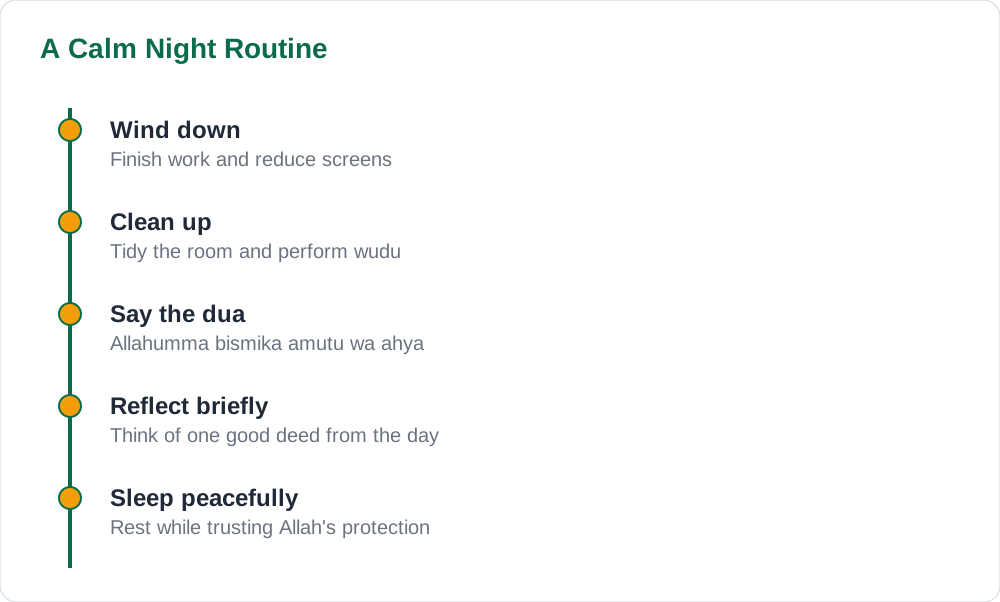
A good routine starts before the dua. Finish homework early where possible, keep the room tidy, and reduce screen use before bed. Perform wudu if you can, because cleanliness helps calmness. Then lie down, say the dua, and think of something good from the day. Parents can sit with younger children for a few minutes, repeat the dua together, and end with a short prayer for the family.
Keep the routine simple and regular. The same steps every night teach the body that it is time to sleep. Avoid long stories, exciting games, or heavy food just before bed. If a child feels afraid at night, a parent can remind them that Allah is their protector and that the dua is a way of asking for that protection. Regularity matters more than perfection: a short routine done nightly beats a long routine done once.
Other Short Night Remembrances
Many families also recite short surahs before sleeping, such as Surah Al-Ikhlas, Surah Al-Falaq, and Surah An-Nas, and sometimes Ayat al-Kursi. These are well-known short passages that children often learn early in Islamiat. They are not a replacement for the sleeping dua, but they go well with it as part of a night routine. Learn them one at a time, with meaning, rather than rushing through many passages without understanding.
If a child knows only the sleeping dua, that is enough to start. Add one short surah at a time when the child is ready. Teachers can check understanding by asking students to explain the dua in their own words, not only to recite it. This keeps learning meaningful. For more study material, see the solved notes and the book lists.
Helping Children Remember Every Night
Repetition at the same time every night is the best method. Say the dua together for a week, then let the child lead. A small chart with stars for each night can motivate younger children, but praise and calm encouragement work even better. If a child forgets one night, simply remind them the next night without punishment. The goal is a habit that lasts into adult life.
Parents can also connect the night dua to the morning dua. The pair teaches a full cycle: we end with Allah's name and begin with Allah's name. A student who learns both duas understands that faith is not only for the mosque or the classroom, but for the whole day. Visit the blog listing for more short guides on daily duas and study habits.
AI Help: Muse AI
Muse AI is Meta's personal AI assistant, and it can explain study topics in simple words, summarise a lesson, and help you practise what you have learned. For this topic, you can ask Muse AI to help you build a simple bedtime routine checklist based on this article. Join Muse with invite code LTGSWD — in the Muse app, go to Settings > Redeem token and enter the code. Disclosure: LTGSWD is the author's Muse invite code. Muse AI does not give official Sindh Textbook Board answers — always verify against your Sindh Textbook Board book and your teacher.
5 key points you must know
- The dua before sleeping is Allahumma bismika amutu wa ahya.
- It means: O Allah, in Your name I die and I live.
- Sleep reminds us that our rest and waking are in Allah's hands.
- A calm routine with less screen time helps better sleep.
- Repeating the dua nightly builds a lifelong habit.
Frequently asked questions
What is the dua before sleeping?
It is Allahumma bismika amutu wa ahya, meaning O Allah, in Your name I die and I live. It places the night under Allah's care.
Why does the dua mention dying?
Sleep is like a small death because we lose awareness of the world and wake again by Allah's will. The words teach trust in Allah during rest.
What is a good bedtime routine for students?
Finish work early, reduce screens, tidy the room, perform wudu if possible, say the dua, and reflect briefly on the day before sleeping.
Can children also recite short surahs at night?
Yes, many families recite Surah Al-Ikhlas, Al-Falaq, and An-Nas, and sometimes Ayat al-Kursi. Learn one at a time with meaning.
What if a child forgets the dua one night?
Simply remind them the next night. A gentle routine repeated daily builds the habit better than punishment for one forgotten night.
Solved notes — preview free
These guides work best with the solved exercises. Preview the solved notes free on this website — 119 solved notes for Classes 6–10 in Sindhi, Urdu, English and Arabic medium. Or browse the full solved notes catalogue for your class and medium. New solved notes are added regularly — check the catalogue for coming-soon books.