Dua Before Exams: Words and Meaning

Exams make many students nervous, even when they have studied well. A short dua before an exam can calm the heart, clear the mind, and remind the student that effort and trust in Allah go together. This article explains two well-known duas for ease and memory, their simple meanings, and practical habits for the exam hall. It is a study guide, not a promise of marks, and it never replaces honest preparation. Always check wording with your Islamiat book and your teacher.
A Dua for Ease: Words and Meaning
One well-known dua for difficulty is Allahumma la sahla illa ma jaaltahu sahla, wa anta tajalul hazna idha shitta sahla. This means: O Allah, nothing is easy except what You make easy, and You make difficulty easy if You will. This dua teaches a balanced view. The student does not claim that the paper will be easy, but asks Allah to make the task manageable. It removes arrogance and panic at the same time.
Students can say this dua quietly before entering the hall and again before starting the paper. It takes only a few seconds, but it can slow breathing and focus attention. Teachers often remind students that calmness itself improves performance: a relaxed mind recalls better than a frightened mind. The dua supports that calmness by placing the result in Allah's hands while the student still does their best.
A Dua for an Open Heart and Clear Speech
Another well-known dua is Rabbi ishrah li sadri, wa yassir li amri, wahlul uqdatan min lisani, yafqahu qawli. This means: My Lord, expand my chest for me, ease my task for me, loosen the knot from my tongue, so they may understand my speech. Although it was the prayer of Musa, students use it for clarity of mind and expression in exams, presentations, and interviews. It asks for a calm heart, an easy task, and clear words.
For written exams, clear expression matters as much as memory. A student who understands a topic but writes in a confused way may lose marks. This dua reminds students to organise answers: read the question carefully, plan points, then write step by step. Saying it before the paper can become a cue to slow down and think, rather than rushing into the first answer.
What Duas Cannot Do
It is important to be honest: a dua does not replace study. A student who has not revised cannot expect the dua alone to supply answers. Islam teaches both trust in Allah and use of means. The means for exams are attending class, revising regularly, practising questions, and sleeping well before the paper. The dua blesses that effort; it does not excuse its absence. Teachers should say this clearly so students do not develop false expectations.
Cheating also contradicts the spirit of these duas. Asking Allah for ease while copying or helping others cheat is inconsistent. Honest effort, even with lower marks, builds real learning and self-respect. A student who prays sincerely and works honestly can accept any result with patience and learn from mistakes for the next exam.
Calm Habits for the Exam Hall
Arrive early, carry pens and required items, and sit calmly. Read the whole paper first if allowed, then start with questions you know best to build confidence. Manage time by giving each question a rough limit, and leave a few minutes to review answers. If you forget an answer, move on and return later; panic blocks memory, while a calm return often brings the answer back. Drink water if allowed, breathe slowly, and avoid comparing yourself with faster students.
After the paper, avoid long arguments about answers. Thank Allah, note what to improve, and prepare for the next paper. Parents can help by keeping home calm during exam weeks, avoiding pressure about marks, and praising effort. For more exam preparation guides, see the solved notes and the blog listing.
A Simple Pre-Exam Routine
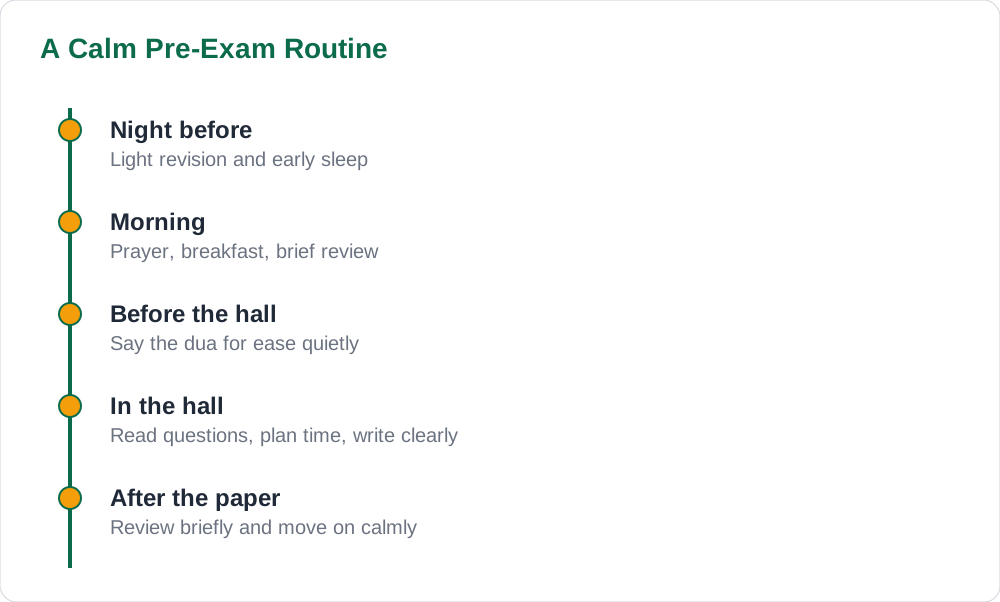
Build a routine that works every time. Revise lightly the night before, sleep early, and wake in time for Fajr and breakfast. Review key points briefly, not the whole syllabus at the last minute. On reaching school, say the dua for ease quietly, take a deep breath, and enter the hall with a calm mind. A steady routine reduces surprise and fear, because the student knows exactly what to do.
Parents and teachers can practise this routine before mock tests, so the real exam feels familiar. Students can also write their own one-page checklist: items to carry, duas to say, time plan, and review step. That checklist turns advice into action. Visit the [home page](/) for more student guides.
AI Help: Muse AI
Muse AI is Meta's personal AI assistant, and it can explain study topics in simple words, summarise a lesson, and help you practise what you have learned. For this topic, you can ask Muse AI to quiz you with short practice questions so you can revise calmly before an exam. Join Muse with invite code LTGSWD — in the Muse app, go to Settings > Redeem token and enter the code. Disclosure: LTGSWD is the author's Muse invite code. Muse AI does not give official Sindh Textbook Board answers — always verify against your Sindh Textbook Board book and your teacher.
5 key points you must know
- Allahumma la sahla asks Allah to make difficulty easy.
- Rabbi ishrah li sadri asks for a calm heart and clear expression.
- Duas bless honest effort; they do not replace revision.
- Read questions carefully and manage time in the hall.
- A steady pre-exam routine reduces fear and improves focus.
Frequently asked questions
What dua should I say before an exam?
Many students say Allahumma la sahla illa ma jaaltahu sahla for ease, and Rabbi ishrah li sadri for clarity. Say them quietly before entering the hall.
What does Allahumma la sahla mean?
It means O Allah, nothing is easy except what You make easy, and You make difficulty easy if You will.
Can a dua help if I have not studied?
No, a dua blesses effort but does not replace it. Attend class, revise regularly, and practise questions honestly.
What should I do if I forget an answer in the hall?
Stay calm, move to another question, and return later. Panic blocks memory, while a calm return often helps recall.
How can parents help during exam weeks?
Keep home calm, praise effort rather than only marks, ensure sleep and meals, and avoid extra pressure before papers.
Solved notes — preview free
These guides work best with the solved exercises. Preview the solved notes free on this website — 119 solved notes for Classes 6–10 in Sindhi, Urdu, English and Arabic medium. Or browse the full solved notes catalogue for your class and medium. New solved notes are added regularly — check the catalogue for coming-soon books.