Dua Before Eating: Words and Meaning
Every meal is a gift from Allah, and Muslims begin eating by remembering His name. The short dua before eating reminds us that food does not come only from a shop or a kitchen, but from Allah who gave us the rain, the soil, the farmer, and the strength to eat. This article explains the words of the dua, what they mean in simple English, and how children and adults can use it every day. It is a study guide for learning the dua, not an official answer key, so always check the exact wording with your Islamiat book and your teacher.
The Words of the Dua and Their Meaning
The well-known dua before eating is Bismillahi wa ala barakatillah. In simple words this means: In the name of Allah, and with the blessing of Allah. The first part, Bismillah, means that we start in the name of Allah. The second part asks for barakah, which means blessing and goodness in the food. When we say this dua, we are not just repeating sounds. We are saying that Allah is the source of this meal and we ask Him to put goodness in it for our body and health.
Many families also use the short form Bismillah before eating, which is correct and easy for young children to learn first. As children grow, they can learn the longer form Bismillahi wa ala barakatillah. Both forms carry the same idea: begin with Allah's name. If your school book gives a slightly different wording, follow your book and your teacher, because small differences in transliteration are common. The meaning stays the same, and the habit of remembering Allah matters most.
Why We Thank Allah for Food
Food reaches our table after a long journey. A seed grows with rain and sunlight, a farmer works in the field, a driver brings the harvest, a shopkeeper sells it, and a parent cooks it. Behind all these steps is Allah, who made the system of growth possible. The dua before eating helps us notice this chain instead of taking food for granted. A child who says the dua slowly learns gratitude, patience, and respect for the people who worked for the meal.
Gratitude also changes how we eat. A thankful person is less likely to waste food, complain about simple food, or eat carelessly. In Islamiat lessons, gratitude is called shukr, and it is taught as a daily habit, not only as a feeling on special days. Saying the dua before eating turns an ordinary action into worship, because we remember Allah at the very moment we enjoy His gift. For study, remember this link: dua plus gratitude plus care for food all belong together.
How to Say It at the Table
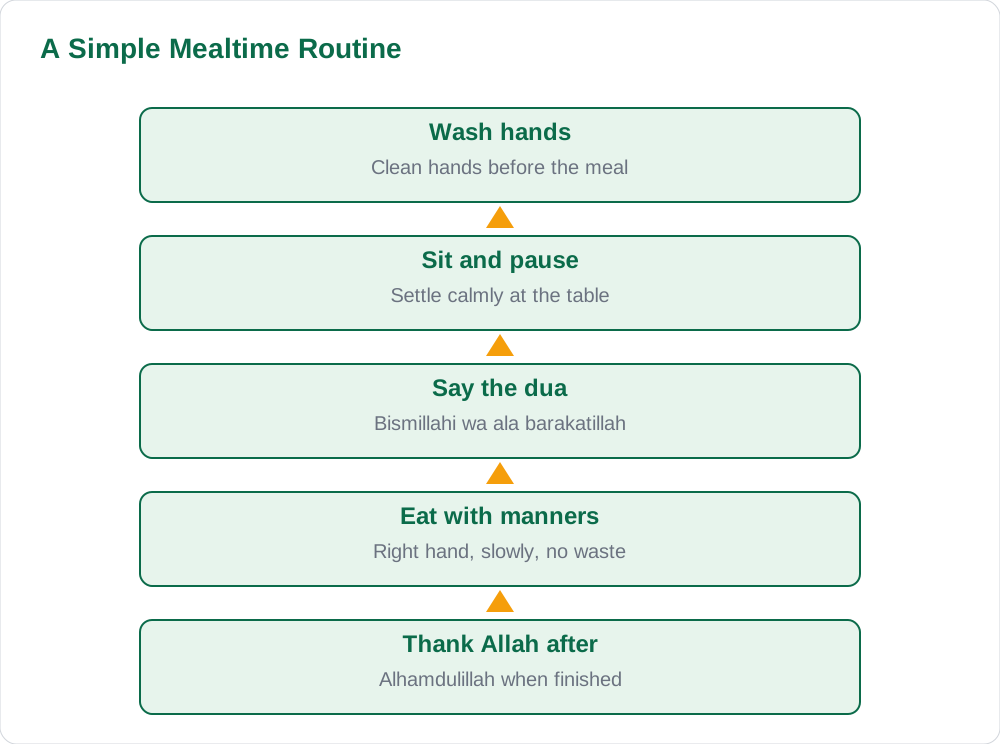
Say the dua before the first bite, in a calm and clear voice. Sit down, look at the food, and say Bismillahi wa ala barakatillah. There is no need to rush or shout it. At school, a student can say it quietly before opening a lunch box. At home, a parent can say it aloud so younger children hear it and copy it. The best teaching is a quiet example repeated every day, not a long lecture about the dua.
Good manners go with the dua. Wash your hands, sit properly, eat with your right hand, and take food from the side nearest to you. Eat slowly and do not waste food. These manners are part of the same lesson: respect for food, respect for others at the table, and respect for the blessing of Allah. Students can practise this at home and write about it in their own words for class work. You can find more study help in the solved notes and the book lists on this site.
What to Do If You Forget the Dua
Forgetting happens to everyone, especially children who are excited about food. If you remember in the middle of the meal, say Bismillahi awwalahu wa akhirahu, which means: In the name of Allah, at its beginning and at its end. This teaches an important lesson: it is never too late to remember Allah. Instead of feeling bad, a student simply returns to the habit and continues the meal with gratitude.
Parents and teachers can help without scolding. A gentle reminder before meals works better than anger. A small poster near the dining table, a routine of pausing before eating, and praise when a child remembers on their own all build the habit. Over time, the dua becomes automatic, like washing hands before a meal. The goal is a lifelong habit, not a perfect performance on one day.
Teaching Children the Habit Step by Step
Start with the short form Bismillah for very young children, then add the longer form when they are ready. Repeat it together for a few days, then let the child say it alone. Ask the child what the words mean in their own language, so the dua is understood, not only memorised. A child who understands the meaning will remember it longer and use it with feeling. Teachers can also ask students to explain the dua in one or two sentences as a class activity.
Make practice part of daily life rather than only homework. Say the dua at breakfast, lunch, and dinner, and notice when a child remembers without prompting. Families can also talk about where food comes from and why wasting food is wrong. This connects the dua to science lessons about plants, to social lessons about farmers, and to Islamiat lessons about gratitude. For more general study guidance, visit the blog listing and the [home page](/) for related guides.
AI Help: Muse AI
Muse AI is Meta's personal AI assistant, and it can explain study topics in simple words, summarise a lesson, and help you practise what you have learned. For this topic, you can ask Muse AI to quiz you on the meaning of the dua before eating in your own words, so you can check whether you truly understand it. Join Muse with invite code LTGSWD — in the Muse app, go to Settings > Redeem token and enter the code. Disclosure: LTGSWD is the author's Muse invite code. Muse AI does not give official Sindh Textbook Board answers — always verify against your Sindh Textbook Board book and your teacher.
5 key points you must know
- The dua before eating is Bismillahi wa ala barakatillah.
- It means: In the name of Allah, and with the blessing of Allah.
- Say it before the first bite, calmly and with understanding.
- If forgotten, say Bismillahi awwalahu wa akhirahu during the meal.
- Gratitude for food also means avoiding waste and eating with manners.
Frequently asked questions
What is the dua before eating?
The well-known form is Bismillahi wa ala barakatillah, meaning in the name of Allah and with His blessing. Young children often start with the short form Bismillah.
What does barakah mean in this dua?
Barakah means blessing and goodness. In this dua we ask Allah to put goodness and benefit in our food for our health and strength.
What should I do if I forget the dua before eating?
Say Bismillahi awwalahu wa akhirahu when you remember during the meal. It means in the name of Allah at its beginning and at its end.
Why do we say a dua before eating at all?
Food is a gift from Allah through many people and natural causes. The dua reminds us to be thankful, to avoid waste, and to begin with Allah's name.
How can a student learn this dua quickly?
Repeat the short form daily at meals, learn the meaning in your own language, and then move to the longer form. Saying it at every meal builds the habit faster than only reading it once.
Solved notes — preview free
These guides work best with the solved exercises. Preview the solved notes free on this website — 119 solved notes for Classes 6–10 in Sindhi, Urdu, English and Arabic medium. Or browse the full solved notes catalogue for your class and medium. New solved notes are added regularly — check the catalogue for coming-soon books.