Dr Abdul Qadeer Khan: Scientist and Patriot
Dr Abdul Qadeer Khan is remembered as the father of Pakistan's nuclear programme and one of the country's most famous scientists. His story is not only about science. It is about a student from a modest background who studied hard, travelled abroad for advanced education, and returned to serve his country. He believed that Pakistan must be strong in science and technology to stand with dignity in the world. For students, especially science students, his life teaches dedication, patriotism, and the value of mastering a difficult subject through years of patient work.
A Student Who Loved Science
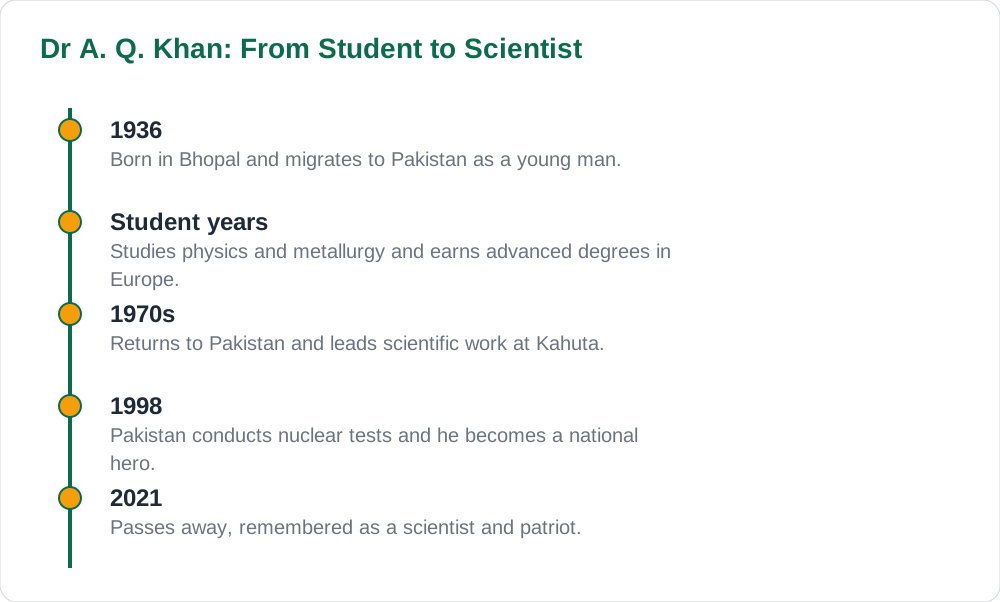
Abdul Qadeer Khan was born in Bhopal, India, in 1936 and migrated to Pakistan as a young man. He studied physics and metallurgy, and he went to Europe for higher studies, where he earned advanced degrees in engineering and metallurgy. This journey teaches students that science requires patience. No one masters physics or chemistry in a week. It takes years of reading, solving problems, and learning from failure in the laboratory and the classroom.
Students who find science difficult should remember his example. Every scientist once struggled with basic concepts. The difference is persistence. Revise formulas daily, practise numerical problems step by step, and ask teachers when a concept is unclear. Science rewards the student who keeps trying. A single difficult chapter does not mean you are not a science student. It means you need more practice, better notes, and a calmer method. Find science notes on the solved notes page.
Returning Home to Serve Pakistan
After completing his studies abroad, Dr Khan could have stayed in Europe with a comfortable career. Instead, he chose to return and serve Pakistan at a time when the country needed scientific expertise. In the 1970s, Pakistan faced a serious security challenge after regional events, and its leaders wanted a strong scientific programme. Dr Khan led work at Kahuta, where Pakistani scientists and engineers built the country's nuclear capability through long, secret, and difficult effort.
His choice teaches patriotism in action. Patriotism is not only waving a flag or singing a song. It is using your education for your country's benefit. A doctor who serves in a rural hospital, a teacher who works in a village school, and an engineer who builds clean water systems all practise the same patriotism. Students should think now about how their future profession can serve Pakistan. That sense of purpose makes study meaningful, because each lesson becomes preparation for service.
Hard Work Behind Scientific Success
Scientific success at Kahuta did not come from one genius working alone. It came from teams of scientists, engineers, technicians, and workers who laboured for years under difficult conditions. They faced shortages, secrecy, and international pressure, yet they continued. Dr Khan is often praised as the leader of this effort, but his story also honours teamwork. A laboratory, like a classroom, succeeds when everyone does their part honestly and carefully.
Students can apply this lesson to group projects and science practicals. Divide tasks fairly, record observations honestly, and check each other's work. Do not copy readings or fake results in a practical notebook, because dishonest data destroys science. Real scientists admit mistakes, repeat experiments, and verify results. That honesty is what makes science trustworthy. A student who practises honest practical work today is already thinking like a scientist. Explore class books on the books page.
- Practise science daily instead of cramming before exams.
- Record practical observations honestly, never fake results.
- Work as a team and divide group tasks fairly.
Science for National Dignity
Dr Khan believed that scientific strength gives a nation dignity and security. A country that depends on others for every technology remains weak in negotiations and in defence. By building scientific capability, Pakistan showed that its people could master advanced technology. In 1998, Pakistan conducted nuclear tests, and Dr Khan became a national hero for many Pakistanis. His name became linked with national pride, and schools and institutions were named after him.
Students should understand both the pride and the responsibility of science. Science can build hospitals, clean water, electricity, and better farming, but it can also be misused. A good scientist thinks about the effects of their work on people and the environment. That is why science education must include honesty, safety, and care for humanity. The best use of science is peaceful progress: health, education, energy, and a better life for ordinary people.
Later Life and Lessons for Young Scientists
In his later years, Dr Khan faced controversy and restrictions related to his work, and he spent time under house arrest before his death in 2021. His later life reminds students that famous people, like all people, face complex chapters and public debate. History should be studied fairly, with respect for service and honesty about difficulties. For students, the lasting lesson is not controversy but dedication: years of study, return to serve the homeland, teamwork, and belief in national capability.
If you dream of becoming a scientist, start now. Read science books beyond the textbook, watch educational programmes, build simple models, and take part in science exhibitions. Keep a notebook of questions and try to answer one question each week through reading or experiment. Science is not a subject for geniuses only. It is a subject for curious, patient, and honest workers. Dr Khan's life shows that a student from an ordinary background can, through education and service, shape the history of a nation. More guides are on the blog home.
AI Help: Muse AI
Muse AI is Meta's personal AI assistant. It can explain science in simple words, summarise a lesson, and make practice questions for revision. For this article, you can ask Muse AI to explain one science concept from your class in simple everyday language. Join Muse with invite code LTGSWD — in the Muse app, go to Settings > Redeem token and enter the code. Disclosure: LTGSWD is the author's Muse invite code. Muse AI does not give official Sindh Textbook Board answers — always verify against your Sindh Textbook Board book and your teacher.
4 key points you must know
- Dr A. Q. Khan studied physics and metallurgy in Pakistan and Europe.
- He returned to serve Pakistan and led scientific work at Kahuta.
- Scientific success came from teamwork, patience, and honest work.
- Science should serve peaceful progress and national dignity.
Frequently asked questions
Why is Dr Abdul Qadeer Khan famous?
He is famous as the father of Pakistan's nuclear programme, leading the scientific effort that built Pakistan's nuclear capability.
What did he study?
He studied physics and metallurgy, earning advanced degrees in Europe before returning to serve Pakistan.
What lesson can science students learn from him?
Science needs patience, daily practice, honest practical work, teamwork, and a sense of service to the country.
How should students think about science and responsibility?
Science should be used for peaceful progress such as health, energy, and education, with honesty, safety, and care for people and the environment.
Solved notes — preview free
These guides work best with the solved exercises. Preview the solved notes free on this website — 119 solved notes for Classes 6–10 in Sindhi, Urdu, English and Arabic medium. Or browse the full solved notes catalogue for your class and medium. New solved notes are added regularly — check the catalogue for coming-soon books.