Class 9 Islamiat: Tawheed and the Attributes of Allah
Tawheed is the first and most important belief in Islam, and it means that Allah alone is worthy of worship. For a Class 9 student, Tawheed is not just a word to memorise for an examination; it is the foundation on which every other belief stands. When a Muslim says that Allah is One, it means that no one shares His power, His knowledge, or His right to be worshipped. This belief gives life a clear direction, because a person who truly believes in one God does not bow before idols, superstitions, or human beings. In this guide, we explain Tawheed and the attributes of Allah in simple words, with examples that students can remember and use in their own answers and daily conduct.
What Tawheed Means in Simple Words
Tawheed comes from the Arabic word for making something one, and in Islamic belief it means affirming that Allah is One in His being, His lordship, and His right to worship. A Muslim believes that Allah created the heavens and the earth, gives life and death, and provides for every creature, and that no partner helps Him in any of these works. This is why the first part of the Shahadah declares that there is no god but Allah. For students, the simplest way to remember Tawheed is this: one Creator, one Sustainer, and one God worthy of worship, without any partner, equal, or rival in any sense at all.
Tawheed also protects a believer from confusion and fear, because it teaches that help should be sought from Allah alone. A person who believes in Tawheed does not believe that stars, charms, graves, or powerful people control destiny by themselves. Instead, such a person works hard, uses lawful means, and trusts Allah for the result. This balance between effort and trust is one of the most practical lessons of Tawheed. It keeps faith pure, keeps hope alive in difficulty, and keeps a student honest, because Allah sees every action even when no teacher or parent is watching.
- One Creator and Sustainer of everything that exists
- No partner, equal, or rival in worship or power
- Help and trust belong to Allah alone, alongside honest human effort
Allah Is One, Without Partner or Equal
The Quran describes Allah as One, Eternal, and unlike anything else, and this description answers a natural question that students often ask: if Allah is One, why do people worship many things? The answer is that human beings sometimes turn to visible objects or powerful personalities because they want quick help or approval. Islam teaches that these things are themselves created and limited, so they cannot give what only Allah can give. Worshipping them alongside Allah is called shirk, and it is the opposite of Tawheed. Understanding this difference helps students recognise pure worship and avoid practices that mix Allah's rights with the rights of created things.
Belief in one God also brings unity to a Muslim's life, because the same Allah is worshipped at home, at school, and in the mosque. A student does not need one set of values for examinations and another for friendships; honesty, kindness, and justice are duties everywhere. This unity of purpose is a great strength in student life. When a young person knows that Allah alone is the judge of deeds, it becomes easier to resist cheating, to admit mistakes, and to treat classmates fairly. Tawheed is therefore not only a belief about God, but also a guide for character in every place and situation.
The Beautiful Names and Attributes of Allah
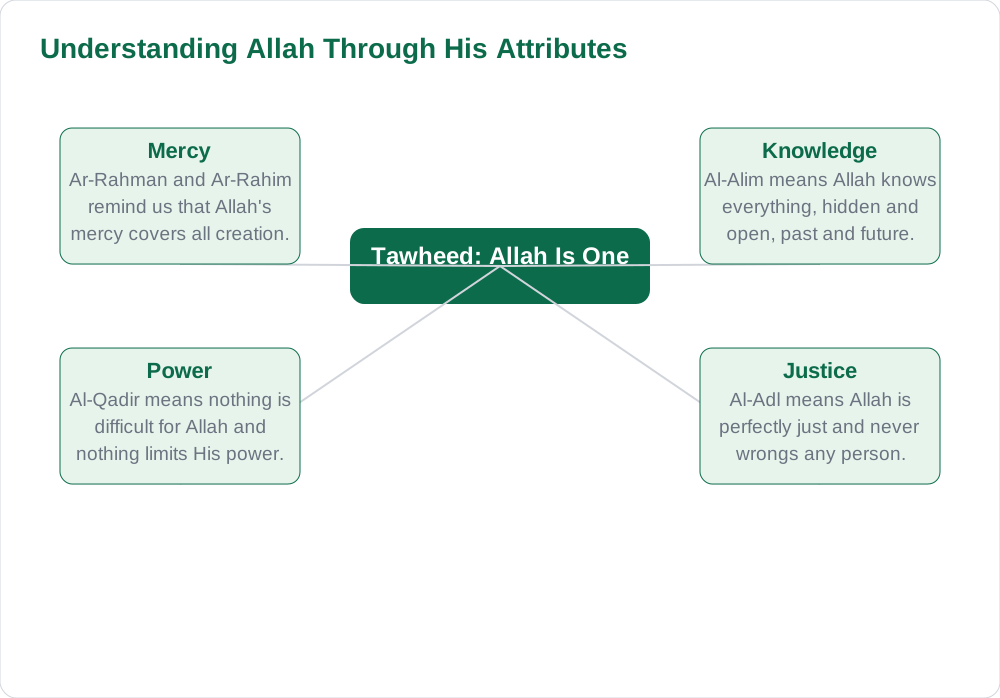
Allah has beautiful names, called Asma-ul-Husna, and each name describes an attribute such as mercy, knowledge, power, and justice. When students learn names like Ar-Rahman, the Most Merciful, and Al-Alim, the All-Knowing, they are learning something real about how Allah relates to His creation. These names are not empty titles; they tell us that Allah's mercy covers His servants, His knowledge includes everything hidden and open, and His justice never wrongs anyone. Learning the names with their meanings, rather than only memorising a list, makes the lesson deeper and helps students explain each attribute in their own words during class discussion or written work.
A helpful study habit is to connect each attribute with a daily example that makes sense to a student. Allah's provision, Ar-Razzaq, can be seen in the food, rain, and opportunities that reach people in ways they did not plan. Allah's wisdom, Al-Hakim, can be seen in the order of nature and the balance of the human body. When students practise this kind of reflection, the attributes stop being abstract definitions and become reasons for gratitude and trust. It also builds a respectful attitude, because a person who remembers that Allah is All-Seeing will think twice before harming another person or wasting a blessing.
Affirming Attributes Without Comparison
Islam teaches that Allah's attributes are perfect and unique, so believers affirm them without comparing Allah to created beings. For example, when we say that Allah hears and sees, we do not mean hearing and seeing like human hearing and seeing, which depend on ears, eyes, distance, and light. Allah's hearing and seeing are perfect and complete, without weakness or limit. This rule protects students from two mistakes: denying the attributes altogether, or imagining Allah in human form. The safe and correct path is to accept what the Quran and authentic teachings affirm, and to leave the exact nature of those attributes to Allah's perfect knowledge.
This point matters for examinations as well as for belief, because many students lose marks by writing confused or exaggerated explanations. A clear answer states the attribute, gives its simple meaning, and adds that it belongs to Allah in a perfect way unlike creation. For instance, a student can write that Allah is Ever-Living and Self-Sustaining, while every living creature depends on food, rest, and help from others. Such comparisons show understanding without claiming that Allah resembles His creation. Teachers appreciate answers that are precise, respectful, and free from guesswork about matters beyond human knowledge.
Living Tawheed Every Day
Tawheed becomes visible when a student prays only to Allah, asks Allah for help in difficulty, and thanks Allah for success instead of boasting about personal ability. It also appears in small daily choices, such as refusing to cheat even when no one would notice, returning a lost item, and speaking truthfully when a lie would be easier. These actions show that belief has moved from the tongue into the heart and then into behaviour. Parents and teachers notice this change quickly, because a student grounded in Tawheed is steadier under pressure and kinder in dealings with others, whether the matter is big or small.
Students can strengthen Tawheed through simple daily habits that take only a few minutes but build lasting faith. Reading a short passage of the Quran with translation, learning one beautiful name with its meaning each week, and pausing before an action to ask whether it pleases Allah are all practical steps. Keeping company with honest friends and avoiding gatherings where false beliefs are promoted also protects faith. For more solved notes and study material, students can explore the solved notes collection on Solved Notes and browse the full book list on Books to support their Islamiat preparation.
AI Help: Muse AI
Muse AI is Meta's personal AI assistant, and it can help you understand Tawheed by explaining the attributes of Allah in simple, everyday language. For example, you can ask it to explain one beautiful name at a time, to give a simple example for each attribute, or to make short practice questions for revision. Muse AI does not give official STBB answers — always verify against your STBB book and your teacher. Always verify against your Sindh Textbook Board book and your teacher before using anything in classwork.
Join Muse with invite code LTGSWD — in the Muse app, go to Settings > Redeem token and enter the code. Disclosure: LTGSWD is the author's Muse invite code.
5 key points you must know
- Tawheed means Allah alone is worthy of worship, with no partner or equal.
- Allah's beautiful names describe His perfect mercy, knowledge, power, and justice.
- Attributes are affirmed without comparing Allah to created beings.
- True Tawheed shows in honest actions, prayer, and trust in Allah alone.
- Daily reflection on one name at a time makes the lesson easy to remember.
Frequently asked questions
What is Tawheed in one simple sentence?
Tawheed is the belief that Allah is One in His being, His lordship, and His right to be worshipped, with no partner, equal, or rival. It is the foundation of Islamic faith, and every other belief in Islam rests on this oneness. A student can remember it as one Creator, one Sustainer, and one God worthy of worship.
What is the difference between Tawheed and shirk?
Tawheed is worshipping Allah alone, while shirk is giving any part of worship, or Allah's unique powers, to someone or something else. Shirk is the opposite of Tawheed because it treats a created thing as if it shared Allah's rights. Islam teaches that only Allah creates, sustains, and deserves worship, so a believer avoids directing prayer or ultimate trust to anyone else.
How should students explain Allah's attributes in an answer?
A good answer names the attribute, gives its simple meaning, and adds that it belongs to Allah in a perfect way unlike creation. For example, Allah's knowledge is complete and covers everything hidden and open, while human knowledge is limited and learned step by step. This method is clear, respectful, and avoids comparing Allah to human beings.
Why do Muslims learn the Asma-ul-Husna?
Learning the beautiful names helps Muslims know Allah better and live by that knowledge. A name like Ar-Rahman reminds a believer of Allah's mercy, while Al-Adl reminds them of His perfect justice. When students connect each name with a daily example, such as provision or forgiveness, the names become practical guidance for gratitude, honesty, and hope.
How can a student practise Tawheed in daily life?
A student practises Tawheed by praying only to Allah, asking Allah for help, thanking Allah for blessings, and acting honestly even when no one is watching. Small habits help, such as reading the Quran with translation, learning one name each week, and choosing honest friends. These habits turn belief into character that teachers, parents, and classmates can see.
Solved notes — preview free
These guides work best with the solved exercises. Preview the solved notes free on this website — 119 solved notes for Classes 6–10 in Sindhi, Urdu, English and Arabic medium. Or browse the full solved notes catalogue for your class and medium. New solved notes are added regularly — check the catalogue for coming-soon books.