Class 9 Islamiat: Seerat in the Madani Period

Seerat means the life of Prophet Muhammad, peace be upon him, and the Madani period covers the years after the Hijrah, when he migrated from Makkah to Madinah and built a Muslim community. This period is different from the Makki period, because the Prophet was no longer only preaching under persecution; he was now leading a society, establishing a mosque, uniting tribes, and setting laws for collective life. For Class 9 students, the Madani period is essential because it shows how Islamic teachings work in government, community relations, and daily social life. This guide explains Hijrat, the Charter of Madinah, and community-building in simple, ordered language. The sections below follow the journey from migration to a settled, united community.
From Makkah to Madinah: The Hijrah
The Hijrah was the migration of Prophet Muhammad, peace be upon him, and his companions from Makkah to Madinah, after thirteen years of preaching under severe persecution. In Makkah, Muslims faced boycott, torture, and mockery, yet they remained patient and firm in faith. When the people of Madinah, then called Yathrib, invited the Prophet and pledged to protect him, migration became the path to a new beginning. The Hijrah was not a flight from duty; it was a planned and courageous move to a place where Islam could be practised openly and a community could be built on its teachings.
The Hijrah is so important that the Islamic calendar begins from it, marking a turning point from individual preaching to collective organisation. Students should remember that the Prophet migrated secretly and carefully, leaving Ali, may Allah be pleased with him, in his bed to return trusts to their owners, and travelling with Abu Bakr, may Allah be pleased with him, through difficult routes. This care for trusts, even while leaving under threat, teaches a powerful lesson: honesty and responsibility do not pause in hardship. The Hijrah therefore begins the Madani period with a message of trust, planning, and reliance on Allah.
The Charter of Madinah
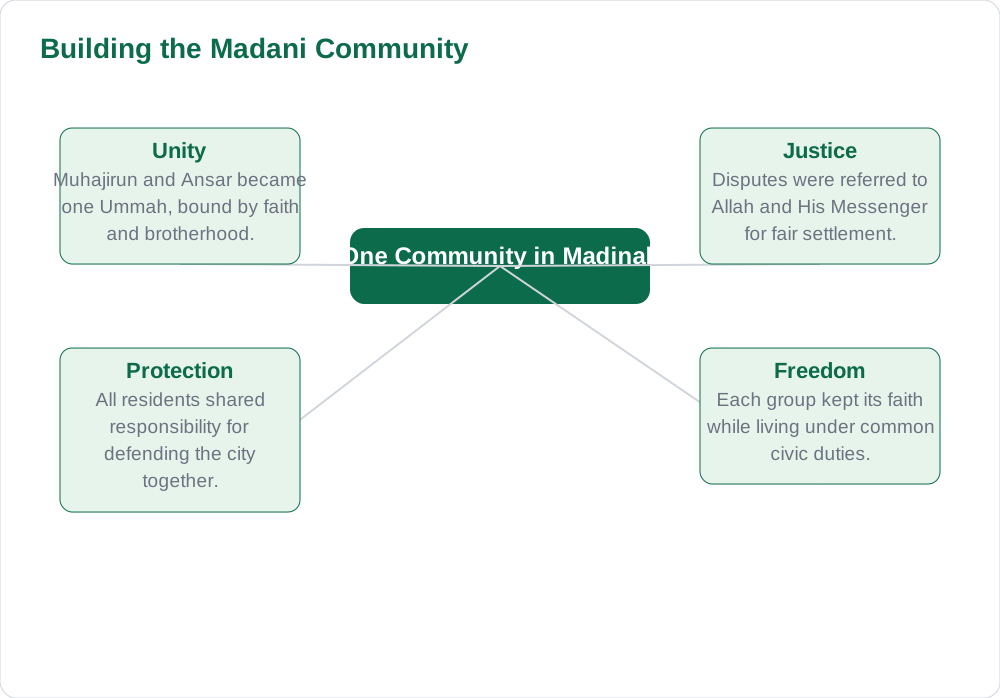
On arrival in Madinah, the Prophet, peace be upon him, established a written agreement known as the Charter of Madinah, which united the diverse groups of the city into one community. The charter recognised Muslims, including Muhajirun from Makkah and Ansar from Madinah, as one Ummah, while also defining rights and duties for Jewish tribes and other residents. It guaranteed freedom of religion, mutual protection, and shared responsibility for the defence of the city, and it required disputes to be referred to Allah and His Messenger. Students should understand the charter as an early example of a constitution: a written agreement that binds different groups to justice and peaceful coexistence.
The charter's importance for examinations lies in its principles, which students can list clearly: unity of the community, protection of life and property, freedom of faith, collective defence, and justice through a common authority. These principles show that the Prophet's leadership was not based on force alone, but on agreement, consultation, and respect for existing communities. For modern students, the charter offers a model for school and society: different groups can live together peacefully when rights are respected, promises are kept, and conflicts are settled fairly rather than through bullying or favouritism. It remains one of the most admired documents of the Madani period.
Brotherhood Between Muhajirun and Ansar
One of the Prophet's first acts in Madinah was to establish brotherhood, called Muakhah, between the Muhajirun, who had left homes and wealth in Makkah, and the Ansar, the helpers of Madinah who welcomed them. Each Ansari was paired with a Muhajir brother, sharing home, food, and support until the newcomers could stand on their own feet. This was not symbolic kindness; Ansar offered half their property and livelihood in a generosity that amazed even the recipients. Students should highlight this brotherhood as a practical example of Islamic compassion, because it turned faith into food, shelter, and dignity for people who had lost everything for their beliefs.
Brotherhood also solved a social problem that could have divided the new community: resentment between newcomers and hosts. By pairing families, the Prophet created personal bonds that crossed tribal and regional lines, replacing old loyalties with a bond of faith. Over time, as Muhajirun found work and trade, the formal sharing eased, but the spirit of brotherhood remained in the community's character. For students, the lesson is direct and applicable: welcoming a new classmate, sharing notes, or helping a struggling student is a small form of Ansar spirit, and schools become stronger when newcomers are welcomed rather than isolated or ignored.
The Mosque as the Heart of Community
The Prophet's Mosque in Madinah, Masjid-e-Nabawi, became the centre of the new community, serving as a place of prayer, learning, consultation, and social welfare. It was here that the Prophet taught, received delegations, settled disputes, and cared for the poor, including the Suffah companions who lived nearby and devoted themselves to learning. Building the mosque with his own hands, alongside his companions, showed leadership through participation rather than command from a distance. Students should note that the mosque was not only a prayer hall; it was the community's school, council chamber, and welfare centre combined, and that breadth explains its central role in the Madani period.
The mosque also hosted the call to prayer, the Adhan, which united the community five times a day and gave Madinah a shared rhythm of worship. Markets, trade, and daily work were organised around prayer times, so faith shaped public life without forcing belief on anyone. For modern students, the mosque's example suggests that a school or community centre works best when it serves learning, welfare, and consultation together, not only one function. A student who helps organise a study circle, a charity collection, or a fair discussion in school is following, on a small scale, the Madani model of a community built around shared worship and shared service.
Lessons of the Madani Period for Today
The Madani period teaches that Islam is not only personal worship, but also a guide for building a just and caring society. Its lessons include keeping agreements, protecting minorities, consulting others before decisions, sharing wealth with newcomers, and settling disputes through justice rather than power. Students can apply these lessons in school by keeping promises to classmates, including students from different backgrounds, listening in group work, and refusing to support bullying or unfair treatment. These actions may seem small, but they are exactly how a community is built: through repeated, honest, and kind choices by ordinary people every day.
Revising the Madani period is easier when students follow its own order: Hijrah, then brotherhood, then the mosque, then the charter, then the laws and events that followed. A timeline drawn from memory, practised twice, will fix the sequence far better than reading the same page five times. For revision material and solved notes, visit Solved Notes and explore the book collection on Books. The Madani Seerat, in the end, shows a prophet who was not only a preacher, but also a statesman, teacher, and neighbour, and whose community became a model because its members lived their faith together.
AI Help: Muse AI
Muse AI is Meta's personal AI assistant, and it can help you revise the Madani period by turning Hijrat, brotherhood, and the Charter into a simple timeline. You can ask it to explain the Charter's principles in plain words, to quiz you on the order of events, or to summarise why brotherhood mattered for the new community. Muse AI does not give official STBB answers — always verify against your STBB book and your teacher. Always verify against your Sindh Textbook Board book and your teacher before using anything in classwork.
Join Muse with invite code LTGSWD — in the Muse app, go to Settings > Redeem token and enter the code. Disclosure: LTGSWD is the author's Muse invite code.
5 key points you must know
- Hijrah moved the Prophet and companions from Makkah to Madinah for open practice.
- The Charter of Madinah united diverse groups under shared rights and duties.
- Brotherhood paired Muhajirun with Ansar in practical, generous support.
- Masjid-e-Nabawi served as prayer hall, school, council, and welfare centre.
- Madani lessons include justice, consultation, protection, and care for newcomers.
Frequently asked questions
What is the Hijrah?
The Hijrah is the migration of Prophet Muhammad, peace be upon him, and his companions from Makkah to Madinah after years of persecution. The people of Madinah invited and pledged to protect the Prophet, making migration possible. The Islamic calendar begins from the Hijrah because it marks the shift from individual preaching under persecution to building an organised Muslim community.
What was the Charter of Madinah?
The Charter of Madinah was a written agreement established by the Prophet that united the city's diverse groups into one community. It recognised Muslims as one Ummah, defined rights and duties for other residents, guaranteed freedom of religion, required mutual protection, and referred disputes to Allah and His Messenger. It is regarded as an early constitution based on agreement and justice.
What was brotherhood between Muhajirun and Ansar?
Brotherhood, or Muakhah, paired each Muhajir, who had left Makkah, with an Ansari helper in Madinah. Ansar shared homes, food, and livelihood with their brothers until the newcomers could support themselves. This practical generosity prevented resentment, created bonds across tribal lines, and showed Islamic compassion in action rather than words alone.
Why was the Prophet's Mosque so important?
Masjid-e-Nabawi was the heart of the Madani community, serving as a place of prayer, learning, consultation, and welfare. The Prophet taught there, received delegations, settled disputes, and cared for the poor, including the Suffah companions. Its multiple roles show that the mosque was a community centre, not only a prayer hall, and it gave Madinah a shared rhythm through the daily Adhan.
What lessons does the Madani period offer students today?
The Madani period offers lessons in keeping agreements, respecting diversity, consulting others, welcoming newcomers, and settling disputes fairly. Students can practise these by including new classmates, listening in group work, keeping promises, and opposing bullying. These small, repeated choices build the kind of just and caring community that Madinah was meant to model.
Solved notes — preview free
These guides work best with the solved exercises. Preview the solved notes free on this website — 119 solved notes for Classes 6–10 in Sindhi, Urdu, English and Arabic medium. Or browse the full solved notes catalogue for your class and medium. New solved notes are added regularly — check the catalogue for coming-soon books.