Class 9 Islamiat: Roza and Zakat Rules

Roza, or fasting, and Zakat, or obligatory charity, are two pillars of Islam that train a Muslim in self-control and compassion at the same time. Fasting teaches a believer to control hunger, thirst, speech, and temper for the sake of Allah, while Zakat teaches a believer to share wealth with those in need and to purify their earnings. For Class 9 students, these two pillars are often studied together because both involve discipline, intention, and care for others. This guide explains fasting rules and zakat nisab in simple words, with worked examples that are clearly labelled as illustrative, so students can understand the method without confusing an example figure with an official rate.
Two Pillars, One Spirit of Discipline
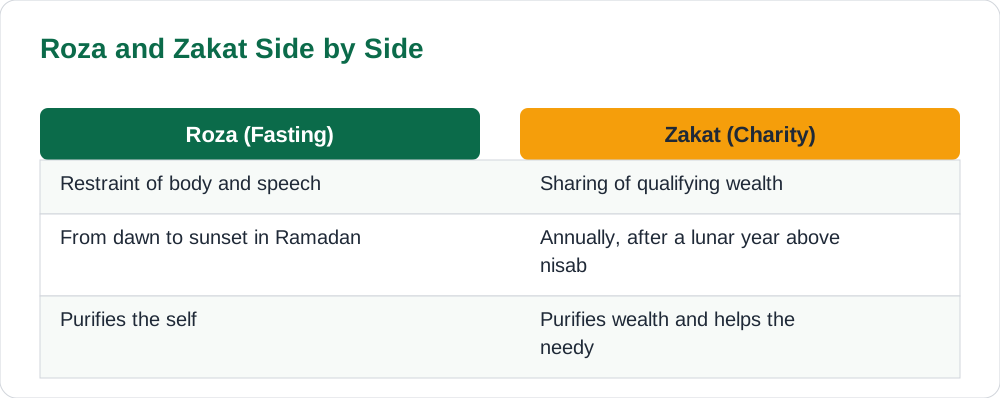
Fasting and Zakat look different on the surface, because one restrains the body while the other releases wealth, yet both teach the same lesson: a Muslim's desires and possessions are trusts from Allah, not absolute personal property. In fasting, a believer gives up lawful food and drink during daylight hours to obey Allah and to feel sympathy for the hungry. In Zakat, a believer gives a fixed portion of qualifying wealth to deserving people, recognising that the poor have a right in the wealth of the rich. Together, these pillars balance personal restraint with social responsibility, and that balance is central to Islamic character.
Students can remember the connection through a simple idea: fasting purifies the self, while Zakat purifies wealth. Both require sincere intention, because an action done only to impress others loses its reward, while the same action done for Allah earns reward even if no one notices. Both also require knowledge of rules, since fasting has conditions about who must fast and what breaks a fast, and Zakat has conditions about nisab, the minimum threshold, and eligible recipients. Learning these rules carefully helps students answer examination questions accurately and practise both pillars with confidence in real life.
Fasting Rules in Brief
Fasting in Ramadan means abstaining from food, drink, and marital relations from dawn until sunset, with a sincere intention to fast for Allah. Healthy adult Muslims are required to fast, while children, travellers, the seriously ill, and others with valid excuses are exempt or may make up missed fasts later, according to Islamic guidance. Suhoor, the pre-dawn meal, and Iftar, the breaking of the fast at sunset, are Sunnah practices that frame the fasting day with gratitude and community. Students should learn that fasting is not only about hunger; it also includes guarding the tongue from lies and harsh words, and guarding behaviour from quarrels and wrongdoing.
Certain actions break a fast, such as eating or drinking deliberately during fasting hours, while forgetful eating does not break it, and other cases have specific rulings that students should learn from teachers rather than guessing. A missed fast due to a valid excuse is normally made up later, and deliberate breaking without excuse carries a serious expiation, so students must understand the difference. For school life, fasting teaches time management, patience, and empathy: a fasting student learns to stay calm under hunger, to revise with focus, and to appreciate the blessing of food that is often taken for granted during the rest of the year.
Zakat: Who Pays and Who Receives
Zakat is obligatory charity paid annually on qualifying wealth that reaches nisab, the minimum threshold, and has been held for a lunar year. It applies to wealth such as cash, savings, trade goods, gold, and silver, while personal items in daily use, such as a home or basic clothing, are generally not counted. The standard rate for cash and trade goods is two and a half percent, which students can remember as two and a half rupees out of every hundred. Eligible recipients include the poor and needy, those in debt, travellers in difficulty, and others described in the Quran, while Zakat is not given to the wealthy or to those a person is already obliged to support.
The purpose of Zakat goes beyond charity, because it circulates wealth, reduces resentment between rich and poor, and reminds wealthy people that their prosperity is a trust. A student who understands Zakat will also understand why Islam forbids hoarding wealth while neighbours go hungry. For examination answers, students should state the definition, the nisab idea, the rate for cash, and examples of recipients in a clear sequence. For exact nisab values in a given year, families should ask a knowledgeable scholar or local religious authority, because nisab depends on the current value of gold or silver and is not a fixed figure to guess.
Worked Illustrative Examples
The following examples are illustrative only, with stated assumptions, and they are not official rates or rulings for any person. Example one: suppose, purely for illustration, that a person holds cash savings of 200,000 rupees for a full lunar year above the nisab threshold; at the standard cash rate of two and a half percent, the Zakat would be 5,000 rupees, because two and a half percent of 200,000 equals 5,000. This calculation shows the method clearly: first check that wealth reaches nisab and completes a year, then apply the rate to the qualifying amount. Students can practise the same method with different illustrative figures to build confidence in percentage calculations for examinations.
Example two, also illustrative: suppose a small trader holds trade goods worth 400,000 rupees at the end of the lunar year, again above the assumed nisab; two and a half percent of 400,000 equals 10,000 rupees, so the illustrative Zakat would be 10,000 rupees. If wealth falls below nisab, or has not completed a lunar year, Zakat would not yet be due on that amount under the stated assumptions. Students should always label such figures as examples in their answers, state the assumption, and add that real cases should be checked with a scholar, because personal circumstances, debts, and asset types can change the ruling in practice.
The Spirit Behind Both Pillars
Beyond rules and calculations, fasting and Zakat shape a believer's heart in ways that last long after Ramadan or the annual Zakat payment. Fasting creates empathy for the hungry, because a person who has felt hunger will give food more generously and waste less. Zakat creates gratitude for wealth, because giving away a portion reminds a person that provision comes from Allah and that others share a right in it. Students who practise even small voluntary versions, such as fasting on recommended days when able, or giving small sadaqah from pocket money, build the same habits on a scale suited to their age and means.
Teachers often look for this deeper understanding in answers, not only lists of rules. A strong answer explains the rule, gives an example, and then explains the wisdom behind it, such as self-control, sympathy, or social justice. Students can revise by teaching a classmate the difference between fasting and Zakat, or by solving one illustrative percentage problem each day. For more study material, visit Solved Notes and browse the full collection on Books. When discipline and compassion grow together, both pillars fulfil their purpose: a believer who controls the self and shares with others.
AI Help: Muse AI
Muse AI is Meta's personal AI assistant, and it can help you revise Roza and Zakat by explaining nisab and percentage calculations step by step with simple practice sums. You can ask it to walk through an illustrative example slowly, to quiz you on who pays and who receives Zakat, or to summarise fasting rules in a short checklist. Muse AI does not give official STBB answers — always verify against your STBB book and your teacher. Always verify against your Sindh Textbook Board book and your teacher before using anything in classwork.
Join Muse with invite code LTGSWD — in the Muse app, go to Settings > Redeem token and enter the code. Disclosure: LTGSWD is the author's Muse invite code.
5 key points you must know
- Roza is fasting from dawn to sunset in Ramadan, with sincere intention.
- Fasting trains self-control of body, speech, and temper, not only hunger.
- Zakat is paid annually on qualifying wealth above nisab, held for a lunar year.
- The standard cash rate is two and a half percent, with worked examples labelled illustrative.
- Real nisab values and personal cases should be checked with a knowledgeable scholar.
Frequently asked questions
Who must fast in Ramadan?
Healthy adult Muslims are required to fast in Ramadan, while children, travellers, the seriously ill, and others with valid excuses are exempt or make up missed fasts later according to Islamic guidance. Fasting includes abstaining from food, drink, and marital relations from dawn to sunset, with sincere intention. It also means guarding speech and behaviour from lies, quarrels, and wrongdoing throughout the day.
What is nisab in Zakat?
Nisab is the minimum threshold of qualifying wealth above which Zakat becomes due, provided the wealth has been held for a lunar year. It is traditionally linked to the value of gold or silver, so its cash figure changes with market prices and should be confirmed from a knowledgeable scholar for the relevant year. Wealth below nisab does not attract Zakat, even if a person wishes to give voluntary charity.
What is the Zakat rate for cash savings?
The standard rate for cash, savings, and trade goods is two and a half percent, which is two and a half rupees out of every hundred. As an illustrative example only, two and a half percent of 200,000 rupees equals 5,000 rupees, assuming the amount is above nisab and has completed a lunar year. Real cases depend on debts, asset types, and current nisab, so they should be checked with a scholar.
Who can receive Zakat?
Eligible recipients include the poor and needy, those burdened by debt, travellers in difficulty, and other categories described in the Quran. Zakat is meant for those who genuinely need support, not for the wealthy or for people a giver is already obliged to support, such as dependent children. Giving Zakat to the right recipients ensures that wealth reaches those it was intended to help.
What breaks a fast?
Deliberately eating or drinking during fasting hours breaks a fast, while forgetful eating does not, according to standard teaching. Other cases, such as illness or medical treatment, have specific rulings that students should learn from a teacher rather than guessing. A fast missed for a valid excuse is normally made up later, while deliberate breaking without excuse carries a serious expiation, which shows how seriously fasting is treated.
Solved notes — preview free
These guides work best with the solved exercises. Preview the solved notes free on this website — 119 solved notes for Classes 6–10 in Sindhi, Urdu, English and Arabic medium. Or browse the full solved notes catalogue for your class and medium. New solved notes are added regularly — check the catalogue for coming-soon books.