Class 9 Islamiat: Risalat and the Finality of Prophethood
Risalat means the sending of prophets by Allah to guide human beings, and it is one of the central beliefs in Islam. Allah did not leave people without guidance; He sent messengers in different times and places to teach the same basic message of worshipping one God and living justly. The chain of prophethood reached its completion with Prophet Muhammad, peace be upon him, who is the final prophet, and this belief is called Khatm-e-Nubuwwat. For Class 9 students, understanding Risalat means understanding both the role of prophets and why no prophet comes after the final prophet. This guide explains the idea step by step, in clear and simple language.
Why Allah Sent Prophets to People
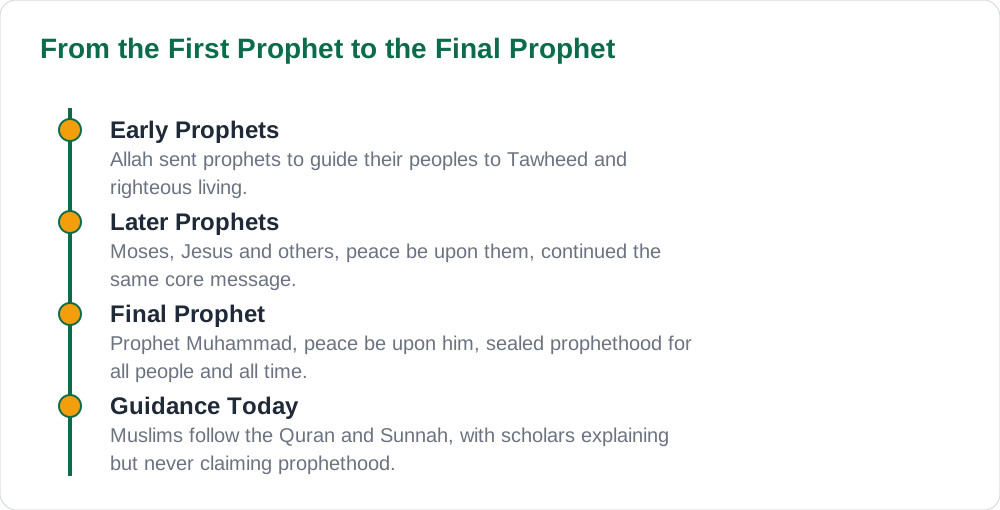
Human beings have reason and conscience, but they still need clear guidance about the purpose of life, right and wrong, and the life after death. Allah sent prophets to provide that guidance in a form people could understand and follow. A prophet was a human being chosen by Allah, known for truthfulness and good character, who received revelation and conveyed it to his people. This is why prophets are described as guides and warners: they showed the straight path, warned against wrongdoing, and gave glad news of reward for those who obey Allah and live righteously in this world.
Prophets also served as living examples, because their followers could watch how they prayed, treated neighbours, kept promises, and faced hardship with patience. A book alone might be misunderstood, but a prophet's life showed how its teachings worked in real situations. For students, this is an important point: Risalat is not only about receiving a message, but also about demonstrating it. When a prophet forgave an enemy, helped the poor, or stood firm for truth, he was teaching his community through action, and that practical example is part of why prophethood was necessary for human guidance.
The Common Message of All Prophets
Although prophets came to different peoples and times, their core message was the same: worship Allah alone, avoid shirk, live justly, and prepare for accountability after death. The Quran mentions many prophets, including Adam, Noah, Abraham, Moses, and Jesus, peace be upon them all, and presents them as part of one continuous chain of guidance. Their laws and practices differed in details according to their communities, but the foundation never changed. Recognising this unity helps students avoid the mistake of thinking that each prophet brought a completely different religion; instead, they all called people to the same Tawheed and the same moral values.
This unity also teaches respect, because Muslims believe in all the prophets sent by Allah and do not reject any of them. A Muslim honours earlier prophets while following the final message given to Prophet Muhammad, peace be upon him. For classroom answers, students can explain this point clearly: earlier scriptures and prophets are respected, and the final revelation completes and confirms the guidance that came before. This balanced view keeps faith firm without disrespecting the beliefs of others, and it shows why Risalat is described as a mercy, since guidance reached people again and again through history.
The Final Prophet and Khatm-e-Nubuwwat
Khatm-e-Nubuwwat means that prophethood ended with Prophet Muhammad, peace be upon him, and that no prophet will come after him. The word Khatm means a seal, and just as a seal closes a document, the final prophet sealed the chain of prophethood. The Quran describes him as the Seal of the Prophets, and his message, the Quran, is preserved as guidance for all people until the end of time. For students, the key idea is simple: earlier prophets were sent to particular peoples, but the final prophet was sent as a mercy to all worlds, so his guidance is complete and does not need a successor prophet.
The finality of prophethood also has a practical meaning for Muslims today. When a question about faith or practice arises, Muslims turn to the Quran and the Sunnah of the final prophet, rather than expecting a new prophet or a new revelation. Scholars explain and apply these sources, but they do not claim prophethood, and no new scripture can replace the Quran. Understanding this distinction helps students answer examination questions accurately and avoid confusion. It also gives confidence, because the guidance Muslims follow is complete, preserved, and available to every generation without waiting for another messenger.
What Finality Means for Believers Today
Belief in finality protects the Muslim community from false claims and confusion, because any person who claims prophethood after the final prophet contradicts a clear and settled belief. Students should understand that this is not a minor detail; it is part of the core faith, and that is why teachers treat it with such seriousness. At the same time, finality does not mean that learning has stopped. Scholars, teachers, and students continue to study, explain, and apply the Quran and Sunnah to new situations, such as modern science, business, and social life, without adding new revelation or claiming prophetic authority for themselves.
Finality also brings a sense of responsibility, because Muslims are the carriers of the final message and are expected to present it through good character. When a student is honest in examinations, kind to classmates, and respectful to elders, that behaviour reflects the teachings of the final prophet. In this way, Khatm-e-Nubuwwat is not only a belief to state in an answer, but also a trust to live by. Students who understand this connection write stronger answers, because they can explain both the belief itself and its effect on daily conduct in their school and community.
Following the Prophet's Example
Loving and following the final prophet means studying his Seerat, adopting his manners, and obeying his teachings in practical matters. His honesty earned him the title Al-Amin, the Trustworthy, even before prophethood, and his kindness extended to family, neighbours, children, and even those who opposed him. Students can take simple lessons from this example: keep promises, speak gently, help those in need, and remain patient when treated unfairly. These qualities are not separate from worship; they are part of what it means to follow a prophet whose character the Quran describes as a great and noble example for believers.
A good study method is to learn one aspect of the Seerat each week and practise it consciously, such as truthfulness in speech or punctuality in prayer. Students can also use solved notes and guides to revise the topic, and the solved notes collection on Solved Notes offers helpful revision material for Islamiat. For the full list of books and subjects, visit Books and choose the relevant class. Revising with a clear structure, belief, evidence, and daily application, will help students write confident answers about Risalat and the finality of prophethood in examinations.
AI Help: Muse AI
Muse AI is Meta's personal AI assistant, and it can help you revise Risalat by explaining Khatm-e-Nubuwwat in simple words with everyday examples. You can ask it to summarise the role of prophets, to list the common points of their message, or to create short quiz questions for self-testing. Muse AI does not give official STBB answers — always verify against your STBB book and your teacher. Always verify against your Sindh Textbook Board book and your teacher before using anything in classwork.
Join Muse with invite code LTGSWD — in the Muse app, go to Settings > Redeem token and enter the code. Disclosure: LTGSWD is the author's Muse invite code.
5 key points you must know
- Risalat means Allah sent prophets to guide people to Tawheed and righteous living.
- All prophets shared the same core message, though their laws differed in detail.
- Prophet Muhammad, peace be upon him, is the Seal of the Prophets.
- No prophet comes after him, and no new revelation replaces the Quran.
- Following the final prophet means adopting his honesty, kindness, and patience.
Frequently asked questions
What does Risalat mean?
Risalat means the sending of prophets by Allah to guide human beings. A prophet received revelation from Allah and conveyed it to his people, showing them how to worship Allah alone and live justly. Prophets were also living examples, so their character and actions demonstrated the teachings they preached in daily life.
What is Khatm-e-Nubuwwat?
Khatm-e-Nubuwwat is the belief that prophethood ended with Prophet Muhammad, peace be upon him, who is the Seal of the Prophets. The word Khatm means seal, showing that the chain of prophets is complete. After him, no new prophet comes and no new revelation is sent, because his message is complete for all people and all time.
Did all prophets teach the same religion?
Yes, in their core message all prophets taught Tawheed, righteous conduct, and accountability after death. Their detailed laws differed according to their peoples and times, but the foundation remained the same. Muslims therefore believe in all prophets and respect them, while following the final and complete message given to Prophet Muhammad, peace be upon him.
Why is finality of prophethood important?
Finality is important because it settles the source of guidance: Muslims turn to the Quran and the Sunnah, not to any new claimant of prophethood. It protects faith from false claims and confusion, and it places responsibility on the Muslim community to preserve and practise the final message. Scholars continue to explain the sources, but they never claim prophethood themselves.
How can students follow the final prophet in school life?
Students follow the final prophet by adopting his character: truthfulness, keeping promises, kindness to classmates, respect for teachers, and patience in difficulty. Small daily actions, such as refusing to cheat, helping a struggling classmate, and speaking gently, reflect his example. Studying one part of the Seerat each week and practising it consciously makes this lesson practical and memorable.
Solved notes — preview free
These guides work best with the solved exercises. Preview the solved notes free on this website — 119 solved notes for Classes 6–10 in Sindhi, Urdu, English and Arabic medium. Or browse the full solved notes catalogue for your class and medium. New solved notes are added regularly — check the catalogue for coming-soon books.