Class 9 Islamiat: Revelation of the Quran in Stages
The Quran is the final revelation from Allah, revealed to Prophet Muhammad, peace be upon him, over about twenty-three years, not all at once. This gradual revelation is itself a lesson, because each passage came at a time when the Muslim community needed guidance for a particular situation, question, or hardship. For Class 9 students, understanding the stages of revelation means knowing how it began, how Makki and Madani surahs differ, and how the Quran was written, memorised, and compiled into the book Muslims read today. This guide explains that journey in simple, ordered language, with clear points that are easy to revise and explain in examinations. The stages below follow the historical order, from first revelation to final compilation.
The First Revelation in the Cave of Hira
Before prophethood, Prophet Muhammad, peace be upon him, would spend time in reflection in the Cave of Hira, outside Makkah, away from the idolatry and injustice of his society. In the month of Ramadan, the Angel Jibril came to him with the first revealed words, commanding him to read in the name of his Lord who created. These opening verses of Surah Al-Alaq emphasised reading, knowledge, and the Creator, and they set the tone for the entire Quran. The Prophet was shaken by the experience, and his wife Khadijah, may Allah be pleased with her, comforted him and confirmed his truthfulness, marking the humble and human beginning of a world-changing mission.
Students should note two lessons from the first revelation that often appear in examination answers. First, the Quran began with a command to read and learn, which shows the high value Islam places on knowledge from its very first word. Second, revelation came to a human prophet who lived among his people, so its guidance was practical and understandable, not distant or abstract. The first revelation also began a period of gradual guidance, because the Prophet did not receive the whole Quran at once; he received it piece by piece, as events unfolded and as the community grew in faith and understanding over time.
Revelation Over Twenty-Three Years
Revelation continued for about thirteen years in Makkah and about ten years in Madinah, making a total of roughly twenty-three years. This long period allowed the early Muslims to absorb teachings gradually, to change their habits step by step, and to face new challenges with fresh guidance. For example, early passages strengthened belief in one God and patience under persecution, while later passages gave detailed laws for a growing community. Students who understand this gradual pattern can explain why the Quran was not revealed as a single book at once: people learn best in stages, and a community, like a student, grows through steady teaching rather than sudden overload.
Gradual revelation also answered real questions as they arose, which made the Quran deeply relevant to the lives of its first listeners. When the community faced hardship, verses of comfort and patience were revealed; when new social situations appeared, verses of law and guidance followed. This connection between revelation and events is called the context of revelation, and it helps readers understand why a passage was revealed, without treating the Quran as a book tied only to the past. Its guidance remains universal, but knowing its stages helps students read it with wisdom, patience, and respect for its order.
Makki and Madani Surahs
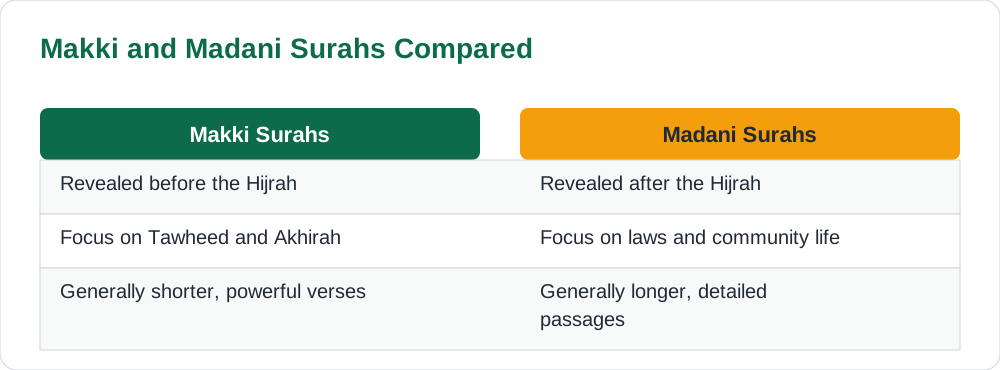
Surahs revealed before the Hijrah are called Makki, while those revealed after the Hijrah are called Madani, and the distinction is based on time rather than only on place. Makki surahs generally focus on Tawheed, prophethood, the Hereafter, and moral character, with short, powerful verses that strengthened faith under persecution. Madani surahs are generally longer and deal with laws for worship, family, business, war and peace, and community organisation, because the Muslims now had a state and a society to govern. Students can remember the difference with a simple contrast: Makki surahs build belief, while Madani surahs build a community on that belief.
Knowing whether a surah is Makki or Madani also helps students understand its style and purpose when they read or revise it. A short surah with vivid images of the Day of Judgement is likely Makki, while a longer surah with detailed rulings on inheritance or fasting is likely Madani. Teachers often test this distinction with examples, so students should learn two or three well-known examples of each type and the reason for their classification. The key point for answers is not memorising a full list, but explaining the general features clearly and giving one correct example for each category with a brief reason.
Writing and Memorisation Side by Side
From the beginning, the Quran was preserved through two methods working together: writing and memorisation. Whenever a passage was revealed, the Prophet, peace be upon him, dictated it to scribes who wrote it on available materials such as parchment, bones, and palm leaves. At the same time, the Prophet recited it to his companions, who memorised it, recited it in prayer, and taught it to others. This double preservation is unique and important, because a written text can be checked against memorised recitation, and memorised recitation can be checked against the written text. Students should stress this point in answers, as it explains why Muslims are confident about the Quran's preservation.
Memorisation, called Hifz, remains a living tradition today, with millions of Muslims, including many children, memorising the entire Quran. This is why the Quran is often described as preserved in hearts as well as in books. A student who memorises even a few surahs with correct pronunciation joins this tradition in a small but real way. Writing also mattered because it fixed the exact wording, preventing changes from memory slips or dialect differences. Together, writing and memorisation formed a system of checks that protected the Quran from alteration through generations, long before modern printing existed.
Compilation Into One Book
During the Prophet's lifetime, the Quran existed as written portions and as memorised recitation, but it was not yet gathered into a single bound volume, because revelation was still continuing. After his passing, during the caliphate of Abu Bakr, may Allah be pleased with him, the written portions were collected and verified against the memories of companions, following the loss of many memorisers in battle. Later, during the caliphate of Uthman, may Allah be pleased with him, standard copies were prepared and sent to major centres, so that all Muslims would recite from the same authoritative text. Students should learn these two stages separately: collection under Abu Bakr, and standardisation under Uthman.
This careful compilation is why Muslims today read the same Quran across the world, in the same Arabic wording, regardless of language or country. Translations exist to help understanding, but the Arabic text remains the Quran itself, and recitation follows rules of pronunciation called Tajweed. For students, the lesson is both historical and practical: respect the Quran by handling it cleanly, reciting it correctly, and reading its translation to understand its message. For revision material, visit Solved Notes and explore the collection on Books. The story of revelation, from Hira to a single preserved book, is a story of guidance protected with extraordinary care.
AI Help: Muse AI
Muse AI is Meta's personal AI assistant, and it can help you revise Quranic revelation by explaining Makki and Madani differences with simple examples. You can ask it to summarise the stages of revelation in order, to quiz you on the first revelation, or to explain a short surah's theme in plain words. Muse AI does not give official STBB answers — always verify against your STBB book and your teacher. Always verify against your Sindh Textbook Board book and your teacher before using anything in classwork.
Join Muse with invite code LTGSWD — in the Muse app, go to Settings > Redeem token and enter the code. Disclosure: LTGSWD is the author's Muse invite code.
5 key points you must know
- The Quran was revealed gradually over about twenty-three years.
- The first revelation came in the Cave of Hira, beginning with a command to read.
- Makki surahs build belief; Madani surahs give laws for a community.
- Writing and memorisation together preserved the Quran from the start.
- Compilation was completed through collection under Abu Bakr and standard copies under Uthman.
Frequently asked questions
Where and how did the first revelation take place?
The first revelation came in the Cave of Hira, outside Makkah, during Ramadan, when the Angel Jibril brought the opening verses of Surah Al-Alaq, commanding the Prophet to read in the name of his Lord who created. The Prophet, peace be upon him, was shaken by the experience, and his wife Khadijah comforted him. This event marked the beginning of prophethood and of gradual revelation over twenty-three years.
Why was the Quran revealed in stages?
The Quran was revealed in stages so that people could absorb its teachings gradually and apply them step by step. Early passages strengthened belief and patience, while later passages gave detailed laws as the community grew. Gradual revelation also answered real questions and situations as they arose, making guidance relevant and easier to follow than a sudden, overwhelming revelation would have been.
What is the difference between Makki and Madani surahs?
Makki surahs were revealed before the Hijrah and generally focus on Tawheed, prophethood, the Hereafter, and moral character, often in short, powerful verses. Madani surahs were revealed after the Hijrah and generally deal with laws for worship, family, business, and community organisation, often in longer passages. The distinction is based on the time of revelation, not only on the place.
How was the Quran preserved?
The Quran was preserved through writing and memorisation working together. Scribes wrote each revealed passage as dictated by the Prophet, while companions memorised it, recited it in prayer, and taught it to others. This double system allowed the written text and memorised recitation to check each other, protecting the Quran from alteration across generations.
When was the Quran compiled into one book?
During the Prophet's lifetime the Quran existed as written portions and memorised recitation, since revelation was still continuing. After his passing, the portions were collected and verified under Abu Bakr, and later standard copies were prepared and distributed under Uthman, so all Muslims would recite the same authoritative text. This careful process is why Muslims worldwide read the same Arabic Quran today.
Solved notes — preview free
These guides work best with the solved exercises. Preview the solved notes free on this website — 119 solved notes for Classes 6–10 in Sindhi, Urdu, English and Arabic medium. Or browse the full solved notes catalogue for your class and medium. New solved notes are added regularly — check the catalogue for coming-soon books.