Class 9 Islamiat: Islami Akhlaq in Daily Society
Akhlaq means character and manners, and Islami Akhlaq means the character that Islam teaches a Muslim to carry into every part of society. A person may pray and fast regularly, yet if they lie, cheat, or treat neighbours badly, their character is incomplete, because the Prophet, peace be upon him, was sent to perfect noble character. For Class 9 students, Akhlaq is one of the most practical topics in Islamiat, because it is tested not only in examinations, but in the classroom, at home, in the market, and online every single day. This guide explains truthfulness, honesty, kindness, and respect in simple words, with examples students can practise immediately. Each section gives a habit you can start today, at home or in class.
Character Is the Message
Islam teaches that good character is not an extra quality for especially pious people; it is central to faith itself. The Quran describes the Prophet, peace be upon him, as being on an exalted standard of character, and his companions were known for honesty long before they were known for scholarship. This means that a student's manners are a form of dawah, or invitation to Islam, because people judge a faith by the behaviour of its followers. A student who is punctual, polite, and fair tells classmates more about Islam than a long speech ever could, while a student who is rude or dishonest damages that message, even if they can recite many verses.
Character is also tested most clearly when no one is watching, because that is when intention becomes visible. Returning extra change to a shopkeeper, admitting a mistake to a teacher, or refusing to copy in an examination are all acts of Akhlaq, even though no audience applauds them. Students should understand that Akhlaq is built through small, repeated choices, not through occasional grand gestures. Each honest choice strengthens the habit, and each dishonest choice weakens it, so daily school life, with its many small temptations, is actually the best training ground for Islamic character.
Truthfulness and Honesty First
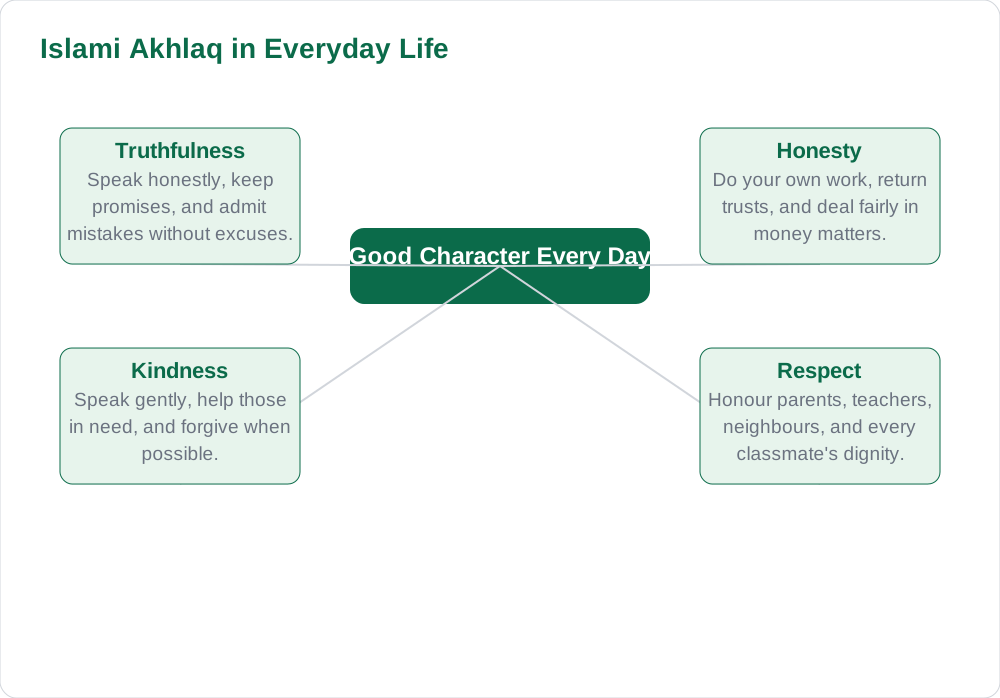
Truthfulness, or Sidq, means speaking the truth, keeping promises, and being sincere in intention, and it was the defining quality of the Prophet, who was called Al-Amin, the Trustworthy. A truthful student does not exaggerate marks, invent excuses for missing homework, or spread rumours about classmates, because each lie, however small, damages trust. Honesty also covers academic work: writing one's own answers, citing sources fairly, and admitting when help was received are all part of Sidq. Teachers trust honest students more, classmates rely on them, and over time honesty becomes a reputation that opens doors in education and work.
Honesty extends beyond speech into dealings with money and property, which students encounter in small ways every day. Returning a borrowed pen, paying the correct bus fare, or telling a shopkeeper about an error in change are all tests of honesty that adults notice and remember. Islam also forbids cheating in measures, breaking promises, and betraying trusts, because these acts harm society's confidence in one another. A society where people keep their word can trade, study, and cooperate smoothly, while a society where lying is normal wastes time on suspicion and checks. Truthfulness is therefore both a personal virtue and a public good.
Kindness and Respect in Practice
Kindness, or Rifq, means gentleness in speech and action, and respect means treating each person according to their dignity, regardless of age, wealth, or background. The Prophet, peace be upon him, was gentle with children, patient with the elderly, and kind even to those who treated him badly, and students can follow this example in simple ways: greeting others warmly, listening without interrupting, and helping a classmate who is struggling. Respect for teachers means listening attentively and speaking politely, respect for parents means obedience and gratitude, and respect for neighbours means avoiding noise, harm, and gossip that disturb their peace and privacy.
Respect also includes respect for differences, because a classroom contains students of different abilities, families, and temperaments. Mocking a slow learner, excluding a shy student, or laughing at someone's accent all violate Islami Akhlaq, even if done as a joke. A respectful student defends the excluded person, includes them in group work, and speaks up against bullying, kindly but firmly. Online manners are part of the same lesson: a comment that would be rude face to face is equally rude on a screen. Kindness and respect, practised daily, create a school environment where every student feels safe enough to learn and grow.
Akhlaq at Home, School, and Market
At home, Islami Akhlaq begins with kindness to parents, which the Quran places immediately after worship of Allah. A student shows this by speaking gently, helping with household work without being asked, and thanking parents for sacrifices that are easy to overlook. Respect for siblings means sharing fairly, avoiding quarrels over small things, and protecting younger children rather than bullying them. Families where Akhlaq is practised become peaceful, because members forgive quickly, apologise sincerely, and avoid harsh words even during disagreements about study, money, or daily routines that every household faces.
At school, Akhlaq means punctuality, cleanliness, care for shared property, and fairness in group work, while in the market it means honest trade, correct weights, and polite bargaining without deception. A student who runs a small stall or helps in a family shop practises market Akhlaq by charging fairly, describing goods truthfully, and returning change correctly. These settings show that Akhlaq is not confined to the mosque; it follows a Muslim into every transaction and relationship. Examination answers that give one example from home, one from school, and one from the market demonstrate this breadth and earn higher marks for practical understanding.
Small Habits, Big Character
Big character is built from small habits repeated daily, and students can start with a simple weekly plan: one habit to practise each week, such as greeting everyone politely, or thanking teachers daily, or avoiding gossip for seven days. Keeping a short diary of successes and slips helps a student notice patterns, such as anger after a poor mark, or impatience when tired, and plan better responses. Seeking forgiveness quickly after a mistake, rather than defending it, is itself a habit of strong character, because it shows humility and care for the other person's feelings. Over months, these small habits reshape reputation, friendships, and self-respect in ways that examinations alone never can.
Students should also choose friends who support good character, because company shapes habits more powerfully than lectures. A friend who encourages honesty, punctuality, and kindness makes Akhlaq easier, while a friend who normalises cheating or mockery makes it harder. For revision material and solved notes, visit Solved Notes and explore the collection on Books. Islami Akhlaq, practised at home, at school, and in society, turns knowledge into the very thing Islam values most: a person whose presence makes life better for everyone around them, day after day.
AI Help: Muse AI
Muse AI is Meta's personal AI assistant, and it can help you practise Islami Akhlaq by suggesting one small habit a week and explaining it with a daily example. You can ask it to role-play a polite reply to a difficult classmate, to summarise honesty in school life, or to make a short checklist for respectful manners. Muse AI does not give official STBB answers — always verify against your STBB book and your teacher. Always verify against your Sindh Textbook Board book and your teacher before using anything in classwork.
Join Muse with invite code LTGSWD — in the Muse app, go to Settings > Redeem token and enter the code. Disclosure: LTGSWD is the author's Muse invite code.
5 key points you must know
- Akhlaq is central to faith, not an extra quality beyond worship.
- Truthfulness means honest speech, kept promises, and sincere intention.
- Honesty covers academic work, money dealings, and returning trusts.
- Kindness and respect apply to parents, teachers, neighbours, and classmates.
- Small daily habits, practised weekly, build lasting character over time.
Frequently asked questions
What is Islami Akhlaq?
Islami Akhlaq means Islamic character and manners, the way a Muslim speaks, behaves, and treats others in daily life. It includes truthfulness, honesty, kindness, patience, respect, and justice, as taught by the Quran and demonstrated by the Prophet, peace be upon him. Akhlaq is central to faith, because a person's manners show whether their beliefs have shaped their behaviour in real situations.
Why is truthfulness so important in Islam?
Truthfulness is important because it builds trust, which is the foundation of families, schools, and markets. The Prophet, peace be upon him, was known as Al-Amin, the Trustworthy, before prophethood, showing that honesty was his defining quality. A truthful student is trusted by teachers and classmates, while even small lies damage reputation and make cooperation harder for everyone.
How can students practise Akhlaq at school?
Students practise Akhlaq at school by arriving on time, doing their own work honestly, listening to teachers politely, including shy or new classmates, and caring for shared property. They also practise it by refusing to cheat, gossip, or bully, and by apologising sincerely after mistakes. These daily choices, repeated over a school year, build a reputation for good character that teachers and peers recognise.
What does kindness to neighbours mean in practice?
Kindness to neighbours means avoiding harm, noise, and gossip, sharing food or help when needed, and checking on elderly or struggling neighbours. It includes greeting neighbours warmly, respecting their privacy, and helping in emergencies. The Prophet, peace be upon him, emphasised neighbours' rights so strongly that his companions thought neighbours might inherit from one another, which shows how seriously this duty is taken.
Can small habits really change character?
Yes, character is formed by small habits repeated over time, not by occasional grand gestures. Practising one habit a week, such as polite greetings or avoiding gossip, and keeping a short diary of progress, gradually reshapes behaviour. Choosing friends who support honesty and kindness also helps, because company influences habits powerfully. Over months, these small steps produce a noticeably different and better character.
Solved notes — preview free
These guides work best with the solved exercises. Preview the solved notes free on this website — 119 solved notes for Classes 6–10 in Sindhi, Urdu, English and Arabic medium. Or browse the full solved notes catalogue for your class and medium. New solved notes are added regularly — check the catalogue for coming-soon books.