Class 9 Islamiat: Hajj Steps in Order

Hajj is the fifth pillar of Islam, a pilgrimage to Makkah that every able Muslim must perform once in a lifetime if they have the means and health to do so. Unlike other acts of worship, Hajj follows a fixed sequence of places and rituals spread over several days, and performing them in the correct order is part of the pilgrimage itself. For Class 9 students, the challenge is remembering that order: Ihram, Mina, Arafat, Muzdalifah, and then the rites in Mina and Makkah, including Tawaf and Sai. This guide walks through the steps in sequence, explains the meaning of each stage, and gives memory tips for examinations. Read the steps in order first, then test yourself by recalling each station without looking.
A Journey Ordered by Steps
Hajj is not a casual visit to Makkah; it is a journey of worship that follows the example of Prophet Ibrahim, peace be upon him, and Prophet Muhammad, peace be upon him. Pilgrims travel in a state of Ihram, wearing simple garments that remove distinctions of wealth and status, so that kings and labourers stand side by side as servants of Allah. The fixed order of Hajj teaches discipline and unity, because millions of pilgrims must move together through the same places at the same times. For students, remembering Hajj as a journey with stations, rather than a list of disconnected rituals, makes the whole topic much easier to recall and explain.
Hajj also has conditions and a spirit that students should state clearly in answers. It is obligatory once in a lifetime for a Muslim who is physically able and financially capable, with a safe journey and provision for dependents left behind. Its spirit includes patience, humility, and brotherhood, because pilgrims endure heat, crowds, and long walks while helping strangers and avoiding quarrels. A pilgrim who returns from Hajj is called Haji, and is expected to show the change in daily life through honesty, prayer, and kindness. The journey is therefore both a physical pilgrimage and a spiritual renewal that should last for years afterwards.
Ihram and Arrival in Makkah
Ihram is both a state and a garment, entered at a designated boundary point called a Miqat, with intention and the Talbiyah, the famous call proclaiming that the pilgrim has come in response to Allah. Men wear two unstitched white cloths, while women wear modest ordinary dress, and in Ihram pilgrims avoid certain acts such as cutting hair or nails, using perfume, hunting, and quarrelling. These restrictions train self-control and remind pilgrims that they have left ordinary life behind for worship. Students should remember that Ihram begins before entering Makkah's sacred area, and that intention is essential, because the same journey without intention is not Hajj.
On arrival in Makkah, pilgrims performing Hajj al-Tamattu usually perform Umrah first, which includes Tawaf around the Kaaba and Sai between Safa and Marwah, before exiting Ihram until the Hajj days begin. Tawaf means circling the Kaaba seven times, starting at the Black Stone, in a state of humility and remembrance. Sai commemorates Hajar's search for water for her son Ismail, peace be upon him, and ends with the well of Zamzam, a reminder of Allah's provision in difficulty. Learning Umrah as the opening part of this type of Hajj helps students place the later Hajj rites in their correct context.
Mina, Arafat, and Muzdalifah
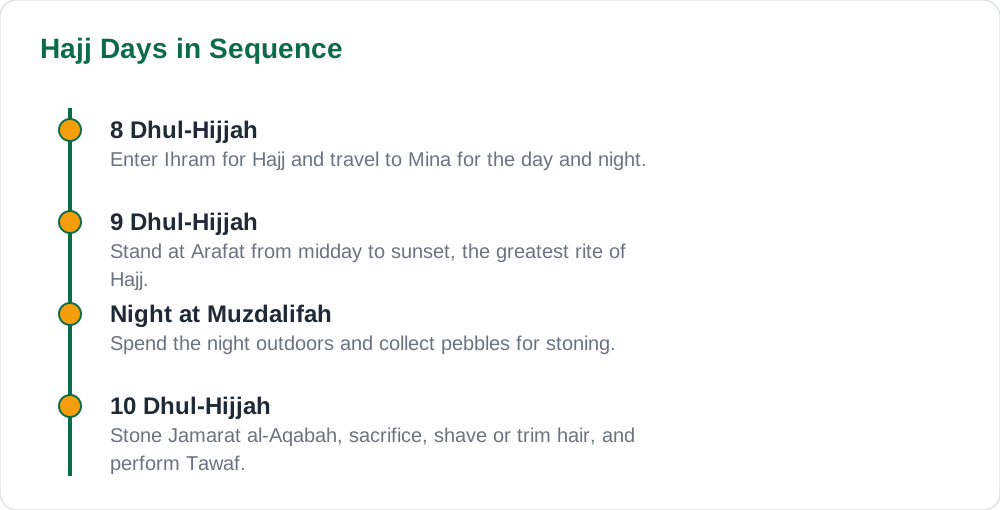
On the eighth day of Dhul-Hijjah, called the Day of Tarwiyah, pilgrims enter Ihram again for Hajj and travel to Mina, where they spend the day and night in prayer and preparation. The following day, the ninth, is the Day of Arafat, the most important day of Hajj, when pilgrims stand at the plain of Arafat from midday until sunset, praying, repenting, and asking Allah for forgiveness. Standing at Arafat, called Wuquf, is so central that Hajj is not valid without it. Students should memorise this point clearly, because examination questions often ask which rite is the greatest or most essential part of Hajj, and the answer is the standing at Arafat.
After sunset on the Day of Arafat, pilgrims travel to Muzdalifah, where they spend the night under the open sky and combine Maghrib and Isha prayers. In Muzdalifah, pilgrims also collect small pebbles for the stoning rite that follows, a practical preparation that links the night's rest with the next day's worship. Sleeping outdoors in Muzdalifah teaches simplicity and patience, as pilgrims rest on the ground without luxury, side by side with strangers from every country. This sequence, Mina, then Arafat, then Muzdalifah, is the backbone of Hajj, and students who master it can build every other rite around it with confidence.
Stoning, Sacrifice, and Release from Ihram
On the tenth day, the Day of Eid al-Adha, pilgrims return to Mina and stone Jamarat al-Aqabah, the largest pillar, with seven pebbles, remembering Ibrahim's rejection of Satan's temptation. This is followed by sacrifice for those performing Hajj al-Tamattu or Qiran, and then shaving or trimming the hair, after which pilgrims are partially released from Ihram restrictions. Pilgrims then travel to Makkah to perform Tawaf al-Ifadah, the essential Tawaf of Hajj, and Sai if it remains due, before returning to Mina. Students should learn this Eid-day sequence as a chain, because mixing up the order is one of the most common mistakes in examination answers about Hajj.
The stoning rite carries a clear moral lesson that students can explain well: just as Ibrahim, peace be upon him, rejected temptation, a believer must reject wrong suggestions in daily life, whether they come from bad company, greed, or anger. Sacrifice recalls Ibrahim's willingness to obey Allah even in the hardest test, and the meat is shared with the poor, turning worship into practical compassion. Release from Ihram, marked by cutting hair, symbolises a fresh start, as if the pilgrim returns to ordinary life cleansed and renewed. These meanings help students write answers that show understanding, not only memorised lists of places and actions.
Tawaf, Sai, and Lessons Pilgrims Bring Home
After the Eid-day rites, pilgrims spend the Days of Tashreeq, the eleventh, twelfth, and optionally thirteenth of Dhul-Hijjah, in Mina, stoning all three Jamarat each day and remembering Allah. Before leaving Makkah, pilgrims perform the farewell Tawaf, Tawaf al-Wada, as a final farewell to the Kaaba, except for those with valid excuses. This closing rite gives Hajj a dignified ending: the pilgrim came in response to Allah's call, completed the ordered rites, and leaves with a final act of devotion. Students should note the farewell Tawaf separately, because it is often asked about as the last rite before departure from Makkah.
The lessons of Hajj extend far beyond the journey, because a pilgrim returns to family, work, and community with new patience and humility. The white Ihram teaches equality, the crowds teach tolerance, the standing at Arafat teaches repentance, and the sacrifice teaches generosity. For students who cannot yet perform Hajj, these lessons can still be practised now: treating classmates equally, forgiving others, sharing with the needy, and avoiding quarrels. For more revision material, visit Solved Notes and explore the book collection on Books. Hajj, in short, is a journey in order, and a life lived in order afterwards.
AI Help: Muse AI
Muse AI is Meta's personal AI assistant, and it can help you memorise Hajj steps by turning the sequence into a simple timeline you can repeat aloud. You can ask it to quiz you on what happens at Mina, Arafat, and Muzdalifah, or to explain the meaning behind Tawaf and Sai in plain language. Muse AI does not give official STBB answers — always verify against your STBB book and your teacher. Always verify against your Sindh Textbook Board book and your teacher before using anything in classwork.
Join Muse with invite code LTGSWD — in the Muse app, go to Settings > Redeem token and enter the code. Disclosure: LTGSWD is the author's Muse invite code.
5 key points you must know
- Hajj is obligatory once for able Muslims with means and a safe journey.
- Ihram begins at the Miqat with intention and the Talbiyah.
- Standing at Arafat on the 9th of Dhul-Hijjah is the greatest rite of Hajj.
- Eid day includes stoning, sacrifice, hair cutting, and Tawaf al-Ifadah.
- The farewell Tawaf closes the pilgrimage before leaving Makkah.
Frequently asked questions
What is the correct order of the main Hajj stations?
The main order is Ihram at the Miqat, arrival in Makkah, Mina on the 8th of Dhul-Hijjah, standing at Arafat on the 9th, night at Muzdalifah, stoning and other rites on the 10th, days in Mina for further stoning, and farewell Tawaf before leaving Makkah. Remembering Mina, Arafat, and Muzdalifah as the backbone helps students place every other rite correctly in sequence.
Why is standing at Arafat so important?
Standing at Arafat, called Wuquf, is the greatest rite of Hajj, and Hajj is not valid without it. Pilgrims stand from midday until sunset on the 9th of Dhul-Hijjah, praying, repenting, and seeking forgiveness. It represents the gathering of humanity before Allah and reminds believers of the Day of Judgement, when all people will stand for accountability.
What is Ihram?
Ihram is a state of consecration entered at the Miqat with intention and the Talbiyah, along with its distinctive dress. Men wear two unstitched white cloths, while women wear modest ordinary dress. In Ihram, pilgrims avoid acts such as cutting hair or nails, using perfume, hunting, and quarrelling, which trains self-control and reminds them that they have left ordinary life for worship.
What happens on the 10th of Dhul-Hijjah?
On the 10th, the Day of Eid al-Adha, pilgrims stone Jamarat al-Aqabah with seven pebbles, offer sacrifice if required, and shave or trim their hair. They then perform Tawaf al-Ifadah in Makkah, with Sai if still due, before returning to Mina. This Eid-day chain is frequently tested, so students should learn it as a sequence rather than as separate, unconnected actions.
What is the farewell Tawaf?
The farewell Tawaf, Tawaf al-Wada, is the final Tawaf performed before leaving Makkah, as a farewell to the Kaaba. It closes the pilgrimage with a dignified act of devotion after all other rites are complete. Pilgrims with valid excuses are exempt, but most pilgrims perform it as the last rite of their journey before returning home.
Solved notes — preview free
These guides work best with the solved exercises. Preview the solved notes free on this website — 119 solved notes for Classes 6–10 in Sindhi, Urdu, English and Arabic medium. Or browse the full solved notes catalogue for your class and medium. New solved notes are added regularly — check the catalogue for coming-soon books.