Class 9 Islamiat: How Hadith Was Compiled and Preserved
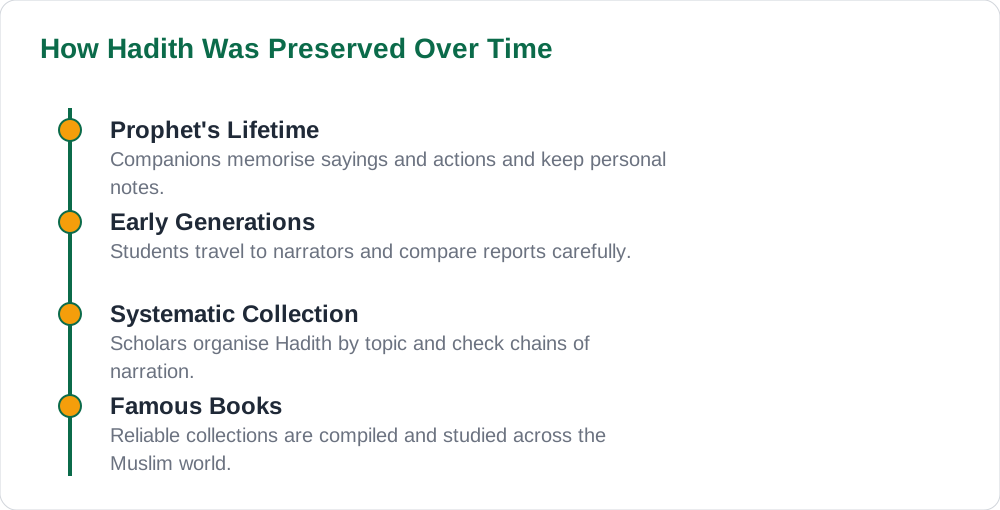
Hadith means the sayings, actions, and approvals of Prophet Muhammad, peace be upon him, and together with the Quran it forms the second source of Islamic guidance. While the Quran gives the direct words of Allah, Hadith shows how the Prophet lived those teachings, explained them, and applied them to daily situations. For Class 9 students, the story of Hadith is a story of careful preservation: from memorisation and early writing, through strict checking of narrators, to the famous books that scholars compiled. This guide explains that journey in simple words, without inventing textbook wording, so students can understand and explain it with confidence. Follow the journey in order, from memory and writing to the great books of Hadith.
What Hadith Is and Why It Matters
Hadith covers what the Prophet said, what he did, and what he approved when done in his presence, and each of these is a form of guidance for Muslims. If the Quran commands prayer, Hadith shows how prayer is performed; if the Quran commands honesty, Hadith shows honesty in trade, family life, and dealings with neighbours. This is why scholars call Hadith the practical explanation of the Quran. Students should understand that Hadith is not a rival to the Quran, but its companion: the Quran gives the command, and the Sunnah, preserved through Hadith, shows the method, manners, and spirit in which the command should be followed.
Hadith also matters because it preserves the Prophet's character for later generations who never met him. Through Hadith, students learn how he treated children, forgave opponents, kept promises, and helped the poor, and these examples shape Muslim manners today. Without Hadith, many details of worship and daily life would be unclear, and Muslims would lack a living model of Islamic character. That is why the Muslim community took such extraordinary care to preserve Hadith accurately, checking not only the words reported, but also the people who reported them, across every link in the chain.
Memorisation in the Early Community
In the early Arab community, memorisation was a highly developed skill, because poetry, genealogy, and important speeches were preserved by memory long before books were common. Companions of the Prophet memorised his sayings and actions with the same care they gave to the Quran, repeating them, teaching them to others, and checking one another's memories. Some companions became famous for their large collections of Hadith, and students learned from them by attending gatherings, listening carefully, and reciting back what they had heard. This oral tradition was not casual storytelling; it was a disciplined system in which accuracy was a matter of religious duty and personal honour.
Memorisation also worked alongside prayer and daily life, because Hadith were not only studied in classrooms but lived in homes, markets, and mosques. A companion who heard the Prophet explain a ruling would apply it the same day, and teach it to family members the same evening, so the Hadith stayed alive through practice. This living transmission helped preserve meaning as well as wording, because students saw how a teaching was applied, not only how it sounded. For examination answers, students can explain that memorisation was the first and most widespread method of Hadith preservation, supported later by writing and systematic collection.
From Writing to Systematic Collection
Writing of Hadith began during the Prophet's lifetime in limited forms, such as personal notes and letters, although the main focus at that time was preserving the Quran without confusion. After the Prophet's passing, as the Muslim community spread across new lands, scholars began collecting Hadith more systematically, travelling to meet narrators, writing down reports, and comparing versions from different teachers. This travelling for knowledge, called Rihlah, shows how seriously scholars took accuracy: a scholar might journey for weeks to hear a single Hadith directly from a reliable narrator, rather than accepting a second-hand version without checking its source and chain.
Systematic collection also meant organising Hadith by topic, such as prayer, fasting, trade, and manners, so that students and judges could find relevant guidance quickly. Early collections grew into larger works, and later scholars refined them by checking chains of narration, called Isnad, and the text itself, called Matn. A Hadith was accepted only if its narrators were trustworthy, its chain was continuous, and its text did not contradict the Quran or stronger reports. This method, developed over generations, is why Hadith science is respected as a rigorous discipline, not a collection of unchecked stories.
The Famous Books of Hadith
Among the most famous Hadith collections are Sahih al-Bukhari and Sahih Muslim, known together as the Sahihain, because their compilers applied extremely strict conditions for authenticity. Other well-known collections include Sunan Abu Dawud, Jami al-Tirmidhi, Sunan al-Nasai, and Sunan Ibn Majah, which together with the Sahihain are often called the six books. Students should learn these names and their general status, rather than memorising long lists of details. A good examination answer names two or three collections, explains that Bukhari and Muslim are regarded as the most authentic, and notes that scholars continue to study and grade individual Hadith within every collection.
It is also important to understand that not every report found in a book is automatically treated the same way; scholars classify Hadith as authentic, good, weak, or fabricated, based on the reliability of narrators and the strength of the chain. This grading protects Muslims from acting on false reports attributed to the Prophet. For students, the lesson is to quote Hadith carefully, to learn from teachers and reliable books, and to avoid sharing unverified sayings, especially on social media. A student who checks a Hadith before sharing it is practising the same care that the great compilers practised centuries ago.
Using Hadith Wisely Today
Today, Hadith is available in printed books, translations, and digital libraries, which makes learning easier but also makes checking more important. Students should learn Hadith from teachers, reliable translations, and well-known collections, and should ask about authenticity when a saying sounds unusual or contradicts established teachings. A practical habit is to learn one Hadith each week with its meaning and one action it suggests, such as truthfulness, kindness to neighbours, or care for parents. This slow, steady method builds both knowledge and character, and it is far better than collecting many sayings without understanding or practising any of them.
Hadith study also connects directly with school life, because the Prophet's teachings cover honesty in examinations, respect for teachers, kindness to classmates, and care for the environment. A student who practises these teachings is living the Sunnah, not only studying it. For revision material and solved notes, visit Solved Notes and explore the full collection on Books. The story of Hadith compilation, from memory to meticulous books, teaches a lasting lesson: truth deserves careful checking, patient learning, and honest practice in every generation.
AI Help: Muse AI
Muse AI is Meta's personal AI assistant, and it can help you revise Hadith compilation by summarising the stages from memorisation to the famous books in a clear timeline. You can ask it to explain Isnad in simple words, to quiz you on the six books, or to suggest one Hadith a week to learn with its meaning. Muse AI does not give official STBB answers — always verify against your STBB book and your teacher. Always verify against your Sindh Textbook Board book and your teacher before using anything in classwork.
Join Muse with invite code LTGSWD — in the Muse app, go to Settings > Redeem token and enter the code. Disclosure: LTGSWD is the author's Muse invite code.
5 key points you must know
- Hadith preserves the Prophet's sayings, actions, and approvals as practical guidance.
- Memorisation was the first widespread method, supported by early writing.
- Scholars travelled to narrators and checked chains, called Isnad, and texts, called Matn.
- Sahih al-Bukhari and Sahih Muslim are regarded as the most authentic collections.
- Hadith are graded by authenticity, so students should quote and share them carefully.
Frequently asked questions
What is Hadith?
Hadith means the sayings, actions, and approvals of Prophet Muhammad, peace be upon him, as reported by his companions and later narrators. It explains and demonstrates the Quran's teachings in practical life, such as how to pray, trade honestly, and treat others. Together, the Quran and the Sunnah preserved through Hadith guide Muslim belief and practice.
How was Hadith first preserved?
Hadith was first preserved mainly through memorisation, because the early Arab community had a strong oral tradition. Companions memorised the Prophet's sayings, repeated them, taught them to students, and checked one another's memories. Personal notes and letters also existed, and later scholars collected reports systematically, travelling to narrators and comparing versions for accuracy.
What are Isnad and Matn?
Isnad is the chain of narrators who passed a Hadith from one generation to the next, while Matn is the actual text or content of the Hadith. Scholars checked both: narrators had to be trustworthy and the chain continuous, and the text had to be consistent with the Quran and stronger reports. This double check is the basis of Hadith science and its grading system.
Which are the most famous Hadith books?
The most famous are Sahih al-Bukhari and Sahih Muslim, known as the Sahihain, regarded as the most authentic collections due to their strict conditions. Other well-known collections are Sunan Abu Dawud, Jami al-Tirmidhi, Sunan al-Nasai, and Sunan Ibn Majah. Together these six are often called the six books, and scholars continue to study and grade individual Hadith within them.
How should students use Hadith today?
Students should learn Hadith from teachers, reliable translations, and well-known collections, and should check authenticity before quoting or sharing a saying. Learning one Hadith a week with its meaning and a practical action, such as honesty or kindness, is an effective habit. This careful approach mirrors the compilers' own care and prevents the spread of weak or fabricated reports.
Solved notes — preview free
These guides work best with the solved exercises. Preview the solved notes free on this website — 119 solved notes for Classes 6–10 in Sindhi, Urdu, English and Arabic medium. Or browse the full solved notes catalogue for your class and medium. New solved notes are added regularly — check the catalogue for coming-soon books.