Class 9 Islamiat: Akhirah and Accountability
Akhirah means the life after death, and belief in it is one of the foundations of Islamic faith. A Muslim believes that this worldly life is temporary and is followed by resurrection, judgement, and an eternal life in which every person is rewarded or held accountable for their deeds. This belief changes how a person lives today, because actions are no longer seen as ending at death; they carry forward into a future that never ends. For Class 9 students, Akhirah is not meant to create fear alone; it is meant to create purpose, responsibility, and hope. This guide explains death, judgement, and good deeds in simple, clear language. It also shows why good deeds matter long after this life ends.
This Life Is a Trust and a Test
Islam teaches that worldly life is a test in which Allah has given human beings time, health, wealth, knowledge, and freedom to choose. These blessings are trusts, called amanah, and a person will be asked how they were used. A student, for example, is tested in how honestly they study, how kindly they treat others, and how patiently they face difficulty. Viewing life as a test does not make it joyless; it gives everyday choices meaning. Even small acts, such as helping a classmate or telling the truth when lying would be easier, become part of a record that matters beyond this world.
Understanding life as a test also helps students handle success and failure with balance. Success is not a reason for pride, because it is a blessing that must be used well, and failure is not a reason for despair, because patience in hardship is itself rewarded. This balance protects young people from two common mistakes: chasing marks or money as if they were the only goal, and giving up when results disappoint. A believer works hard, trusts Allah, and remembers that the final result is judged by effort, intention, and character, not only by worldly outcomes that others can see.
Death and the Life After Death
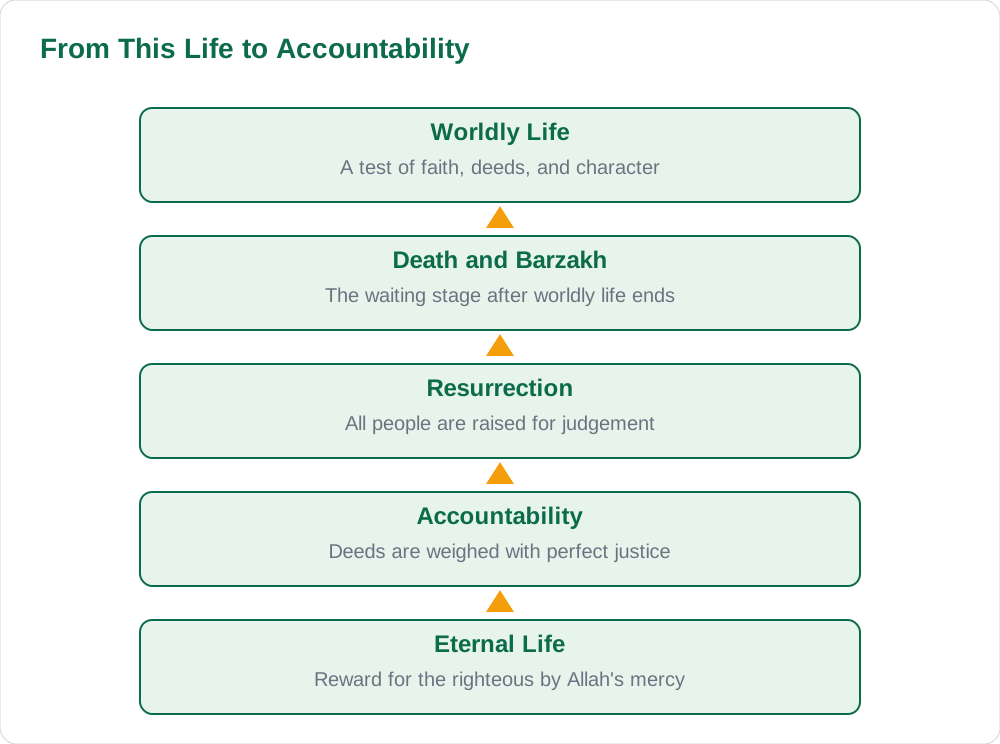
Every living being will taste death, and Islam teaches that death is not the end of existence but a door to the next stage of life. After death, a person enters the life of the grave, called Barzakh, which is a waiting period until the Day of Resurrection. Believers are taught to remember death regularly, not to become sad, but to stay focused on what truly matters. This remembrance encourages people to settle debts, seek forgiveness, repair relationships, and avoid delaying good deeds. A student who remembers death will waste less time and will treat each day as a valuable opportunity that cannot be recovered.
The Quran repeatedly reminds people that worldly life is short compared with the Hereafter, using images of a passing day, a fading plant, or a brief journey. These images are not meant to frighten students, but to put priorities in order. Examinations, careers, and possessions matter, yet they are means to a larger purpose, not the purpose itself. When a young person keeps this perspective, they can enjoy lawful pleasures without becoming attached to them, and they can face loss without losing hope. Death, in this view, is a reminder to live well now, while the chance to act is still open.
The Day of Judgement and Accountability
On the Day of Judgement, all people will be raised and held accountable for their beliefs and deeds, and even small actions will be brought forward. The Quran describes a balance of deeds, a record of actions, and a bridge that every person must cross, and these descriptions teach that nothing is forgotten or overlooked. Justice on that day will be perfect, because Allah knows intentions as well as actions, and no one will be wronged by even the smallest amount. For students, the lesson is clear: honesty in private matters as much as honesty in public, because the Judge of that day sees both equally and completely.
Accountability also brings hope, because sincere repentance, good deeds, and the mercy of Allah can outweigh mistakes. A person who made errors but turned back, sought forgiveness, and changed their behaviour is not treated the same as a person who persisted in wrongdoing without regret. This is why Islam encourages tawbah, returning to Allah, at any stage of life. Students should understand that accountability is not a reason to despair about past mistakes; it is a reason to correct them now, to apologise where possible, and to build a better record from today onwards with sincere intention.
Good Deeds That Keep Giving
Some good deeds continue to benefit a person even after death, and these are known as sadaqah jariyah, ongoing charity. Examples include teaching useful knowledge, building something that benefits people, planting a tree that gives shade and fruit, or raising righteous children who pray for their parents. Students can practise this idea on a small scale right now, such as helping a younger student understand a lesson, sharing helpful notes, or keeping a classroom clean for others. These acts may look small, but their benefit continues as long as others gain from them, and that is why they hold special value in Islamic teaching.
Beyond ongoing charity, everyday good deeds also build a strong record: five daily prayers, honesty, kindness to parents, respect for teachers, and care for neighbours all count. The Prophet, peace be upon him, taught that even a smile is charity, which shows that goodness is not limited to large donations or grand actions. For students, this is encouraging news, because they do not need wealth or status to earn reward. A sincere intention turns ordinary actions, such as studying diligently, helping at home, or comforting a sad friend, into deeds that carry weight on the Day of Judgement.
Preparing While There Is Still Time
Preparation for Akhirah does not require abandoning worldly life; it requires living worldly life with purpose and balance. A student prepares by praying regularly, studying honestly, obeying parents, and using free time wisely instead of wasting it on harmful company or useless habits. Setting a simple daily routine helps: prayers on time, a short period of Quran reading, homework completed honestly, and some time for family and rest. This kind of routine is realistic for school life, and it builds the habits that make accountability something to look forward to with hope rather than something to fear with regret.
Students can also prepare by reviewing their week honestly and asking three simple questions: what good did I do, what mistake should I correct, and whom should I thank or apologise to? This short self-review takes only a few minutes but builds self-awareness and character. For revision material and solved notes that support Islamiat study, students can visit Solved Notes and explore the full collection on Books. Remembering Akhirah, in the end, is about living today in a way that a person will be glad to meet tomorrow, with a clear conscience and a hopeful heart.
AI Help: Muse AI
Muse AI is Meta's personal AI assistant, and it can help you revise Akhirah by explaining accountability in simple words and giving everyday examples of good deeds. You can ask it to summarise the stages of the Hereafter, to suggest a simple daily routine for preparation, or to make revision questions about the topic. Muse AI does not give official STBB answers — always verify against your STBB book and your teacher. Always verify against your Sindh Textbook Board book and your teacher before using anything in classwork.
Join Muse with invite code LTGSWD — in the Muse app, go to Settings > Redeem token and enter the code. Disclosure: LTGSWD is the author's Muse invite code.
5 key points you must know
- Akhirah is belief in life after death, resurrection, and judgement.
- Worldly life is a test, and blessings are trusts to be used well.
- On the Day of Judgement, deeds and intentions are weighed with perfect justice.
- Sadaqah jariyah includes useful knowledge and benefits that continue after death.
- Sincere repentance and good deeds now are the best preparation for the Hereafter.
Frequently asked questions
What does Akhirah mean?
Akhirah means the Hereafter, the life after death that follows resurrection and judgement. Muslims believe that worldly life is temporary and that eternal life comes after it. Belief in Akhirah gives purpose to daily actions, because deeds in this life shape a person's future in the next life.
What happens after death according to Islamic belief?
After death, a person enters Barzakh, the life of the grave, which is a waiting period until the Day of Resurrection. On that day, all people are raised and held accountable for their beliefs and deeds. Justice will be perfect, as Allah knows both actions and intentions, and no one will be wronged in the slightest.
What is sadaqah jariyah?
Sadaqah jariyah is ongoing charity whose benefit continues after a person's death. Examples include teaching useful knowledge, building a well or school, planting a tree, or leaving behind righteous children who pray for their parents. Students can practise the same idea by teaching others, sharing helpful notes, or doing work that keeps helping people over time.
Does belief in judgement mean Muslims should live in fear?
No, belief in judgement is meant to create responsibility and hope, not constant fear. It reminds believers to act honestly and to correct mistakes through sincere repentance. Allah's mercy is vast, and a person who turns back, seeks forgiveness, and improves their conduct has strong reason for hope, while still taking accountability seriously.
How can a student prepare for Akhirah in school life?
A student prepares by praying on time, studying honestly, respecting parents and teachers, helping classmates, and using free time wisely. A simple daily routine of prayer, Quran reading, honest homework, and family time builds lasting habits. A short weekly self-review, asking what good was done and what should be corrected, also keeps character growing steadily.
Solved notes — preview free
These guides work best with the solved exercises. Preview the solved notes free on this website — 119 solved notes for Classes 6–10 in Sindhi, Urdu, English and Arabic medium. Or browse the full solved notes catalogue for your class and medium. New solved notes are added regularly — check the catalogue for coming-soon books.