Class 8 Urdu Zarb-ul-Misal: Proverbs With Meanings

A zarb-ul-misal (proverb) is a short saying that carries a whole lesson in a few words, and Urdu is rich with them. Proverbs make speech and writing lively, but they only work when you know what they really mean and when to use them. Many students memorise proverbs without understanding them, and then use the wrong proverb in an essay or answer. This guide explains ten common proverbs in plain language, tells the simple story or situation behind each one, and shows how to use proverbs correctly in your own writing. All the examples here are well-known, general proverbs explained in simple words, so you can learn them confidently and use them well.
What a Zarb-ul-Misal Is and Why It Matters
A zarb-ul-misal is a fixed saying passed down through generations, and its meaning is usually deeper than its literal words. When someone says that a drop by drop fills a river, they are not giving a lesson in geography; they are saying that small, steady efforts add up to a large result. Proverbs work because they pack a familiar picture and a lesson together, so the listener understands at once. In Urdu exams, proverbs appear in vocabulary questions, in sentence-making, and as a way to enrich a mazmoon, so knowing a good set of them is genuinely useful.
The key rule for proverbs is that their wording is fixed: you should not change the words or invent a new version, because the saying's power comes from its familiar form. What you can do is explain the meaning in your own words and choose the right situation for using it. A proverb used in the wrong situation confuses the reader, while the right proverb at the right moment makes your point stronger and your writing more mature. Learn proverbs with their meanings and one example situation each, and you will use them naturally instead of forcing them. For more Urdu guides, visit the blog and the book collection.
Five Proverbs About Effort, Patience, and Honesty
First, 'Qatra qatra darya banta hai' means drop by drop a river is formed, and it teaches that small, regular efforts build great results. The picture is simple: one drop is nothing, but drops falling steadily fill a river. Use it when praising steady study or saving little by little. Second, 'Mehnat mein azmat hai' means there is greatness in hard work, a reminder that effort itself is honourable even before its reward appears. Third, 'Sab r ka phal meetha hota hai' means the fruit of patience is sweet, teaching that waiting calmly for a good result is better than rushing and spoiling it.
Fourth, 'Sach karwa hota hai, magar faida mand hota hai' is a plain way of saying that truth may feel bitter but is beneficial, and it fits situations where telling the truth is difficult but right. Fifth, 'Jhoot ke paon nahi hote' means falsehood has no feet, meaning a lie cannot stand for long before it falls. The story behind it is everyday life: a lie needs more lies to support it, until it collapses under its own weight. These five proverbs all teach character, and they are safe, strong choices for essays about effort, patience, and honesty. The solved notes page has more Urdu study material.
Five Proverbs About Wisdom, Company, and Caution
Sixth, 'Aqalmand ko ishara kafi hai' means a hint is enough for a wise person, teaching that sensible people learn from a small warning without needing a long lecture. Seventh, 'Jaisi sangat, waisi rangat' means as the company, so the colour, warning that friends and company shape your habits and character. The picture is of dye: whatever you stay close to colours you. Use it when advising about choosing good friends. Eighth, 'Doobte ko tinke ka sahara' means a drowning person clutches at a straw, describing how someone in trouble grabs even the smallest hope, which fits stories of difficulty and desperation.
Ninth, 'Naach na jane aangan tedha' means one who cannot dance blames the courtyard, a humorous saying about blaming the situation instead of admitting one's own weakness. It fits situations where someone excuses failure by faulting tools, place, or timing. Tenth, 'Der aaye durust aaye' means better late than never, teaching that doing a good thing late is still better than never doing it. This is a kind, encouraging proverb for someone who has started late, whether in study or in correcting a mistake. Learn these ten with their stories, and you will have a proverb ready for most common essay themes. Find more guides on the [home page](/) and the blog.
How to Remember Proverbs: Meaning, Picture, Situation
Proverbs are easiest to remember when you learn three things together: the exact wording, the picture behind it, and one situation where it fits. For 'qatra qatra darya banta hai', the picture is drops filling a river, and the situation is a student studying a little every day. For 'jaisi sangat, waisi rangat', the picture is dye colouring cloth, and the situation is choosing friends. When you revise, cover the meaning and try to recall it from the wording alone, then cover the wording and try to recall it from the situation. Testing in both directions, as with vocabulary, makes the learning last.
Write each proverb in your notebook with its meaning in your own words and one sentence using it correctly, just as you would for a difficult vocabulary word. Do not learn twenty proverbs at once; learn five well, use them, and then add five more. A small set of proverbs you can use correctly is worth far more than a long list you can only recite without understanding. Over time, you will also start noticing proverbs in stories, speeches, and everyday conversation, and each one you notice will strengthen the ones you already know. See the book collection and the solved notes for more practice.
Using Proverbs in Essays and Answers
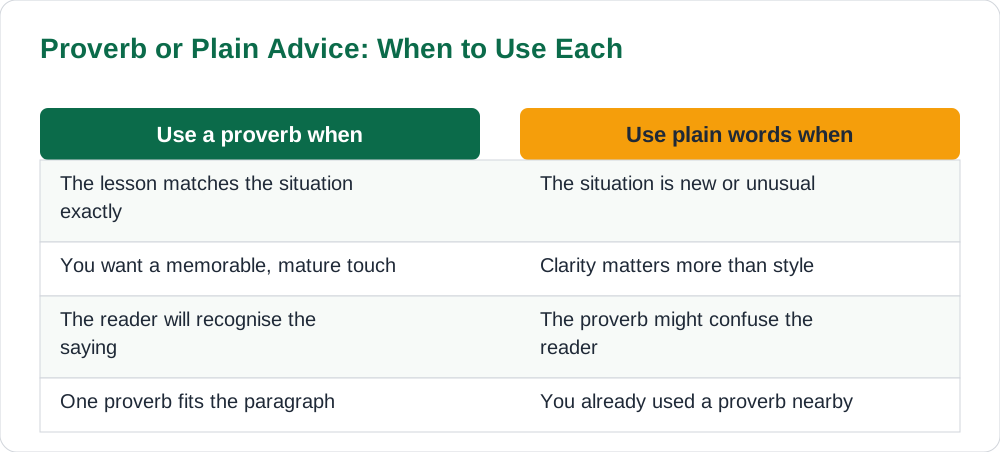
In a mazmoon, one well-chosen proverb can strengthen your point, but it should support your argument, not replace it. Place the proverb where its lesson naturally fits, such as at the end of a paragraph about hard work, and follow it with a sentence explaining how it applies to your topic. Do not open an essay with three proverbs in a row, and do not use a proverb whose meaning you cannot explain if asked, because an examiner may ask you to explain it. One or two proverbs in a whole essay, used correctly, is the right amount for Class 8 writing.
In short answers, use a proverb only when the question asks for it or when it genuinely clarifies your point. If a question asks for the meaning of a proverb, give the meaning first in plain words, then the situation it describes, and then a short sentence using it. If it asks you to complete a proverb or use it in a sentence, write the wording exactly as learned, since proverb wording is fixed. Used with care, proverbs show maturity and a feeling for the language, which is exactly what Urdu examiners hope to see. More writing guides are on the blog and the [home page](/).
AI Help: Muse AI
Muse AI is Meta's personal AI assistant. You can ask it to explain a concept in simple words, summarise a lesson, or make practice questions for revision.
For proverb study, you can ask Muse AI to explain a common Urdu proverb in simple words, or to make a short practice quiz that gives you a situation and asks which proverb fits it best.
Join Muse with invite code LTGSWD — in the Muse app, go to Settings > Redeem token and enter the code.
Disclosure: LTGSWD is the author's Muse invite code.
Muse AI does not give official STBB answers — always verify against your Sindh Textbook Board book and your teacher.
5 key points you must know
- A zarb-ul-misal packs a lesson into a short, fixed saying.
- Learn each proverb with its wording, picture, meaning, and situation.
- Five effort and honesty proverbs cover most essay themes.
- Five wisdom and caution proverbs help with friendship and advice topics.
- Use one or two proverbs per essay, correctly placed and explained.
Frequently asked questions
What does 'qatra qatra darya banta hai' mean?
It means drop by drop a river is formed. It teaches that small, steady efforts add up to a large result, such as studying a little every day or saving a small amount regularly.
What does 'jaisi sangat, waisi rangat' mean?
It means as the company, so the colour. It warns that the people you spend time with shape your habits and character, just as dye colours cloth, so choosing good friends matters.
Can I change the words of a proverb?
No, the wording of a proverb is fixed and should be learned exactly as it is said. You may explain its meaning in your own words, but changing the saying itself weakens it and may be marked wrong.
How many proverbs should I use in an essay?
One or two well-chosen proverbs in a whole essay is enough for Class 8 writing. They should support your argument at a natural place, not replace it, and you should be able to explain each one if asked.
How can I remember proverbs for exams?
Learn each proverb with its picture and one situation where it fits, write it with a sentence using it, and test yourself in both directions: wording to meaning, and situation to wording. Learn five well before adding more.
Solved notes — preview free
These guides work best with the solved exercises. Preview the solved notes free on this website — 119 solved notes for Classes 6–10 in Sindhi, Urdu, English and Arabic medium. Or browse the full solved notes catalogue for your class and medium. New solved notes are added regularly — check the catalogue for coming-soon books.