Class 8 Urdu Tashreeh: Explaining Ashaar Step by Step

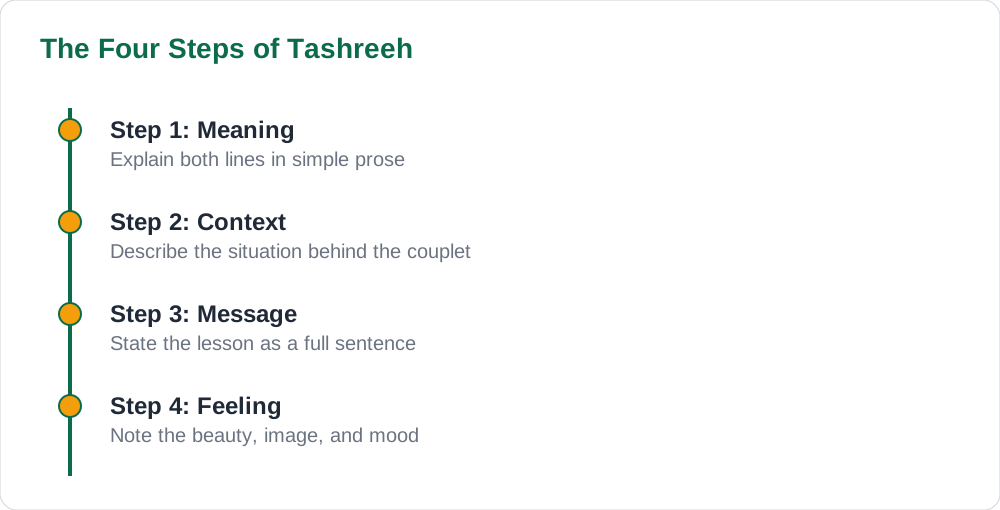
Tashreeh means explaining a couplet (sher) in detail: what it says, what it means, and why it matters. Many Class 8 students either write a one-line meaning and stop, or write a long paragraph that never actually explains the couplet. Both approaches lose marks. A complete tashreeh has four steps: the literal meaning of both lines, the context or situation behind the couplet, the message it gives, and the feeling or beauty it creates. This guide teaches that four-step method with a short practice couplet invented for this article, so you can apply it confidently to any sher in your course.
Step One: The Literal Meaning of Both Lines
Start tashreeh by explaining what each line says in simple prose, in your own words. Read the first line, say what it means plainly, then do the same for the second line, and then join them into one sentence that gives the couplet's overall sense. Do not simply repeat the poet's words in the same order; that is copying, not explaining. For example, if a couplet speaks of a lamp in darkness, your explanation should say in plain words that light is being used as a picture of hope or guidance. This step proves you understood the words before you judged their deeper meaning.
Watch out for difficult words in the couplet, and explain them briefly as part of the meaning, since a tashreeh that leaves hard words unexplained looks incomplete. If a word has a special poetic sense, such as a word for the heart standing for feelings, mention that sense in a few words. Keep this step short and clear, usually three to five sentences for a couplet, because the next steps will add the depth. A literal meaning that is accurate and in your own words is the foundation on which the whole tashreeh stands. For more Urdu guides, visit the blog and the book collection.
Step Two: The Context and the Poet's Situation
Context means the situation the couplet comes from or speaks about: what kind of moment, feeling, or human experience is behind it? A couplet about separation may come from a poem about distance from home, while a couplet about patience may come from advice given in hardship. You do not need to invent the poet's life story, and you should never claim facts about a poet or poem that you do not know. Instead, describe the situation in general terms that the couplet itself supports, such as a person facing difficulty, or someone remembering a loved one.
Context matters because the same words can mean different things in different situations. A line about a journey could be about travel, or about life itself, and the surrounding poem or the couplet's mood usually tells you which. If you know the poem the couplet comes from, mention its subject briefly; if you do not, say what situation the couplet seems to describe, based on its own words. This step shows the examiner that you read the couplet as part of a human experience, not as isolated words on a page. The solved notes page has more poetry help.
Step Three: The Message and the Lesson
The message is what the couplet teaches or urges, stated as a full sentence. Ask yourself: after reading this sher, what should the reader feel or do? A couplet about hard work may urge steady effort, while a couplet about truth may warn against dishonesty. State the message plainly and link it to the couplet's words, so the examiner can see how you reached it. A message that could fit any couplet, such as that life is important, is too vague; a good message belongs to this couplet, because it grows from its particular images and words.
Also note whether the message is direct advice, a warning, a comfort, or a reflection, since naming the type sharpens your answer. A couplet that comforts a sad reader works differently from one that warns a careless one, even if both use similar words. If the couplet has no direct lesson but simply paints a beautiful feeling, say so honestly and describe that feeling instead of forcing a moral onto it. Examiners respect an honest reading more than a forced lesson, and a message grounded in the couplet's own words is always stronger than one borrowed from a guidebook. Find more guides on the [home page](/) and the blog.
Step Four: Feeling, Image, and Beauty
The final step is to say what makes the couplet beautiful or moving: its image, its comparison, or its mood. If the poet compares hope to a lamp, say why that image works: a lamp gives light in darkness, just as hope gives courage in difficulty. If the couplet uses contrast, such as sorrow and joy side by side, point out how the contrast sharpens the feeling. You do not need heavy technical terms; naming the image and explaining its effect in simple words is enough for Class 8, and it shows appreciation of poetry rather than just understanding of words.
Keep this step brief, usually two or three sentences, and always tie the beauty back to the couplet's words. Avoid saying only that the couplet is very beautiful, which tells the examiner nothing; instead, say what is beautiful about it and why it moves the reader. For example, you might say the couplet's gentle rhythm and hopeful image leave the reader comforted rather than sad. This closing step turns a correct explanation into a complete tashreeh, and it is often what separates a good answer from an average one. See the book collection and the solved notes for more practice.
A Worked Practice Example, Step by Step
Here is a short practice couplet invented for this article: 'Mehnat ki roshni se ghar roshan hua, umeed ka diya kabhi bujhne na diya.' Step one, meaning: the couplet says that through the light of hard work, the home became bright, and the lamp of hope was never allowed to go out. In plain words, a family's life improved because someone kept working hard and kept hope alive. Step two, context: the situation is a person or family facing difficulty, who continues to work and hope instead of giving up.
Step three, message: the couplet urges steady hard work joined with hope, teaching that effort and hope together change difficult circumstances. Step four, feeling: the image of light against darkness makes the message hopeful and warm, because light is something everyone understands as safety and guidance. Put together, the four steps give a complete tashreeh in about a paragraph and a half, without copying the couplet or adding invented facts. Practise this method on any couplet, and tashreeh questions will stop feeling frightening. More poetry guides are on the blog and the [home page](/).
AI Help: Muse AI
Muse AI is Meta's personal AI assistant. You can ask it to explain a concept in simple words, summarise a lesson, or make practice questions for revision.
For tashreeh practice, you can ask Muse AI to explain a difficult word from a practice couplet in simple words, or to help you check whether your four-step explanation covers meaning, context, message, and feeling.
Join Muse with invite code LTGSWD — in the Muse app, go to Settings > Redeem token and enter the code.
Disclosure: LTGSWD is the author's Muse invite code.
Muse AI does not give official STBB answers — always verify against your Sindh Textbook Board book and your teacher.
5 key points you must know
- Explain both lines in simple prose, in your own words.
- Describe the situation or context the couplet comes from.
- State the message as a full sentence linked to the couplet's words.
- Note the image, comparison, and mood that make it beautiful.
- Never invent facts about the poet or poem that you do not know.
Frequently asked questions
What is tashreeh?
Tashreeh is a detailed explanation of a couplet: its literal meaning, its context, its message, and its feeling or beauty. A complete tashreeh covers all four steps, not just a one-line meaning.
How long should a tashreeh answer be?
Usually about a paragraph and a half for one couplet: a few sentences for meaning, a sentence or two for context, a sentence for the message, and two or three sentences on feeling and image. Quality and completeness matter more than length.
Should I quote the couplet in my tashreeh?
Yes, briefly quoting the couplet or its key words at the start is good practice, but the rest must be your own explanation in prose. Copying the couplet and calling it an explanation earns no marks.
What if I do not know the poem the couplet comes from?
Do not invent facts about it. Describe the situation the couplet itself suggests, based on its own words and mood, and explain the meaning and message from the couplet alone.
What is the most common tashreeh mistake?
Writing only a one-line meaning, or writing a long paragraph that never explains the couplet's words. Use the four steps in order, and check that every claim is backed by a word or image from the couplet.
Solved notes — preview free
These guides work best with the solved exercises. Preview the solved notes free on this website — 119 solved notes for Classes 6–10 in Sindhi, Urdu, English and Arabic medium. Or browse the full solved notes catalogue for your class and medium. New solved notes are added regularly — check the catalogue for coming-soon books.