Class 8 Urdu Sabaq: Khulasa Likhnay Ka Tareeqa
A khulasa (summary) is a short version of a lesson that keeps all the important ideas and leaves out everything extra. Many Class 8 students write summaries that are either too long, because they copy half the lesson, or too short, because they miss the main idea. A good khulasa is usually about one third of the original length, it follows the lesson's own order, and it uses your own words. This guide teaches a reliable method: read the lesson fully, pick out the main ideas, arrange them in sequence, and then write them as a smooth short paragraph or a few short paragraphs. Once you learn it, the same method works for every sabaq in your Urdu course.
Read the Whole Sabaq Before You Summarise
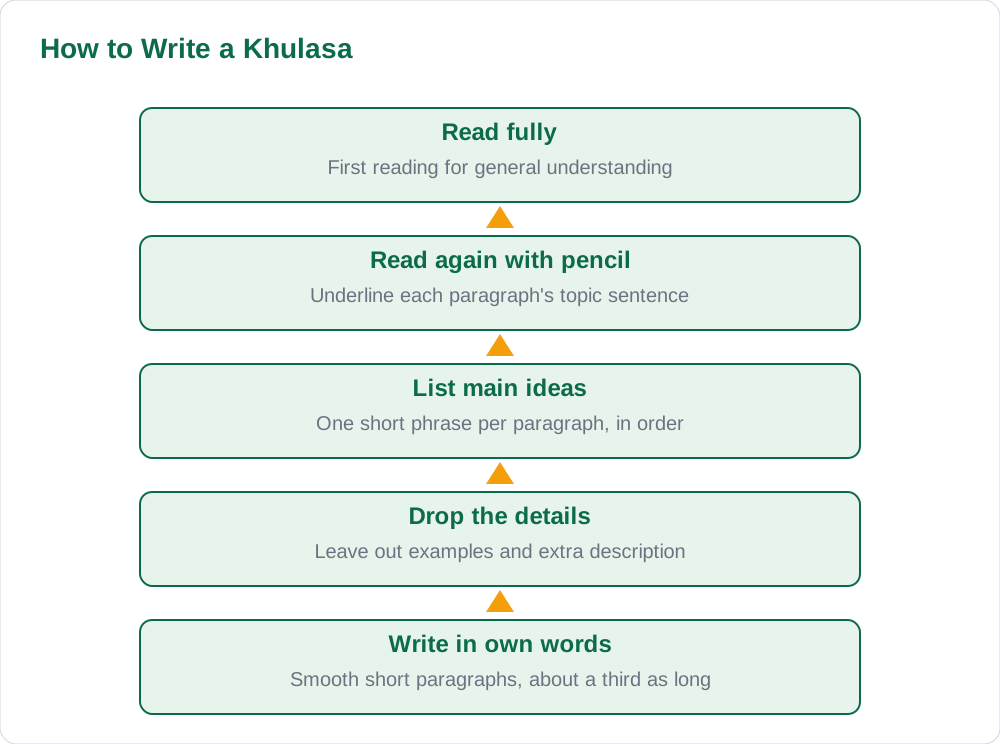
Never start a khulasa after reading only the first paragraph, because the main idea of a lesson often becomes clear only at the end. Read the whole sabaq once for general understanding, without writing anything, and ask yourself what the lesson is mainly about. Then read it a second time with a pencil, underlining the topic sentence of each paragraph, which is usually the sentence that states what that paragraph is about. These topic sentences are the bones of your summary, and everything else in the paragraph is usually an example, a detail, or an explanation that supports them.
As you read the second time, also mark any repeated idea, because repetition is a strong signal of importance. If the lesson returns to the same point in different words, that point almost certainly belongs in your khulasa. On the other hand, a single colourful example, a name mentioned once, or a long description is usually supporting detail that can be left out or mentioned in a few words. This two-reading habit takes a little extra time at first, but it saves you from summaries that miss the point or drown in detail. For more Urdu guides, see the blog and the book collection.
Pick the Main Ideas, Leave Out the Details
After your second reading, write a list of the main ideas, one short phrase per paragraph, in the order they appear. Aim for five to eight main ideas for a typical lesson, and check that together they cover the beginning, middle, and end of the sabaq. If your list covers only the first half of the lesson, you have missed the conclusion, and if it has fifteen items, you are probably listing details instead of main ideas. A helpful test for each item is to ask whether the summary would still make sense without it; if it would, the item is probably a detail and can go.
Examples, stories within the lesson, and long descriptions are the details most often mistaken for main ideas. You may mention an example very briefly if it is needed to explain a main idea, but do not retell it fully. Numbers, dates, and names should appear in a khulasa only when they are central to the lesson's point; otherwise, leave them out. Remember the goal: a reader who has never read the lesson should understand its main message from your summary alone, without needing the original. That reader test is the best check of a good khulasa. The solved notes page has further Urdu revision help.
Keep the Lesson's Sequence in Your Summary
A khulasa must follow the same order as the original lesson, because changing the order can change the meaning. If the lesson first describes a problem, then gives causes, and finally suggests a solution, your summary should do the same: problem, causes, solution. Jumping to the solution first and then explaining the problem makes the summary confusing, even if every sentence is correct on its own. Sequence words such as first, then, therefore, and finally help the reader follow your summary, but they only work if the ideas themselves are in the right order.
To check your sequence, compare your main-idea list with the lesson's paragraph order side by side. If you moved an idea, ask whether the move was necessary; usually it was not, and you should restore the original order. One exception is a lesson that repeats its introduction at the end as a conclusion; in that case, state the main idea once, at the start, and do not repeat it as a separate point at the end. Keeping the sequence faithful is also a mark of honesty in summary writing, since it shows you are representing the lesson, not rewriting it to suit yourself. Find more study guides on the [home page](/) and the blog.
Write in Your Own Words, Smoothly and Briefly
A khulasa must be written in your own words, not copied sentence by sentence from the lesson, because copying shows no understanding and is often penalised. Read your main-idea list, cover the lesson, and then write the summary from the list alone. This forces you to express the ideas yourself, and it naturally shortens the text, since you will not reproduce the lesson's long sentences. Use simple, clear language and short sentences, and join the ideas with connecting words so the summary reads as one piece of writing rather than a list of disconnected points.
Check the length when you finish: a good khulasa is roughly one third of the original, though the exact length depends on the lesson and your teacher's instruction. If your summary is nearly as long as the lesson, you have kept too many details; if it is only two lines, you have probably missed main ideas. Read it aloud once: it should sound smooth, complete, and faithful to the lesson. If a sentence sounds copied or unclear, rewrite it in simpler words. This final read-aloud check catches most problems before the examiner ever sees them. See the book collection and the solved notes for more practice.
Common Khulasa Mistakes and How to Avoid Them
The most common khulasa mistake is adding your own opinion, such as saying the lesson is good or that you agree with it. A summary reports what the lesson says; it does not judge it, unless the question specifically asks for your view. Another common mistake is starting with unimportant detail, such as a story's opening scene, while the lesson's main argument appears only at the end. Always check that your first sentence states or leads directly to the main idea, so the examiner knows at once that you understood the lesson.
A third mistake is using the lesson's difficult words without understanding them, which produces sentences that sound impressive but mean nothing. If a word is unclear, find its meaning before writing, and use a simpler word in your summary where you can. Finally, do not write a khulasa as a list of bullet points unless your teacher asks for that format; a summary is normally written as connected paragraphs. Avoid these four mistakes, and your khulasa will already stand out from most answers. More exam writing guides are on the blog and the [home page](/).
AI Help: Muse AI
Muse AI is Meta's personal AI assistant. You can ask it to explain a concept in simple words, summarise a lesson, or make practice questions for revision.
For khulasa practice, you can ask Muse AI to explain a difficult sentence from a lesson in simple words, or to check whether a short paragraph you wrote covers the main ideas in the right order.
Join Muse with invite code LTGSWD — in the Muse app, go to Settings > Redeem token and enter the code.
Disclosure: LTGSWD is the author's Muse invite code.
Muse AI does not give official STBB answers — always verify against your Sindh Textbook Board book and your teacher.
5 key points you must know
- Read the whole sabaq twice before writing any summary.
- Underline each paragraph's topic sentence to find the main ideas.
- Keep five to eight main ideas, covering beginning, middle, and end.
- Follow the lesson's own sequence in your summary.
- Write in your own words, about one third of the original length.
Frequently asked questions
What is a khulasa?
A khulasa is a short version of a lesson that keeps all its main ideas and leaves out extra details and examples. It follows the lesson's order, uses your own words, and is usually about one third of the original length.
How long should a khulasa be?
Roughly one third of the original lesson, unless your teacher gives a different length. If it is nearly as long as the lesson, you kept too many details; if it is only two lines, you probably missed main ideas.
Can I copy sentences from the lesson in a khulasa?
No, a khulasa should be in your own words. Copying sentences shows no understanding and is often penalised. Write from your main-idea list with the lesson covered, so the wording becomes naturally your own.
Should I add my own opinion to a khulasa?
No, unless the question asks for it. A summary reports what the lesson says; it does not judge it. Adding opinions confuses the summary and can cost marks.
What should I do if I cannot find a paragraph's main idea?
Re-read the paragraph and ask what it is mainly about, ignoring examples. The topic sentence, often near the start, usually states it. If you still struggle, summarise the paragraph in one sentence of your own and check it against the lesson's overall subject.
Solved notes — preview free
These guides work best with the solved exercises. Preview the solved notes free on this website — 119 solved notes for Classes 6–10 in Sindhi, Urdu, English and Arabic medium. Or browse the full solved notes catalogue for your class and medium. New solved notes are added regularly — check the catalogue for coming-soon books.