Class 8 Urdu Nazam: Tafheem Ka Aasan Tareeqa

A nazam can look difficult at first glance because poetry says a lot in very few words, but tafheem (comprehension) becomes easy once you read it in small pieces instead of all at once. Many Class 8 students read a whole nazam quickly, feel confused, and then guess at the meaning. A better method is to slow down, take one stanza (band) at a time, and ask what each stanza is actually saying before moving on. This guide teaches that step-by-step method: reading for literal meaning, noticing images and feelings, and then joining the stanzas together to find the poet's message. It works for any nazam in your Urdu course, and it also helps you write clear, well-organised tafheem answers that earn full marks.
Start With One Stanza, Not the Whole Nazam
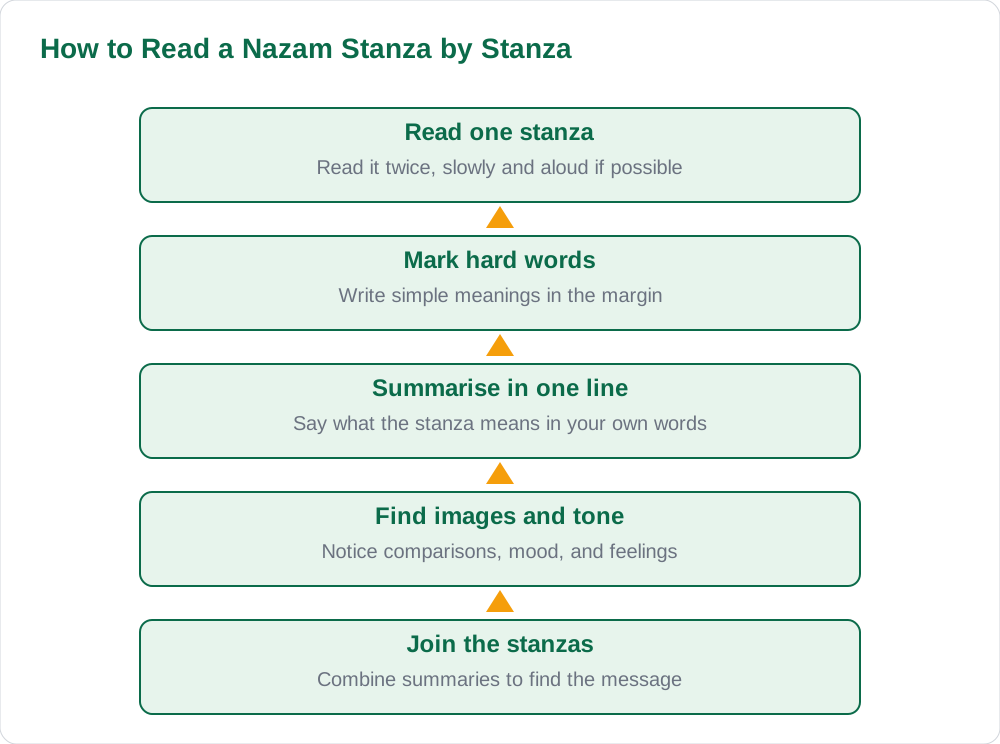
A nazam is built from stanzas, and each stanza usually carries one complete thought or picture. When you read the whole poem in one rush, those thoughts blur together and the meaning slips away. Instead, read the first stanza twice: once slowly for the sound and flow of the words, and once with a pencil in hand to mark any word you do not know. Write the meaning of difficult words in the margin in your own simple words, because a stanza cannot make sense while its key words stay unclear. This slow first pass takes only a few minutes, but it changes the whole reading experience.
After the first stanza feels clear, write one short sentence in your notebook saying what it means, in your own words. Do not copy the poet's lines and call that an answer; a summary sentence forces you to check whether you really understood. Then move to the next stanza and repeat the process. By the end, you will have a chain of short sentences, one per stanza, and the poem's overall story will already be visible. This is the foundation of tafheem, and it works far better than memorising someone else's explanation. For more study guides, visit the blog and the book collection.
Find the Literal Meaning Before the Deep Meaning
Every stanza has a literal meaning, which is simply what the words say on the surface, and a deeper meaning, which is what the poet wants you to feel or learn. Students often jump straight to the deeper meaning and write vague answers about feelings, while missing what is actually happening in the poem. Ask first: who is speaking, what scene is described, and what is happening? If the stanza describes morning light, birds, and a farmer going to the fields, say so plainly. Only after the surface picture is clear should you ask what it might stand for, such as hope, hard work, or a new beginning.
A useful habit is to underline the action words and the describing words in each stanza, because they carry the picture. Words about light, darkness, journey, rain, or seasons are often used as images (tashbeeh and istiara) for bigger ideas, but you should only name an image when you can point to the exact words that create it. In your answer, give the literal meaning first and the message second, in that order. Examiners reward answers that show both levels, and this order keeps your tafheem grounded in the poem instead of floating into general comments that could fit any nazam. You can also explore the solved notes for more Urdu study help.
Notice Images, Feelings, and the Poet's Tone
Poets paint with words, so a nazam often works through images rather than direct statements. When a poet compares hope to a lamp in the dark, the lamp is not just a lamp; it is a picture of guidance and courage. Look for comparisons, repeated words, and contrasts such as light and darkness, or sorrow and joy, because these are clues to the poem's mood. Also notice the tone: is the poet hopeful, sad, proud, or urging the reader to act? The tone often tells you the message faster than any single line, since a poem urging hard work sounds very different from one mourning a loss.
Do not force an image onto every line, and do not invent symbolism that the words do not support. A good rule is that every claim in your answer should be backed by a word or phrase from the stanza, quoted briefly in Roman Urdu or paraphrased accurately. If you say the stanza shows love for the homeland (watan), point to the words about soil, rivers, or sacrifice that made you think so. This evidence-based habit makes your tafheem answer convincing, and it also protects you from writing the same generic paragraph for every poem. Practise on one stanza a day, and your eye for images will grow steadily. Find more reading guides on the [home page](/) and the blog.
Join the Stanzas to Find the Central Message
Once every stanza has its own one-line summary, lay those summaries side by side and look for the thread that runs through them. A nazam may begin with a scene, move to a problem, and end with a hope or a lesson; the message is usually the idea that appears in more than one stanza or that the final stanza stresses most. Ask yourself: what does the poet want the reader to feel or do after reading this? The answer is rarely a single word like honesty; it is usually a fuller thought, such as that honest effort, even when unseen, eventually bears fruit. Writing the message as a complete sentence makes it testable against the stanzas.
Check your message against each stanza summary, and if one stanza clearly contradicts it, revise the message rather than ignoring that stanza. A message that fits only the first stanza is probably too narrow, while a message so broad that it fits every poem you know is probably too vague. The best central ideas sit in the middle: specific enough to belong to this poem, but broad enough to cover all its stanzas. In an exam answer, state the message early, then show how the stanzas build towards it, so the examiner sees your thinking instead of having to hunt for it. The solved notes page has more Urdu revision material.
Writing a Strong Tafheem Answer in Exams
A strong tafheem answer has a simple shape: a short introduction naming the poem's subject, a stanza-by-stanza explanation in your own words, and a closing line stating the message. Begin with one or two sentences about what the nazam is about overall, then take the stanzas in order, giving the meaning of each in a few clear sentences. Keep the order of the poem, because jumping between stanzas confuses the reader and hides gaps in understanding. Use simple, correct language rather than fancy words you are unsure about, and mention difficult words with their meanings where they matter to the sense.
Finish with the central message and, if asked, a short personal response such as which stanza you found most effective and why, backed by a reason from the poem. Before submitting, read your answer once and check three things: does every stanza get covered, does the message match the stanzas, and is anything copied blindly from a guidebook without understanding? Time management matters too, so practise writing a full tafheem answer in about fifteen minutes at home. With the stanza-by-stanza method, even an unseen nazam becomes a set of small, solvable steps rather than one frightening whole. Browse the book collection and the blog for further practice guides.
AI Help: Muse AI
Muse AI is Meta's personal AI assistant. You can ask it to explain a concept in simple words, summarise a lesson, or make practice questions for revision.
For nazam tafheem, you can ask Muse AI to explain a difficult word from a stanza in simple words, or to turn your one-line stanza summaries into a short practice quiz that checks whether you caught the poem's message.
Join Muse with invite code LTGSWD — in the Muse app, go to Settings > Redeem token and enter the code.
Disclosure: LTGSWD is the author's Muse invite code.
Muse AI does not give official STBB answers — always verify against your Sindh Textbook Board book and your teacher.
5 key points you must know
- Read a nazam one stanza at a time instead of rushing through the whole poem.
- Write the meanings of difficult words in the margin before judging the stanza.
- Summarise each stanza in one sentence in your own words.
- Give the literal meaning first, then the deeper message, with evidence from the words.
- State the central message as a full sentence and check it against every stanza.
Frequently asked questions
What is tafheem of a nazam?
Tafheem means understanding and explaining a poem: what each stanza says, what images and feelings it uses, and what message the poet is giving. A good tafheem answer explains the poem in your own words, stanza by stanza, rather than copying lines.
How should I start reading a difficult nazam?
Start with the first stanza only. Read it twice, mark the words you do not know, write their simple meanings in the margin, and then write one sentence saying what the stanza means. Repeat this for each stanza before trying to judge the whole poem.
What is the difference between literal meaning and message?
The literal meaning is what the words say on the surface, such as a morning scene or a journey. The message is the deeper lesson or feeling the poet wants you to take away, such as hope or hard work, which you find by joining the stanzas together.
How long should a tafheem answer be in an exam?
Cover every stanza in order, give the meaning of each in a few clear sentences, and close with the central message. Aim for a complete, organised answer rather than a very long one, and practise finishing one in about fifteen minutes at home.
What if I cannot understand one stanza?
Do not skip it silently. Break it into smaller parts, look up the hard words, and read the stanzas around it for clues. If one line stays unclear, explain the rest honestly and note the general sense, rather than inventing a meaning that does not fit the poem.
Solved notes — preview free
These guides work best with the solved exercises. Preview the solved notes free on this website — 119 solved notes for Classes 6–10 in Sindhi, Urdu, English and Arabic medium. Or browse the full solved notes catalogue for your class and medium. New solved notes are added regularly — check the catalogue for coming-soon books.