Class 8 Urdu Mukalma Nigari: Dialogue Writing Practice
Mukalma nigari (dialogue writing) is writing a conversation between two or more people, and it tests something different from an essay: can you make people sound real, polite, and purposeful in speech? Many Class 8 students write dialogues that read like essays chopped into lines, with both speakers sounding exactly the same. A good dialogue has a clear purpose, natural short exchanges, and speakers who sound like themselves, whether a respectful student, a kind teacher, or a busy shopkeeper. This guide explains the correct format, shows two practice dialogues invented for this article, and gives you a method for writing your own dialogue on any topic.
The Correct Format of a Mukalma
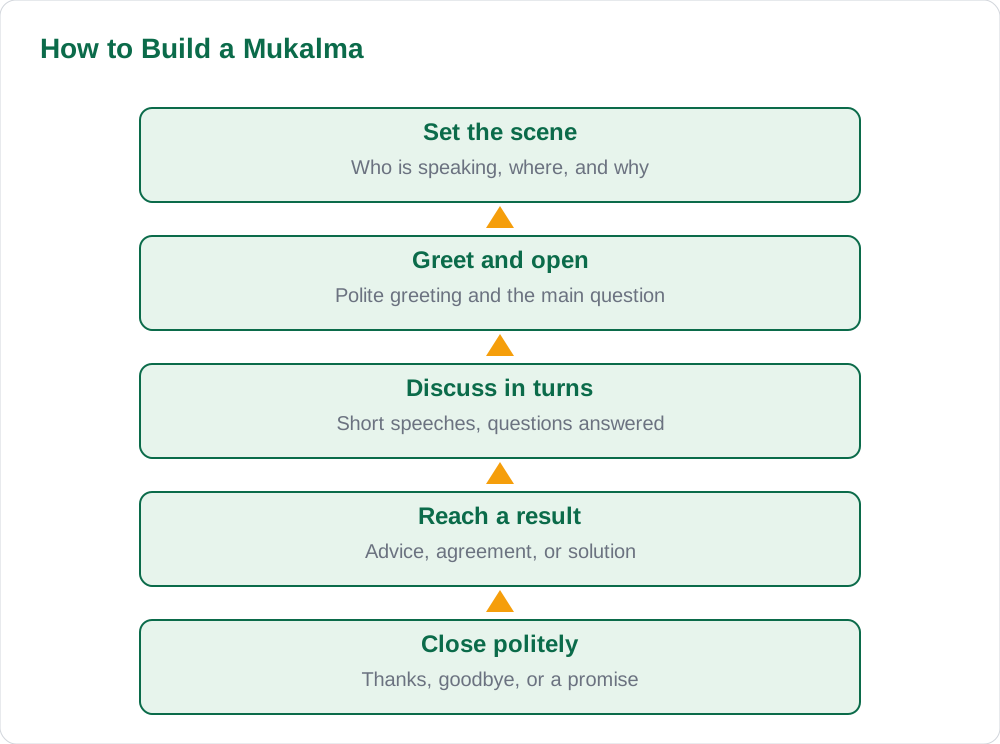
A mukalma begins with a short introduction, usually one or two lines, saying who is speaking and where or why they are talking. For example, a line saying that a student meets his teacher after class to ask about homework sets the scene at once. After the introduction, each speaker's words start on a new line, with the speaker's name followed by a colon, so the reader always knows who is talking. Keep each speech short, usually one to three sentences, because real people rarely speak in long paragraphs, and short exchanges keep the dialogue lively and easy to follow.
End the dialogue with a natural closing, such as thanks, a goodbye, or an agreement about what happens next, rather than stopping suddenly in the middle of a point. Also keep the language suitable for the speakers and the situation: a student speaks respectfully to a teacher, using words like janab where appropriate, while friends speak more casually. Do not use rude or slang words, even for a shopkeeper or a stranger, since examiners mark politeness and good manners in dialogue writing. A clean format with names, short speeches, and a proper closing already earns a good share of the marks. For more Urdu guides, visit the blog and the book collection.
Give the Dialogue a Purpose and a Clear Flow
Every good dialogue has a purpose: asking for help, buying something, solving a problem, or sharing news. Before writing, decide the purpose in one sentence, such as a student asking a teacher how to improve in Urdu, and let every exchange move towards that purpose. A dialogue that wanders from homework to cricket to the weather may sound chatty, but it wastes words and loses marks. Plan three or four stages: greeting and opening, the main question or problem, the answer or discussion, and the closing. This plan keeps the dialogue focused even when you write it quickly in an exam.
Within that flow, let the speakers take turns naturally, with questions answered and answers leading to new questions. If one speaker asks a question, the other should answer it before a new topic begins, because unanswered questions make a dialogue feel broken. Also give each speaker a slightly different voice: the teacher explains and encourages, the student asks and listens, the shopkeeper informs and bargains politely. When the speakers sound different, the dialogue feels real, and the examiner can tell you thought about character, not just about filling lines. The solved notes page has more Urdu writing help.
Practice Dialogue One: Student and Teacher
The following short dialogue is invented for this article as a practice example. Introduction: After class, a student named Ali meets his Urdu teacher to ask how he can improve his writing. Ali: Assalam-o-Alaikum, ustad ji. Mujhe Urdu mazmoon likhne mein mushkil hoti hai, kya aap kuch rehnumai kar sakte hain? Teacher: Wa Alaikum Assalam, Ali. Zaroor. Pehle batao, tumhe kis cheez mein zyada mushkil hoti hai, khayal jama karne mein ya alfaz chunne mein? Ali: Ustad ji, khayal to aata hai, magar jab likhne baithta hoon to alfaz nahi milte. Teacher: To roz thora parho aur naye alfaz apni copy mein likho. Jab likhne baitho, pehle khaka banao, phir aasan alfaz mein likho.
Notice how the dialogue works: it opens with a greeting, the student states his problem clearly, the teacher asks a guiding question instead of lecturing at once, and the advice is practical and short. Ali: Shukriya, ustad ji. Main aaj se roz das naye alfaz likhoon ga aur hafte mein aik mazmoon likh kar aap ko dikhaoon ga. Teacher: Bohat acha, Ali. Mehnat jari rakho, natija zaroor mile ga. Allah Hafiz. Ali: Allah Hafiz, ustad ji. This closing shows gratitude and a promise, which gives the dialogue a satisfying end. When you write your own, aim for this balance: respectful tone, short speeches, and a clear purpose carried from greeting to goodbye. Find more writing guides on the [home page](/) and the blog.
Practice Dialogue Two: Customer and Shopkeeper
A shopkeeper dialogue tests a different skill: polite bargaining and clear requests. Introduction: A customer enters a bookshop to buy notebooks and pens for school. Customer: Assalam-o-Alaikum, bhai. Mujhe chaar copyan aur do pen chahiye. Shopkeeper: Wa Alaikum Assalam. Zaroor, kis class ki copyan chahiye, aur pen kis company ka pasand karenge? Customer: Class 8 ki copyan de dein, aur pen woh dein jo likhne mein aaram de. Shopkeeper: Yeh copyan mazboot kagaz ki hain, aur yeh pen likhne mein bohat aasan hai. Customer: Theek hai, qeemat kya hogi? Shopkeeper: Copyan aur pen mila kar paanch sau rupay honge.
Notice the natural flow: request, clarifying question, information, price question, and answer, each in a short speech. A good continuation would bargain politely or agree and close, for example: Customer: Bhai, thori riayat kar dein, main aap ka purana gahak hoon. Shopkeeper: Chalein, aap ke liye chaar sau assi rupay kar deta hoon. Customer: Bohat shukriya. Yeh lein, Allah Hafiz. Shopkeeper: Allah Hafiz, phir zaroor aaiye ga. The bargaining stays polite on both sides, which is exactly what examiners want. No speaker is rude, no speech is too long, and the dialogue ends with thanks. Practise this pattern with other situations, such as buying fruit or asking for directions. See the book collection and the solved notes for more practice.
Common Mistakes in Mukalma Nigari
One common mistake is writing the dialogue as a single long paragraph without speaker names, which makes it impossible to tell who is speaking. Always start a new line for each speaker and write the name clearly. Another mistake is making both speakers sound identical, so the teacher, student, and shopkeeper all use the same words and tone. Give each speaker fitting language: respect for elders and teachers, politeness for strangers, and warmth for friends. A third mistake is writing speeches that are too long, turning the dialogue into two essays taking turns, so keep speeches to one to three sentences.
Also avoid sudden topic changes, rude language, and endings that stop without a closing. Read your dialogue aloud after writing it, and ask whether it sounds like real people talking; if a line sounds stiff or unnatural, rewrite it in simpler spoken words. Finally, check that the dialogue answers its own purpose: if it began as a request for help, it should end with help given or a plan made. A dialogue that fulfils its purpose, sounds natural, and follows the format will score well even if its language is simple. More exam writing guides are on the blog and the [home page](/).
AI Help: Muse AI
Muse AI is Meta's personal AI assistant. You can ask it to explain a concept in simple words, summarise a lesson, or make practice questions for revision.
For dialogue practice, you can ask Muse AI to suggest a short practice situation for a mukalma, or to explain in simple words how to make two speakers sound different from each other.
Join Muse with invite code LTGSWD — in the Muse app, go to Settings > Redeem token and enter the code.
Disclosure: LTGSWD is the author's Muse invite code.
Muse AI does not give official STBB answers — always verify against your Sindh Textbook Board book and your teacher.
5 key points you must know
- Start with a short introduction saying who speaks and why.
- Give each speaker a new line with the name followed by a colon.
- Keep speeches short, one to three sentences, and polite.
- Plan the flow: greeting, main point, discussion, and closing.
- Give each speaker a fitting voice and read the dialogue aloud to check it.
Frequently asked questions
What is mukalma nigari?
Mukalma nigari is dialogue writing: a written conversation between two or more people on a given topic. It is judged on format, natural speech, politeness, and whether the conversation has a clear purpose and ending.
How should a dialogue be formatted?
Begin with a short introduction naming the speakers and situation. Then write each speaker's words on a new line, with the speaker's name and a colon first, and end with a polite closing such as thanks or goodbye.
How long should each speech be in a dialogue?
Usually one to three sentences. Short exchanges sound like real conversation and keep the dialogue lively, while long speeches turn it into essays taking turns.
How do I make speakers sound different?
Give each speaker language fitting their role: a student speaks respectfully to a teacher, a teacher explains and encourages, and a shopkeeper informs and bargains politely. Different roles should use different words and tones.
What is the most common mistake in dialogue writing?
Writing both speakers in the same voice, or writing one long paragraph without speaker names. Always label each speaker on a new line, keep speeches short, and check that the dialogue reaches its purpose and closes politely.
Solved notes — preview free
These guides work best with the solved exercises. Preview the solved notes free on this website — 119 solved notes for Classes 6–10 in Sindhi, Urdu, English and Arabic medium. Or browse the full solved notes catalogue for your class and medium. New solved notes are added regularly — check the catalogue for coming-soon books.