Class 8 Urdu Khat Nigari: Letter Writing Format
Khat nigari (letter writing) is one of the most practical skills in Class 8 Urdu, because letters are still used for requests, invitations, thanks, and official matters. The challenge is that formal and informal letters follow different formats, and mixing them up costs marks. A letter to a friend is warm and personal, while a letter to a principal or an officer is respectful and to the point, and each type has its own opening and closing. This guide explains both formats clearly, gives a model letter invented for practice, and shows you how to adapt it to any letter topic in an exam.
The Parts of Every Letter
Every letter, formal or informal, has the same basic parts in order: the sender's address and date at the top, a greeting (khitaab), the body (mazmoon), and a closing with the sender's name. The sender's address usually goes at the top right or top left according to your teacher's format, followed by the date written clearly. The greeting depends on the reader: a friend gets a warm greeting, while an officer or principal gets a respectful one. Learning this skeleton once means you can write any letter, because only the details change from topic to topic.
The body of the letter is where the message lives, and it is usually written in two or three short paragraphs: an opening that states the purpose, a middle paragraph with the details or request, and a closing paragraph that thanks the reader or states what you hope will happen. Keep the body focused on one main purpose; a letter that asks for three unrelated things confuses the reader and weakens each request. Finally, the closing line and signature must match the letter's tone: warm for friends, respectful for officials. Practise the skeleton until it is automatic, and letter questions become easy marks. For more Urdu guides, visit the blog and the book collection.
Informal Letters: To Family and Friends
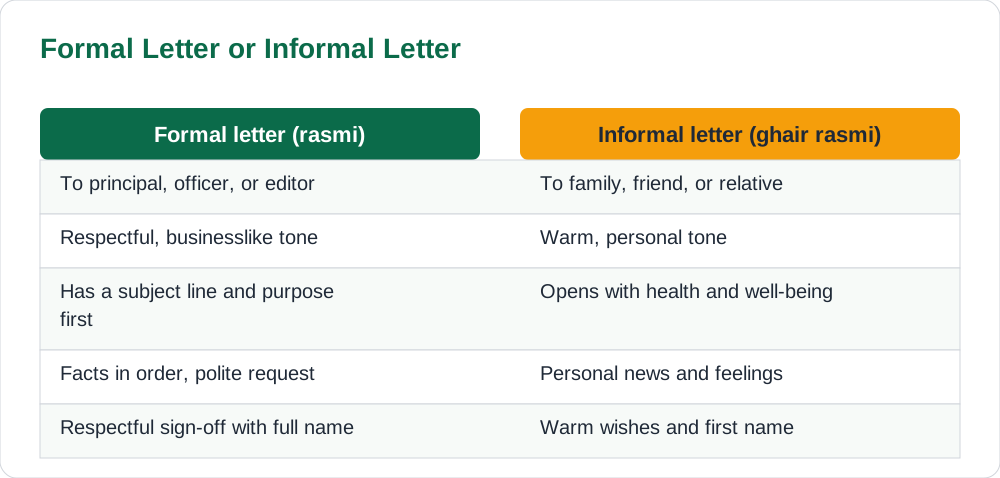
An informal letter (ghair rasmi khat) is written to family, friends, or relatives, and its tone is warm, personal, and relaxed. The greeting is affectionate, such as a greeting to a dear friend, and the opening paragraph asks about health and well-being before coming to the main news or purpose. This personal touch is not wasted words; it is part of the format, and examiners expect it. The body can include personal news, feelings, and everyday details, written in the natural language you would use when talking to that person.
Even in an informal letter, keep the writing neat and organised: one idea per paragraph, simple sentences, and no slang or rude words. End with warm wishes, such as prayers for health or hopes of meeting soon, and sign with your name or a loving closing as fits the relationship. A common mistake is writing an informal letter in stiff, official language, which sounds unnatural and loses marks for tone. Another is forgetting the date or address, which are required even in a friendly letter. Write as you would speak to a dear friend, but with the care of written language. The solved notes page has more Urdu writing help.
Formal Letters: To Principals, Officers, and Editors
A formal letter (rasmi khat) is written to a principal, teacher in an official capacity, government officer, or newspaper editor, and its tone is respectful, clear, and businesslike. It begins with the sender's address and date, then the receiver's title and address, then a respectful greeting, and then a subject line stating the purpose in a few words, which is a feature informal letters do not have. The opening sentence should state the purpose directly, without personal greetings about health, because the reader is busy and the letter is official.
The body of a formal letter gives facts in order: what is needed, why it is needed, and what action is requested, each in a short paragraph. Use polite, respectful language throughout, such as requesting rather than demanding, and avoid emotional or exaggerated wording. Close with thanks for attention and a respectful sign-off, followed by your full name, class, and roll number where your teacher asks for them. A formal letter that is polite, factual, and to the point shows maturity, and it is the format most often tested in exams. Find more guides on the [home page](/) and the blog.
A Model Informal Letter You Can Adapt
The model below is invented for this article as practice, and you can adapt its shape to any informal topic. Address and date at the top, then the greeting to a dear friend. Opening: I hope you are well, and I was very happy to receive your letter. Main news: Our school is holding a book fair next month, and I am taking part in a reading competition. I remember how much you love stories, and I wish you could visit and join us. Details: The fair will have books, storytelling sessions, and a small prize for the best reader, and our teachers are helping us prepare. Closing: Please write back soon and tell me about your school and your studies. Give my regards to your family. With warm wishes, your friend, Ahmed.
Notice the structure: greeting and well-being, purpose, details, and warm closing, each in its own paragraph. To adapt this model to another topic, keep the skeleton and change only the middle paragraphs: for a letter inviting a friend to a function, change the news and details; for a letter thanking a relative, change the purpose to thanks and the details to what you received. Do not copy the model word for word in an exam, since examiners value your own wording; instead, learn its shape and fill it with your own sentences. This adaptation skill is what turns one model into answers for many topics. See the book collection and the solved notes for more models.
Common Letter Writing Mistakes to Avoid
The most costly mistake is using the wrong format: writing to a principal in friendly language, or to a friend in stiff official language. Before writing, underline the reader in the question and decide at once whether the letter is formal or informal. The second mistake is forgetting parts of the format, especially the date, the greeting, or the signature, each of which carries marks. A quick checklist before you start, covering address, date, greeting, body paragraphs, closing, and signature, prevents these small but expensive losses.
Other common mistakes include writing a body that is too long and unfocused, using rude or overly casual language in a formal letter, and signing with the wrong name or no name at all. Always use your own name as given or as the question directs, never a famous person's name. Read the finished letter once from the reader's point of view: would a principal find it respectful and clear, or would a friend find it warm and natural? If the answer is yes, the letter is ready. With the skeleton learned and one model practised, khat nigari becomes one of the most reliable scoring questions in Urdu. More guides are on the blog and the [home page](/).
AI Help: Muse AI
Muse AI is Meta's personal AI assistant. You can ask it to explain a concept in simple words, summarise a lesson, or make practice questions for revision.
For letter writing, you can ask Muse AI to explain the difference between formal and informal letters in simple words, or to suggest a short outline for a letter on a practice topic before you write it yourself.
Join Muse with invite code LTGSWD — in the Muse app, go to Settings > Redeem token and enter the code.
Disclosure: LTGSWD is the author's Muse invite code.
Muse AI does not give official STBB answers — always verify against your Sindh Textbook Board book and your teacher.
5 key points you must know
- Every letter needs address, date, greeting, body, closing, and signature.
- Informal letters are warm and personal, opening with well-being.
- Formal letters are respectful and direct, with a subject line.
- Keep the body focused on one purpose, in two or three paragraphs.
- Check the reader first, then choose formal or informal format.
Frequently asked questions
What is the difference between a formal and an informal letter?
A formal letter goes to a principal, officer, or editor, uses respectful and businesslike language, and includes a subject line. An informal letter goes to family or friends, uses warm personal language, and opens by asking about well-being.
What parts must every letter have?
The sender's address, the date, a greeting, the body in paragraphs, a closing line, and the sender's name. Formal letters also add the receiver's address and a subject line. Missing any part can cost marks.
How should I start a formal letter?
After the address, date, receiver's title, and greeting, state your purpose directly in the first sentence, often supported by a short subject line. Avoid personal greetings about health, since the letter is official.
How should I start an informal letter?
After the address and date, greet your friend or relative warmly and ask about their health and well-being. Then come to your main news or purpose in the next paragraph, keeping the tone natural and personal.
Can I copy a model letter in an exam?
No, learn the model's shape and adapt it with your own sentences for the given topic. Copying a model word for word shows no understanding, while adapting its structure with your own wording earns full marks.
Solved notes — preview free
These guides work best with the solved exercises. Preview the solved notes free on this website — 119 solved notes for Classes 6–10 in Sindhi, Urdu, English and Arabic medium. Or browse the full solved notes catalogue for your class and medium. New solved notes are added regularly — check the catalogue for coming-soon books.