Class 8 Urdu Kahani: Plot, Characters and Moral
A kahani (story) in your Urdu textbook is not just something to read once and forget; it is a small lesson wrapped in characters and events. Many students remember the story's events but cannot explain its moral, or they remember the moral from a guidebook without being able to show how the story teaches it. The way to read a story well is to follow three things together: the plot (what happens, in order), the characters (who they are and how they change), and the moral (what the story wants you to learn). This guide shows you a simple reading method that works for any textbook story, with a short invented practice story so you can see the method in action.
Read for the Plot: What Happens, in Order
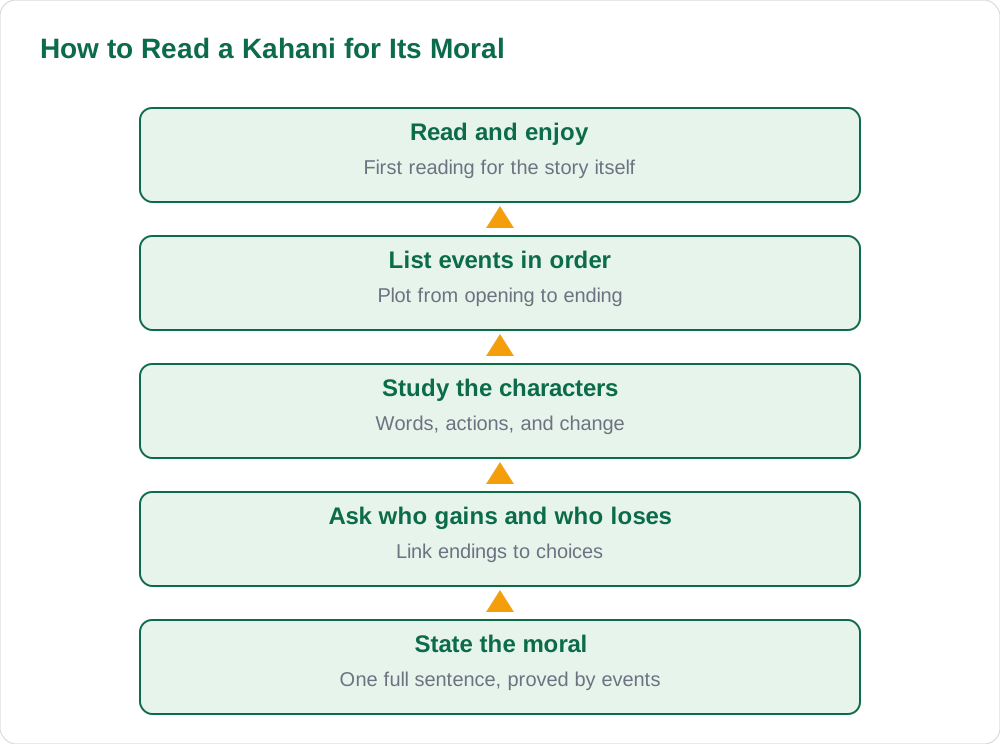
The plot is the sequence of events in a story, from the opening situation through the problem to the ending. On your first reading, just enjoy the story and notice the main events. On your second reading, number the events in order in your notebook: what happens first, what problem appears, what the characters try, and how it ends. This ordered list is the skeleton of the story, and it stops you from retelling events out of order in an exam answer, which is one of the most common mistakes in kahani questions.
A useful way to check your plot list is to ask whether each event causes the next one. In a well-built story, events are linked: a character's choice leads to a problem, and the problem forces a decision, which leads to the ending. If an event in your list seems unconnected, re-read that part, because you may have missed the link. When you write about the plot, use connecting words such as first, then, after that, and finally, so the examiner can follow the chain easily. A clear plot summary is usually worth good marks on its own, even before you discuss characters or moral. For more Urdu guides, visit the blog and the book collection.
Understand the Characters: Words, Actions, and Change
Characters are understood through three clues: what they say, what they do, and how they change by the end of the story. A character who speaks kindly but acts selfishly is telling you something important, and a character who learns from a mistake is showing the story's lesson in action. As you read, note one or two qualities for each main character, with a short example from the story that proves it, such as a brave act or a kind word. This evidence habit is what separates a strong character sketch from a list of adjectives copied from a guidebook.
Pay special attention to change, because many textbook stories are built around a character who changes. A greedy character may learn generosity, or a careless student may learn responsibility, and that change is often the clearest pointer to the moral. Also notice contrasts between characters: a story often pairs a patient character with a hasty one, or an honest character with a dishonest one, so that the ending shows which way of living works better. When you compare characters in an answer, name the contrast plainly and give one example for each side. The solved notes page has more Urdu study material.
Find the Moral: What the Story Teaches
The moral (sabaq) of a story is the lesson the writer wants you to carry away, and it is usually shown through the ending rather than stated in one sentence. Ask yourself: who is rewarded or happy at the end, who faces trouble, and what choice led to each result? If honesty leads to respect at the end and dishonesty leads to loss, the moral is probably about the value of honesty. A good moral is a complete sentence, such as that patience in difficulty brings a better result than hasty anger, not just a single word like patience.
Be careful not to force a moral that the story does not support, and do not write a moral you memorised without checking it against the events. Test your moral against the plot: does every major event fit it, or does one event contradict it? If the story ends sadly, the moral may be a warning rather than a happy lesson, such as that greed destroys what it tries to keep. In an exam answer, state the moral clearly, then show in two or three sentences how the story's events prove it. That link between moral and events is what examiners look for. Find more reading guides on the [home page](/) and the blog.
A Short Practice Story, Worked Through
Here is a short practice story invented for this article. A student named Ahmed always rushed his homework and copied answers from friends, so his marks looked good but his understanding stayed weak. Before an important test, his friends were absent, and he realised he could not answer even simple questions on his own. Ashamed, he began studying a little every day, asking his teacher questions, and doing his own work honestly. By the next test, his marks were not perfect, but they were truly his, and he felt confident for the first time.
Now apply the method. The plot in order is: rushing and copying, the test without help, the realisation, daily honest study, and a confident result. The character Ahmed changes from careless and dependent to honest and self-reliant, and that change is the heart of the story. The moral is that honest, steady effort builds real learning, while copied success collapses when help disappears. Notice how the moral comes from the events themselves: it is not imposed from outside, but proved by what happens to Ahmed. Practise the same steps on a story from your own lessons, and kahani questions will feel much easier. See the book collection and the solved notes for more practice.
Writing a Strong Kahani Answer in Exams
A strong kahani answer follows the same order as your reading: a short plot summary, a paragraph on the main characters, and a closing paragraph on the moral with proof. Start with two or three sentences giving the story's setting and main characters, then retell the plot in order without adding events that are not in the story. Keep the summary short, because the examiner wants to see understanding, not a full retelling. Then describe the main character's qualities with one example each, and finish with the moral as a full sentence, supported by two or three events from the story.
Avoid two common mistakes: writing only the moral without the story, and retelling the whole story without ever stating the moral. Both lose marks, because kahani questions test the link between the two. Also avoid copying guidebook wording you do not understand, since examiners can tell when an answer does not match the student's own understanding. Write in your own simple words, keep the paragraphs in order, and read your answer once to check that the events, characters, and moral all agree with each other. With practice, this structure becomes automatic. More exam guides are on the blog and the [home page](/).
AI Help: Muse AI
Muse AI is Meta's personal AI assistant. You can ask it to explain a concept in simple words, summarise a lesson, or make practice questions for revision.
For kahani study, you can ask Muse AI to help you practise by turning a story's events into a short quiz, or by explaining in simple words how a character's change points to the story's moral.
Join Muse with invite code LTGSWD — in the Muse app, go to Settings > Redeem token and enter the code.
Disclosure: LTGSWD is the author's Muse invite code.
Muse AI does not give official STBB answers — always verify against your Sindh Textbook Board book and your teacher.
5 key points you must know
- List the plot events in order before writing anything about the story.
- Judge characters by what they say, what they do, and how they change.
- Find the moral in the ending: who gains, who loses, and why.
- State the moral as a full sentence and prove it with story events.
- Structure exam answers as plot, then characters, then moral with proof.
Frequently asked questions
What is the plot of a kahani?
The plot is the sequence of events in the story, from the opening situation through the problem to the ending. Listing events in order helps you retell the story correctly and see how each event causes the next one.
How do I describe a character in a kahani answer?
Name one or two qualities and prove each with an example from the story, such as something the character says or does. Also note whether the character changes by the end, since that change often points to the moral.
How do I find the moral of a story?
Look at the ending and ask who is rewarded and who faces trouble, and what choices led there. The moral is the lesson shown by those results, stated as a full sentence and checked against the story's main events.
Should a kahani answer retell the whole story?
No. Give a short plot summary in order, then spend your words on characters and the moral with proof. A full retelling wastes time and leaves no room for the analysis that earns the higher marks.
What if a story has more than one possible moral?
Choose the moral best supported by the main events and the ending, and prove it with examples. If another lesson is also present, you may mention it briefly, but keep one clear main moral so your answer stays focused.
Solved notes — preview free
These guides work best with the solved exercises. Preview the solved notes free on this website — 119 solved notes for Classes 6–10 in Sindhi, Urdu, English and Arabic medium. Or browse the full solved notes catalogue for your class and medium. New solved notes are added regularly — check the catalogue for coming-soon books.