Class 8 Urdu Imla: Common Spelling Mistakes Fixed

Imla (spelling) mistakes are among the most avoidable ways to lose marks in Urdu, because they often come from a few repeated patterns rather than from knowing too little. Many Class 8 students spell most words correctly but keep tripping on the same tricky words: words with similar sounds, words with silent or doubled letters, and words borrowed from Arabic or Persian whose spelling does not match their sound. This guide explains why these mistakes happen, gives memory tricks for the most common traps, and teaches a proofreading habit that catches errors before the examiner does. It does not list textbook contents; it teaches the patterns and habits that fix spelling for good.
Why Urdu Spelling Goes Wrong
Urdu spelling goes wrong for a few predictable reasons, and knowing them helps you watch for them. First, Urdu has several letters that sound alike but are spelled differently, so a word heard in speech can be written with the wrong letter if you only trust your ear. Second, some words keep a spelling from Arabic or Persian that does not match how they sound in everyday speech, so writing them as they sound produces an error. Third, hurried writing causes its own mistakes: missing dots (nuqte), misplaced dots, and letters joined in the wrong shape, especially when you write fast in an exam.
The good news is that these causes point to clear fixes. For similar-sounding letters, you must learn the correct spelling of each word by sight, not by sound alone. For borrowed words, learning the word's family or root often explains its spelling. For hurried mistakes, slowing down slightly and proofreading at the end catches most errors. Spelling is therefore not a matter of talent; it is a matter of learning words by sight, understanding a few patterns, and checking your work. That is a skill any student can build with regular practice. For more Urdu guides, visit the blog and the book collection.
Similar Sounds, Different Letters: Learn by Sight
The biggest spelling trap in Urdu is letters that sound the same but look different, such as the different forms of 's', 'z', and 'h' sounds that come from Arabic and Persian. When two words sound alike but mean different things, their spelling is often the only difference, so guessing by sound is risky. The fix is to learn such words as pictures: look at the word carefully, notice its exact letters and dots, and write it from memory several times. Flashcards work well here: the word on one side, its meaning and a sentence on the other, tested in both directions.
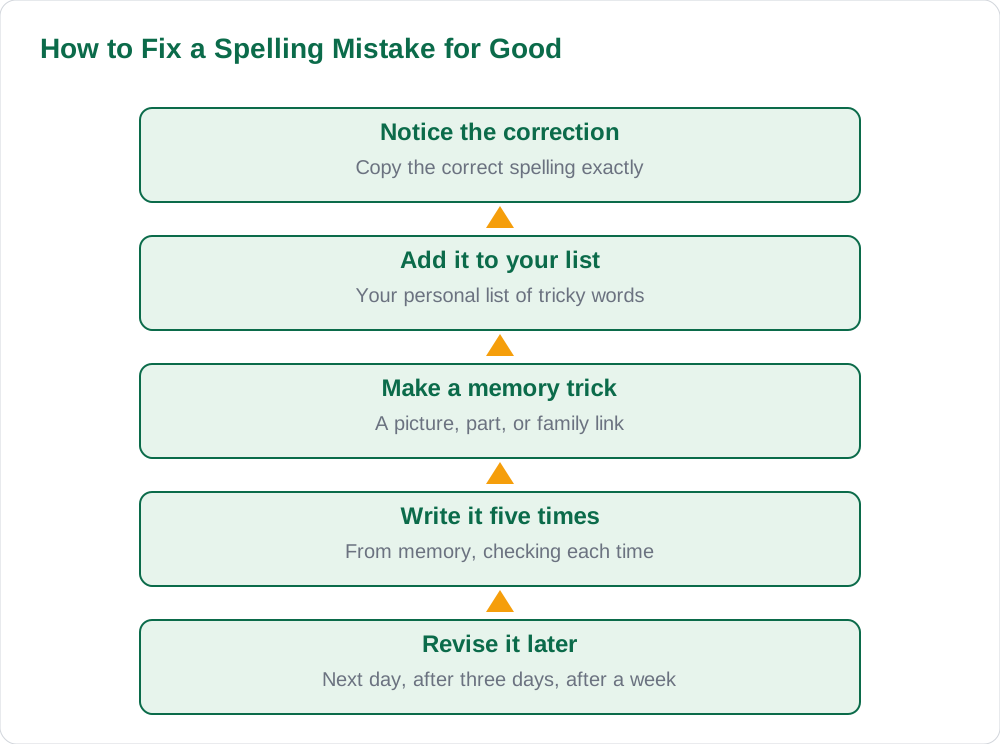
Make a personal list of the sound-alike words you personally confuse, rather than a long generic list, because your list targets your real weaknesses. Each time a teacher corrects a spelling in your work, add that word to your list at once, with its correct spelling highlighted. Revising that list for five minutes a few times a week will fix more spelling than memorising a whole dictionary page, because it attacks exactly the words you get wrong. Over time, the correct spelling will start to look right and the wrong one will start to look strange, which is the sign that sight memory is working. The solved notes page has more Urdu study help.
Memory Tricks for Tricky Words
Memory tricks (also called mnemonics) turn a hard spelling into something easy to recall. One useful trick is to link a tricky letter to the word's meaning: for a word about light, picture the bright letter standing out, or for a word about patience, picture waiting calmly for the right letter. Another trick is to break a long word into smaller parts you already know, and learn the parts in order, since a long word spelled part by part is much less frightening. A third trick is to learn words in families: if you know one word's spelling, words from the same root often share its tricky letter.
Rhymes and short sentences also help: make a tiny sentence in which the tricky word appears with a clue to its spelling, and repeat it until it sticks. The trick does not need to be clever or funny to anyone else; it only needs to work for you. Write your tricks next to the words in your notebook, and use them when you test yourself. If a trick stops working, replace it with a better one, because memory tricks are tools, not rules. With a handful of good tricks for your most stubborn words, your spelling will improve noticeably within a few weeks. Find more study methods on the [home page](/) and the blog.
Proofreading: Catching Errors Before Submission
Proofreading is reading your own writing slowly to find mistakes, and it is the single most effective habit for imla. After finishing an answer, read it once just for spelling, moving slowly and looking at each word's letters and dots, rather than reading for meaning. Reading aloud in a whisper helps, because your ear may catch a word that looks wrong even when your eye skipped over it. Also read the answer backwards, sentence by sentence from the end, which forces you to see each sentence fresh instead of gliding over familiar text.
Pay special attention to the words you know you confuse, to the first and last lines of each answer, and to names and technical terms, since these are where errors hide most often. If you find a mistake, correct it neatly with a single line through the wrong letter or word, and write the correct form clearly above or beside it, rather than scribbling. Leave two or three minutes at the end of every exam for proofreading, and practise it at home so it becomes automatic. A student who proofreads regularly can gain several marks per paper purely by catching errors that were already avoidable. See the book collection and the solved notes for more exam habits.
A Daily Routine for Better Imla
Good spelling is built by a small daily routine, not by cramming before a test. Each day, learn two or three new spellings from your lessons, write each one from memory five times, and use each in a sentence. Keep a spelling diary with three columns: the word, its correct spelling, and your trick or note, and revise the diary on the schedule of next day, three days, and a week. Ask a friend or family member to dictate a short passage once a week, since dictation (imla practice itself) tests spelling under realistic conditions and shows exactly which words still need work.
Also read regularly in Urdu, because reading builds sight memory for spellings without any extra effort: every correct word you read is a spelling lesson your eyes absorb. When you read, notice the spelling of words you have struggled with, and pause on them for a second. Over a term, this combination of daily learning, a personal tricky-words list, memory tricks, dictation, and reading will transform your imla. Spelling stops feeling like luck and starts feeling like a skill you control, which is exactly what it is. More guides are on the blog and the [home page](/).
AI Help: Muse AI
Muse AI is Meta's personal AI assistant. You can ask it to explain a concept in simple words, summarise a lesson, or make practice questions for revision.
For imla practice, you can ask Muse AI to explain a spelling pattern in simple words, or to make a short dictation-style practice quiz from a list of words you often misspell.
Join Muse with invite code LTGSWD — in the Muse app, go to Settings > Redeem token and enter the code.
Disclosure: LTGSWD is the author's Muse invite code.
Muse AI does not give official STBB answers — always verify against your Sindh Textbook Board book and your teacher.
5 key points you must know
- Urdu spelling errors come from similar sounds, borrowed spellings, and hurried writing.
- Learn sound-alike words by sight, with their exact letters and dots.
- Keep a personal list of the words you actually misspell.
- Use memory tricks: pictures, word parts, and word families.
- Proofread every answer slowly, and leave exam time for it.
Frequently asked questions
Why do I spell Urdu words as they sound and still get them wrong?
Because Urdu has several letters that sound alike but are spelled differently, and some borrowed words keep spellings that do not match their sound. You must learn such words by sight, noticing their exact letters and dots, not by sound alone.
How can I remember the spelling of a tricky word?
Use a memory trick: link a letter to the word's meaning with a picture, break the word into known parts, or learn it with its word family. Write the word from memory several times, and add it to your personal tricky-words list for revision.
What is the best way to proofread my Urdu answers?
Read once slowly just for spelling, looking at each word's letters and dots, and read aloud in a whisper. Reading sentence by sentence from the end also helps, since it forces you to see each sentence fresh instead of gliding over it.
How many spellings should I learn each day?
Two or three new spellings a day, learned well with sentences and memory tricks, is enough. Revise them the next day, after three days, and after a week, and add a weekly dictation to test yourself under realistic conditions.
Does reading help Urdu spelling?
Yes, reading builds sight memory: every correctly spelled word you read teaches your eyes its form. When reading, pause briefly on words you have struggled with, and notice their exact spelling and dots.
Solved notes — preview free
These guides work best with the solved exercises. Preview the solved notes free on this website — 119 solved notes for Classes 6–10 in Sindhi, Urdu, English and Arabic medium. Or browse the full solved notes catalogue for your class and medium. New solved notes are added regularly — check the catalogue for coming-soon books.