Class 8 Urdu Ghazal: Sher, Matla and Maqta Explained
The ghazal is one of the most loved forms of Urdu poetry, but it confuses many Class 8 students because it does not tell one continuous story like a nazam. Instead, a ghazal is a collection of couplets (ashaar), and each couplet (sher) is a complete thought on its own. Once you learn the names of its parts, especially the matla and the maqta, the whole form suddenly makes sense, and reading a ghazal becomes a pleasure instead of a puzzle. This guide explains each part in plain language, shows you how to spot the matla and maqta in any ghazal, and works through two short practice couplets that were invented for this article so you can practise without worrying about textbook contents.
What a Ghazal Is: A Chain of Independent Couplets
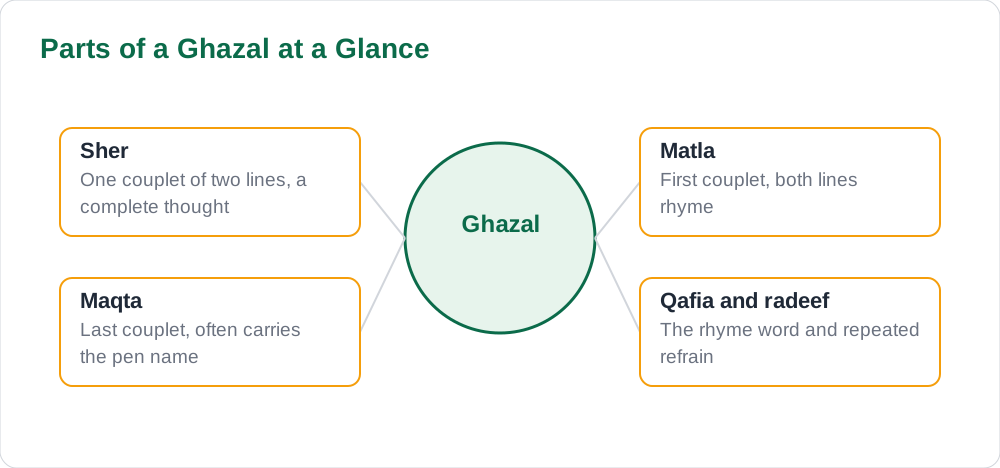
A ghazal is a poem made of couplets, where each sher has two lines (misray) that rhyme and share a rhythm. Unlike a story, the couplets of a ghazal are usually independent: one sher may speak of hope, the next of separation, and the next of patience, without needing to follow from the one before. This independence is the key to reading a ghazal. You do not have to force a single storyline across all the couplets; instead, you enjoy and understand each sher on its own, and then notice the mood or theme that links several of them loosely together.
The couplets of a ghazal also share a rhyme pattern and a repeated refrain word, which gives the poem its musical quality when read aloud. The rhyme word is called the qafia and the repeated word or phrase after it is called the radeef. You do not need to master these technical terms to enjoy a ghazal, but noticing the rhyme helps you hear where each couplet ends and the next begins. When you read a ghazal for study, take it sher by sher, just as you would take a nazam stanza by stanza. For more Urdu guides, see the blog and the book collection.
What Is a Sher? Two Lines, One Complete Thought
A sher is the basic unit of a ghazal, and it always has two lines. The first line is called the misra-e-oola and the second is the misra-e-sani, but in class discussion you can simply call them the first and second lines. A good sher says something complete in just those two lines: it sets up an idea in the first line and completes, deepens, or turns it in the second. That is why a sher can feel so striking; it compresses a whole feeling or observation into a very small space, like a short saying that stays in the mind.
When you read a sher, first read both lines together slowly, then ask what the first line sets up and what the second line adds. Sometimes the second line gives a reason, sometimes a contrast, and sometimes a surprising conclusion. Practise by covering the second line, guessing where the thought might go, and then reading it to see how the poet completed it. This small game trains you to read poetry actively instead of passively, and it is exactly the skill that tafheem questions test. More poetry help is on the solved notes page and the blog.
The Matla: The Opening Couplet of the Ghazal
The matla is the very first sher of a ghazal, and it has a special feature: both of its lines end with the same rhyme and refrain. In later couplets, only the second line needs to carry the rhyme, but the matla sets the pattern by rhyming in both lines. That is how you can spot it: it is the first couplet, and both its lines rhyme. A ghazal may have more than one matla if the poet repeats the double rhyme in a second couplet, and that second one is sometimes called the matla-e-sani, but the first couplet is always the matla.
The matla matters because it announces the ghazal's rhyme, rhythm, and often its mood, so readers know at once what kind of poem they are entering. In an exam, a question may ask you to identify the matla, and the answer is simply the first sher, quoted or described accurately. A common mistake is to call any beautiful couplet the matla; remember that position and the double rhyme decide it, not beauty alone. When you practise, always label the first couplet as matla in your notebook before analysing the rest. Visit the [home page](/) and the book collection for more study material.
The Maqta: The Closing Couplet and the Pen Name
The maqta is the last sher of a ghazal, and it is special because the poet often includes his or her pen name (takhallus) in it. The takhallus is the name a poet writes under, which may differ from the poet's real name. When you see a name woven into the final couplet, often in the second line, you have almost certainly found the maqta. Not every ghazal has a maqta with a pen name, but when one is present, it is a clear signal that the poem is ending, almost like a signature at the bottom of a letter.
Students sometimes confuse the maqta with the matla because both have special jobs, so remember the simple pair: matla opens, maqta closes. The matla is found by position at the start and by its double rhyme, while the maqta is found by position at the end and often by the pen name. In your notebook, practise labelling a ghazal's couplets as matla, middle ashaar, and maqta, and you will never mix them up again. This labelling habit also makes exam questions about the form of a ghazal quick and easy to answer. More guides are on the solved notes and the blog.
Two Practice Couplets, Read Step by Step
The two couplets below are simple practice examples invented for this article, not lines from your textbook, so you can use them freely for practice. First example: 'Mehnat ka diya har dil mein jalao, andheron se kabhi tum na ghabrao.' Read it as one thought: the first line urges lighting the lamp of hard work in every heart, and the second line completes it by saying never fear darkness. The image of the lamp stands for effort and hope, and the message is that hard work removes the darkness of difficulty. Notice how the two lines rhyme and how the second line finishes the idea the first line began.
Second example: 'Sach ki raah par chalna aasan nahi, magar is raah ka anjaam roshan hai.' Here the first line admits that walking the path of truth is not easy, and the second line answers with hope, saying the end of that path is bright. The couplet works by contrast: difficulty in the first line, reward in the second. Try the same method on any couplet: read both lines, find what the first sets up, see what the second adds, and then state the message in one sentence. With this habit, even a difficult ghazal becomes a set of small, readable thoughts. Explore the book collection and the [home page](/) for further reading.
AI Help: Muse AI
Muse AI is Meta's personal AI assistant. You can ask it to explain a concept in simple words, summarise a lesson, or make practice questions for revision.
For ghazal study, you can ask Muse AI to explain the difference between matla and maqta in simple words, or to make a short practice quiz that asks you to spot the opening and closing couplets of a sample ghazal.
Join Muse with invite code LTGSWD — in the Muse app, go to Settings > Redeem token and enter the code.
Disclosure: LTGSWD is the author's Muse invite code.
Muse AI does not give official STBB answers — always verify against your Sindh Textbook Board book and your teacher.
5 key points you must know
- A ghazal is a chain of couplets, and each sher is a complete thought on its own.
- A sher has two lines: the first sets up an idea and the second completes it.
- The matla is the first couplet, with rhyme in both lines.
- The maqta is the last couplet and often includes the poet's pen name.
- Read a ghazal sher by sher, and state each couplet's message in one sentence.
Frequently asked questions
What is the difference between a sher and a ghazal?
A sher is a single couplet of two lines, while a ghazal is the whole poem made of several couplets. Each sher in a ghazal is usually an independent thought, so you can understand and enjoy one sher even on its own.
How do I identify the matla of a ghazal?
Look at the first couplet. In the matla, both lines end with the same rhyme and refrain, while in later couplets only the second line needs to rhyme. Position plus double rhyme together identify the matla.
How do I identify the maqta of a ghazal?
Look at the last couplet. The maqta often includes the poet's pen name (takhallus), usually in the second line. Remember the pair: matla opens the ghazal and maqta closes it.
What are qafia and radeef?
Qafia is the rhyme word that repeats at the end of the second line of each couplet, and radeef is the word or phrase repeated after the qafia. Together they give the ghazal its musical, repeating sound.
Why do the couplets of a ghazal seem unconnected?
Because each sher is meant to stand alone as a complete thought. Instead of forcing one story across the whole ghazal, read each couplet on its own and then notice any shared mood or theme that links several of them.
Solved notes — preview free
These guides work best with the solved exercises. Preview the solved notes free on this website — 119 solved notes for Classes 6–10 in Sindhi, Urdu, English and Arabic medium. Or browse the full solved notes catalogue for your class and medium. New solved notes are added regularly — check the catalogue for coming-soon books.