Class 8 Urdu Alfaz-o-Mani: Vocabulary From Your Lessons

Urdu vocabulary (alfaz-o-mani) is the key that unlocks every lesson, because a sabaq, nazam, or kahani cannot make sense while its difficult words stay unknown. Many Class 8 students skip the vocabulary list at the end of a lesson and then struggle with the whole chapter, when ten minutes of word study would have made everything clear. The best way to learn alfaz is lesson by lesson: take the difficult words from the lesson you are actually studying, learn their meanings, use each word in your own sentence, and revise the words regularly. This guide shows you how to build a personal vocabulary notebook that grows with your course and actually stays in your memory.
Take Vocabulary From the Lesson You Are Studying
The most useful vocabulary comes from your current lesson, not from a random word list, because those are the words your exams will test and the words you need to understand the chapter. As you read a sabaq or nazam, underline every word whose meaning you are unsure about, even if you think you can guess it from context. Guessing is useful for reading, but it is not the same as knowing, and exam questions often test the exact meaning of a word you only half-guessed. After reading, collect the underlined words into your vocabulary notebook, lesson by lesson, with the lesson name and date at the top of each page.
Aim for a manageable number of words per lesson, such as ten to fifteen, rather than copying every unfamiliar word you meet. If a lesson has very many hard words, learn the most important ones first: words that appear more than once, words that carry the lesson's main idea, and words your teacher explained in class. Words that appear only once in a colourful description can wait. This selection keeps vocabulary study realistic, so you actually finish it instead of abandoning a list of fifty words. For more Urdu guides, visit the blog and the book collection.
Learn Each Word With Meaning and a Sentence
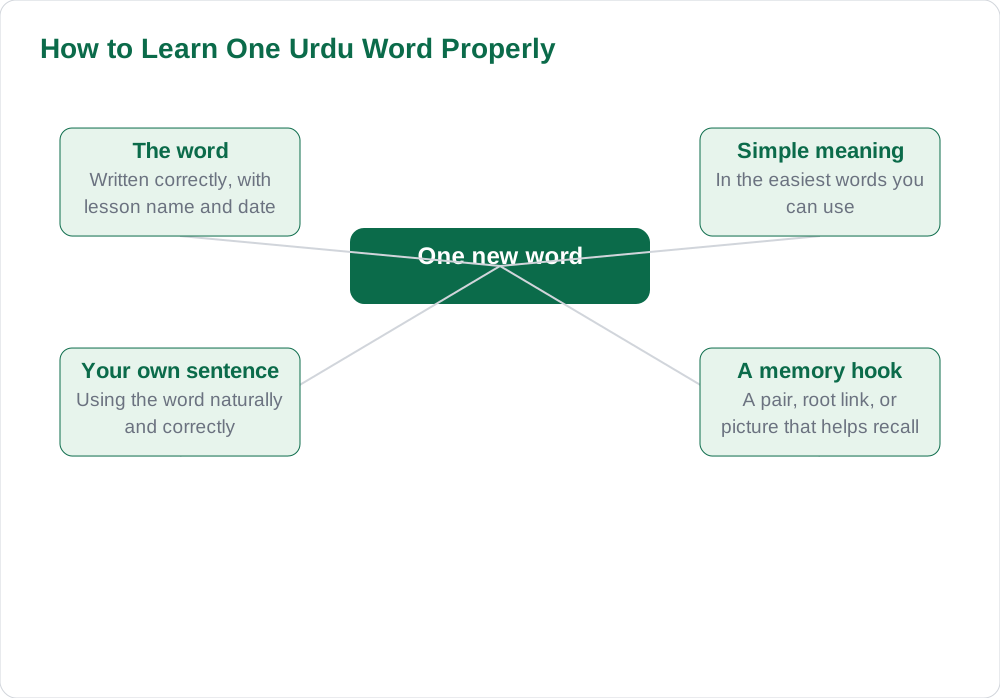
A word is only half-learned when you know its meaning but cannot use it, so always learn each word in three parts: the word itself, its simple meaning, and a sentence using it correctly. Write the meaning in the simplest words you can, because a meaning written in harder words than the original word helps nobody. Then write your own sentence, not a copied one, using the word in a natural situation. For example, for the word mehnat (hard work), a good sentence is that mehnat se mushkil kaam bhi aasan ho jata hai, which shows you understand both the word and its use.
Also note the word's form where it matters, such as whether it is used as a noun or an adjective, and any common opposite or similar word that helps you remember it. Learning words in pairs, such as roshni (light) and andhera (darkness), or mehnat and susti (laziness), gives your memory two hooks instead of one. Avoid learning a long list of meanings by reading them silently again and again; that method feels productive but fades fast. Writing the word, its meaning, and your own sentence is slower but far more lasting, because it forces you to think about the word. The solved notes page has more vocabulary help.
Use Word Families, Roots, and Sound Clues
Urdu words often come in families, and learning the family is easier than learning each word alone. Words sharing a root or pattern, such as ilm (knowledge), aalim (scholar), and taleem (education), support each other in memory, because knowing one helps you guess the others. When you meet a new word, ask whether it looks or sounds like a word you already know, and note the connection in your notebook. Even a rough connection, such as a shared first syllable, gives your memory something to hold on to when the word appears again in a test.
Sound and meaning clues also help: some words sound like what they describe, and others can be remembered through a small story or image you invent. For instance, you might remember a word for brightness by picturing a lamp, or a word for patience by picturing someone waiting calmly. These memory hooks do not need to be clever; they only need to be yours, because a hook you invented yourself is easier to recall than one someone else gave you. Add one hook per difficult word, and your vocabulary notebook becomes a set of personal memory aids rather than a dull list. Find more study methods on the [home page](/) and the blog.
Revise Words on a Schedule, Not Just Before Tests
Vocabulary learned once and never revised is usually forgotten within days, so revision must be built into your routine. A simple schedule works well: revise new words the next day, again after three days, and again after a week. Each revision should be active: cover the meanings, try to recall them, and only then check. Words you recall easily can move to a weekly list, while words you miss stay on the daily list until they stick. This spaced revision takes only five minutes a day, but it is the difference between words you know for a test and words you know for good.
Test yourself in both directions: see the word and recall the meaning, and see the meaning and recall the word. The second direction is harder and more useful for writing, because in an exam you must produce the right word yourself, not just recognise it. You can also test with a friend by taking turns to ask words from each other's notebooks, which makes revision quicker and more enjoyable. Keep a small list of stubborn words that you keep missing, and give those words extra sentences and extra revision, since a few stubborn words often cause most of the lost marks. See the book collection and the solved notes for more revision guides.
Using New Words in Speaking and Writing
Words become truly yours only when you use them, so look for chances to use new alfaz in your own writing and speaking. Try to use two or three new words in your next mazmoon (essay) or khulasa, where they fit naturally, and use them in class discussion when you can. Using a word in a real sentence tests your understanding far better than reading its meaning again, because a wrong use shows up at once and can be corrected. Do not force a difficult word into a sentence where a simple word would be better; examiners reward correct, natural use, not showing off.
Also notice new words outside your textbook: in news, stories, and everyday conversation, because vocabulary grows fastest when you stay curious about words everywhere. When you hear an unfamiliar word, ask its meaning or note it down to check later, and add it to your notebook if it seems useful. Over a school year, this habit can add hundreds of words to your vocabulary, and each one makes the next lesson easier to read. Vocabulary study is slow work with a large reward: every word you truly learn makes every future lesson, poem, and story a little clearer. More guides are on the blog and the [home page](/).
AI Help: Muse AI
Muse AI is Meta's personal AI assistant. You can ask it to explain a concept in simple words, summarise a lesson, or make practice questions for revision.
For vocabulary study, you can ask Muse AI to explain a difficult Urdu word in simple words, or to make a short practice quiz from a list of words you are learning so you can test yourself.
Join Muse with invite code LTGSWD — in the Muse app, go to Settings > Redeem token and enter the code.
Disclosure: LTGSWD is the author's Muse invite code.
Muse AI does not give official STBB answers — always verify against your Sindh Textbook Board book and your teacher.
5 key points you must know
- Collect difficult words from the lesson you are actually studying.
- Learn each word with a simple meaning and a sentence of your own.
- Use word families, opposites, and memory hooks to aid recall.
- Revise actively on a schedule: next day, after three days, after a week.
- Use new words in your own writing and speaking so they truly stick.
Frequently asked questions
How many new words should I learn from each lesson?
Aim for ten to fifteen important words per lesson: words that repeat, carry the main idea, or were explained by your teacher. Learning a manageable number well is far better than copying fifty words you never revise.
Why should I write my own sentence for each word?
Because using a word correctly proves you understand it, while reading its meaning only proves you recognise it. Your own sentence also gives your memory a second hook, so the word is easier to recall in an exam.
How often should I revise vocabulary?
Revise new words the next day, again after three days, and again after a week, testing yourself actively by covering the meanings. Words you miss stay on the daily list until they stick, while easy words move to a weekly list.
What should I do with words I keep forgetting?
Give them extra attention: write more than one sentence, link them to a word family or opposite, and add a personal memory hook such as a picture or story. Keep them on a small stubborn-words list and revise that list daily.
Is it enough to guess word meanings from context?
Guessing helps you keep reading, but it is not the same as knowing. Exam questions often test exact meanings, so after guessing, check the meaning, write it down with a sentence, and revise it like any other new word.
Solved notes — preview free
These guides work best with the solved exercises. Preview the solved notes free on this website — 119 solved notes for Classes 6–10 in Sindhi, Urdu, English and Arabic medium. Or browse the full solved notes catalogue for your class and medium. New solved notes are added regularly — check the catalogue for coming-soon books.