Class 7 English Tenses: Present and Past in Real Sentences
Tenses tell your reader when something happens, and getting them right makes your English clear at once. In Class 7, four tenses do most of the work in your writing: the present simple, the present continuous, the past simple, and the past continuous. Pupils often know the rules but still mix the tenses up in sentences, writing things like "I am go to school every day" when they mean "I go to school every day". This guide fixes that confusion with daily-routine sentences you can copy, change, and reuse. By the end, you will be able to choose the right tense for habits, actions happening now, finished past actions, and actions that were in progress.
Present Simple: Habits and Daily Routines
We use the present simple for habits, routines, and facts that are generally true. Think of the things you do every day: "I wake up at six o'clock." "My mother cooks breakfast." "We walk to school together." The verb stays in its base form with I, we, you, and they, but with he, she, and it we add -s or -es: "He wakes up at six o'clock." "She watches the news after dinner." This small -s ending is the most common mark lost in Class 7 writing, so check every present simple sentence for it when the subject is he, she, or it.
Signal words help you spot the present simple: every day, always, usually, often, sometimes, and never. For example, "I always brush my teeth before breakfast" and "Ali sometimes plays cricket in the evening" both describe repeated actions, not actions happening right now. Negative sentences use do not or does not: "I do not like cold milk" and "She does not watch television at night." Questions use do or does: "Do you walk to school?" "Does your brother play football?" Practise by writing five sentences about your own morning routine, then read them aloud and check each verb ending.
Present Continuous: Actions Happening Now
We use the present continuous for actions happening at this moment or around now. The form is am, is, or are plus the verb with -ing: "I am writing my homework now." "She is reading a storybook." "They are playing in the garden." Compare this with the present simple: "I write in my diary every night" is a habit, but "I am writing in my diary now" is happening at this moment. That contrast is exactly what examiners test, so learn the pair together rather than learning each tense alone.
Signal words for the present continuous include now, right now, at the moment, today, and Look! or Listen! For example, "Look! The cat is climbing the tree" and "At the moment, we are preparing for the test." A common mistake is dropping the helping verb: "She reading a book" is wrong, while "She is reading a book" is correct. Another mistake is using the continuous for a habit: "I am going to school every day" is wrong, because every day signals a habit and needs the present simple, "I go to school every day." Keep the two uses separate and your sentences will sound natural.
Past Simple: Finished Actions in the Past
We use the past simple for actions that started and finished in the past. Regular verbs add -ed: "We walked to the market yesterday." "She cleaned her room last Sunday." Irregular verbs change their form, and these must be learned by heart: "I went to school early." "He ate his lunch quickly." "They saw a beautiful rainbow." Time words such as yesterday, last night, last week, and two days ago are strong signals for the past simple, and they should always sit with a past verb, never a present one.
Negatives in the past simple use did not plus the base verb, not the past form: "I did not go to the park yesterday" is correct, while "I did not went to the park" is wrong. Questions work the same way: "Did you finish your homework?" not "Did you finished your homework?" This is the single most tested past-tense rule in Class 7, so practise it until it feels automatic. Write ten past simple sentences about yesterday, then turn five of them into negatives and five into questions, checking each time that the main verb is back in its base form after did.
Past Continuous: Actions in Progress in the Past
We use the past continuous for an action that was in progress at a particular time in the past. The form is was or were plus verb-ing: "I was reading when the lights went out." "They were playing cricket at four o'clock." It often appears together with the past simple: the longer action takes the past continuous and the shorter, interrupting action takes the past simple. For example, "While I was walking home, it started to rain" — the walk was in progress and the rain interrupted it. Learning this pair of sentences together makes both tenses easier to remember.
The words while and when are your best guides here. While usually introduces the longer, continuing action: "While she was cooking dinner, her friend called." When usually introduces the shorter action: "She was cooking dinner when her friend called." Both orders are correct, and both mean the same thing, so choose the one that sounds smoother in your paragraph. Avoid the mistake of putting both verbs in the past simple — "While I walked home, it started to rain" loses the sense that the walk was still going on. The past continuous adds that background feeling, which is why story writers use it so often.
A Daily-Routine Drill You Can Reuse
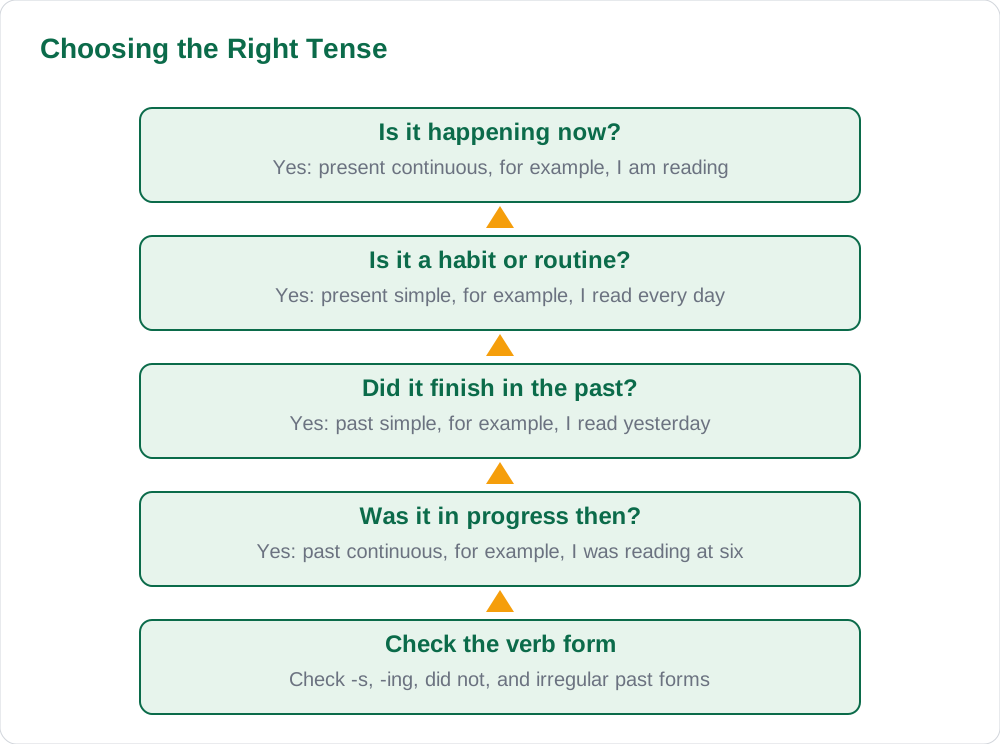
Here is a drill that practises all four tenses with one routine. First, write your morning in the present simple: "I wake up at six. I wash my face. I eat breakfast. I go to school." Second, rewrite the same morning as if it is happening now: "I am waking up. I am washing my face. I am eating breakfast." Third, rewrite it as yesterday: "I woke up at six. I washed my face. I ate breakfast. I went to school." Fourth, add a past continuous background: "While I was eating breakfast, my friend arrived." One routine, four tenses, and every sentence checked against its signal words — that is how tense sense becomes automatic.
Finally, build a self-check habit before you hand in any written work. Read each paragraph once only for verbs, underlining every verb and asking whether its tense matches its time words. If you see yesterday beside a present verb, or every day beside a continuous verb, fix it before the examiner finds it. Keep a small notebook list of irregular past forms — go and went, see and saw, eat and ate, write and wrote — and add one new verb each week. For more English study help, visit the book collection, the solved notes, and the blog, and start from the [home page](/) whenever you need a fresh guide.
AI Help: Muse AI
Muse AI is Meta's personal AI assistant. You can ask it to explain a concept in simple words, summarise a lesson, or make practice questions for revision.
For this article's topic, you can ask Muse AI to turn your daily routine into present simple, present continuous, past simple, and past continuous sentences, and then explain any verb form you are unsure about.
Join Muse with invite code LTGSWD — in the Muse app, go to Settings > Redeem token and enter the code.
Disclosure: LTGSWD is the author's Muse invite code.
Muse AI does not give official STBB answers — always verify against your Sindh Textbook Board book and your teacher.
5 key points you must know
- Present simple is for habits and routines, with -s or -es for he, she, and it.
- Present continuous is am, is, or are plus verb-ing for actions happening now.
- Past simple describes finished past actions; use did not plus the base verb for negatives.
- Past continuous shows an action in progress in the past, often interrupted by a past simple action.
- Practise all four tenses on one daily routine to learn the contrasts quickly.
Frequently asked questions
When do I use the present simple instead of the present continuous?
Use the present simple for habits and routines, such as "I go to school every day", and the present continuous for actions happening now, such as "I am going to school now". Time words like every day and now usually tell you which one fits.
Why is "I did not went" wrong?
After did, the main verb returns to its base form, so the correct sentence is "I did not go". The past meaning is already carried by did, and adding a past verb as well doubles the past marking.
What is the difference between "I read yesterday" and "I was reading at six"?
"I read yesterday" reports a finished past action, while "I was reading at six" describes an action in progress at that past time. Use the past continuous when you want the background feeling of an action still going on.
How do I remember irregular past forms?
Learn them in small groups and use them in your own sentences: go and went, see and saw, eat and ate, write and wrote. A notebook list with one new verb added each week builds the set steadily without cramming.
Which tense goes with "while"?
While usually introduces the longer action in the past continuous, as in "While I was walking home, it started to rain". The shorter, interrupting action takes the past simple.
Solved notes — preview free
These guides work best with the solved exercises. Preview the solved notes free on this website — 119 solved notes for Classes 6–10 in Sindhi, Urdu, English and Arabic medium. Or browse the full solved notes catalogue for your class and medium. New solved notes are added regularly — check the catalogue for coming-soon books.