Class 7 Synonyms and Antonyms: Grow Your Vocabulary
A synonym is a word with a similar meaning, and an antonym is a word with an opposite meaning: happy and glad are synonyms, while happy and sad are antonyms. Class 7 tests love these pairs because they check whether you really know a word or only recognise it. Pupils who memorise long lists often fail anyway, because synonyms are rarely exact — glad and happy are close but not identical — and antonyms depend on context. This guide teaches word pairs the way they actually work: in sentences, in families, and in your own notebook, so your vocabulary grows in a way that survives tests and improves your writing.
What Synonyms and Antonyms Really Are
A synonym shares meaning with another word but almost never matches it perfectly. Big, large, and huge all describe size, yet "a huge mistake" sounds stronger than "a big mistake," and "a large number" sounds more natural than "a huge number" in a report. Learning a synonym therefore means learning its strength and its usual company, not just its dictionary meaning. When you meet a new word, ask which words it can replace and which it cannot, and you will learn the word properly instead of collecting a false twin.
An antonym is the opposite of a word, but many words have more than one opposite depending on meaning. The antonym of light as a weight is heavy, but the antonym of light as brightness is dark. The antonym of right as a direction is left, but the antonym of right as correct is wrong. Context decides, which is why test questions always give the word in a sentence or ask for the opposite "in this sense." Always read the sentence before choosing an antonym, and never pick the first opposite that comes to mind without checking which meaning is in play.
Learning Words in Pairs and Families
Words stick better in pairs and families than alone. Learn brave with its synonym courageous and its antonym cowardly together, in one group, and the three words support each other in memory. Learn families the same way: happy, glad, cheerful, joyful form a family of rising strength, while sad, unhappy, gloomy, and miserable form the opposite family. When you revise one word, the whole family comes back, and in a test you can reach for the exact strength you need instead of repeating happy in every sentence.
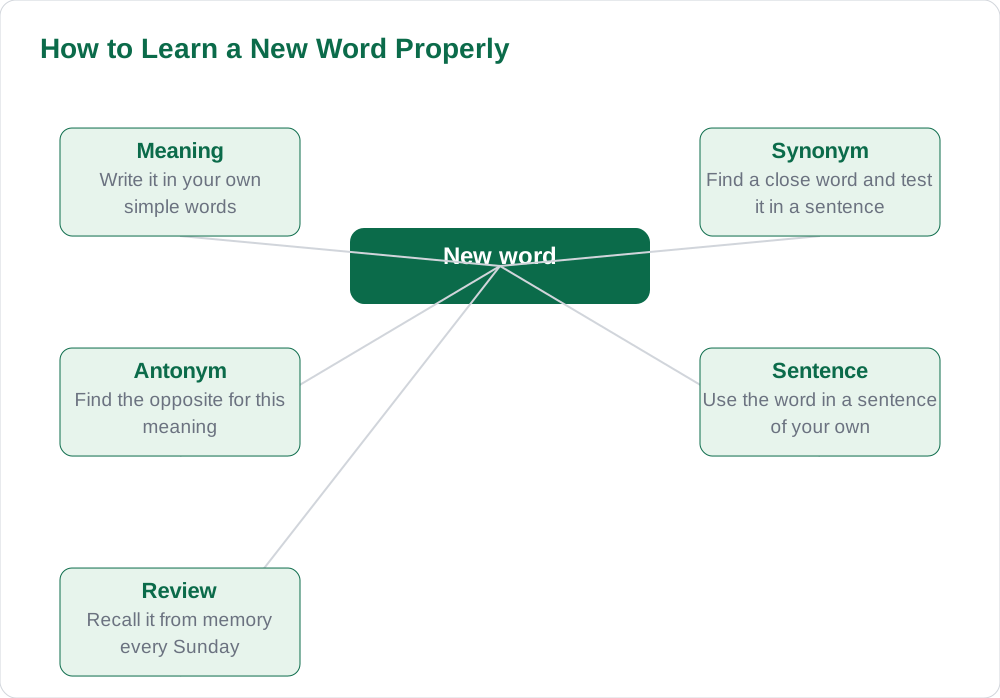
A word notebook makes this method work. Give each new word a small entry: the word, its meaning in your own words, one synonym, one antonym, and one sentence of your own. For example: "Ancient — very old. Synonym: old. Antonym: modern. Sentence: The ancient fort stands on the hill." Five words a day in this format beats fifty words copied from a list, because every entry forces you to use the word. Review the notebook every Sunday, covering the meanings and recalling them before you look, and your vocabulary will grow week by week without cramming.
Synonyms in Sentences: The Only Real Test
A synonym is only learned when you can use it correctly in a sentence, so sentence practice is the heart of vocabulary work. Take the word begin and its synonym start, and write both in sentences: "The lesson begins at eight" and "The lesson starts at eight" both work, so these two are close twins. Now try rich and wealthy: "He is a rich man" and "He is a wealthy man" both work, but "a rich harvest" sounds natural while "a wealthy harvest" sounds odd. That oddness is the lesson: synonyms overlap but do not always swap, and only sentence practice reveals the edges.
Try this exercise with five words from your current lesson: rapid, clever, kind, honest, and brave. For each word, write one synonym sentence and one antonym sentence. For example: "The rapid river rushed past" and "The slow river moved gently." Then swap the synonym into a different sentence and check whether it still sounds natural. If it does not, note the restriction in your word notebook. This habit of testing words in sentences is what separates pupils who know words from pupils who only recognise them, and it directly improves composition marks, where varied, accurate vocabulary earns credit.
Antonym Traps and How to Avoid Them
Antonym questions contain traps, and knowing them saves marks. The first trap is the near-opposite: the antonym of love is hate, not dislike, when the question wants the strongest opposite. The second trap is the wrong meaning: the antonym of hard as difficult is easy, but the antonym of hard as solid is soft. The third trap is the negative prefix that looks right but is not a real word or not the expected answer — unkind is the antonym of kind, but unbrave is not the antonym of brave; cowardly is. When a prefix answer feels invented, it probably is, and a real opposite word is expected.
Another trap is the antonym that changes the part of speech: the antonym of the adjective happy is sad, not sadness, because the answer must match the word's form. Keep the part of speech the same in every answer. A final trap is the sentence that flips the meaning: "He is not happy" does not make not happy the antonym; the antonym is still sad. Read the question stem carefully — does it ask for the opposite word, or the opposite meaning in this sentence? Answering the question actually asked, rather than the one you assumed, is a skill that protects marks across every subject, not just vocabulary.
Using New Words in Your Writing
Vocabulary only counts when it appears in your writing, so set yourself a weekly target: use five notebook words in your compositions and answers that week. Replace a repeated word deliberately — instead of writing good three times, use excellent once, pleasant once, and fine once, where each fits. Do not force a difficult word into a sentence where a simple word is better; examiners reward accurate variety, not decoration. A well-chosen simple word always beats a misused impressive one, and a misused synonym is worse than a repeated correct word.
Finally, read widely, because reading is where vocabulary grows fastest. Storybooks, lesson texts, and even newspaper headlines expose you to words in their natural company, which is exactly the knowledge tests check. When you meet an unknown word, do not skip it: guess its meaning from the sentence, check it in a dictionary, and add it to your notebook with a synonym, an antonym, and your own sentence. Ten minutes of this habit after each reading session will do more for your vocabulary than any list. For more English study help, visit the book collection, the solved notes, and the blog from the [home page](/).
AI Help: Muse AI
Muse AI is Meta's personal AI assistant. You can ask it to explain a concept in simple words, summarise a lesson, or make practice questions for revision.
For this article's topic, you can ask Muse AI to suggest synonyms and antonyms for a word from your lesson and to show each one in a sentence, so you can check whether the words really swap.
Join Muse with invite code LTGSWD — in the Muse app, go to Settings > Redeem token and enter the code.
Disclosure: LTGSWD is the author's Muse invite code.
Muse AI does not give official STBB answers — always verify against your Sindh Textbook Board book and your teacher.
5 key points you must know
- Synonyms share meaning but are rarely exact, so test them in sentences.
- Antonyms depend on which meaning of the word is in play.
- Learn words in pairs and families, with a synonym and an antonym together.
- Keep a word notebook: meaning, synonym, antonym, and your own sentence.
- Use five notebook words in your writing every week to make them stick.
Frequently asked questions
Are synonyms always interchangeable?
No. Synonyms overlap but have different strengths and usual company. "A big mistake" and "a huge mistake" differ in strength, and "a wealthy harvest" sounds odd beside "a rich harvest". Test every synonym in a sentence before using it.
What is the antonym of light?
It depends on the meaning. As a weight, the antonym is heavy; as brightness, the antonym is dark. Always read the sentence to find which meaning is in play before choosing.
How many new words should I learn each day?
Five words a day, learned properly with a meaning, synonym, antonym, and your own sentence, beats fifty words copied from a list. Review them weekly from memory.
Why is "unbrave" not the antonym of brave?
Because the real opposite word is cowardly. Not every word forms its antonym with a prefix, and an invented prefix word is not an acceptable answer even if its meaning is guessable.
Does the antonym have to match the part of speech?
Yes. The antonym of the adjective happy is the adjective sad, not the noun sadness. Keep the word form the same in every vocabulary answer.
Solved notes — preview free
These guides work best with the solved exercises. Preview the solved notes free on this website — 119 solved notes for Classes 6–10 in Sindhi, Urdu, English and Arabic medium. Or browse the full solved notes catalogue for your class and medium. New solved notes are added regularly — check the catalogue for coming-soon books.