Class 7 Story Writing: Beginning, Middle and End
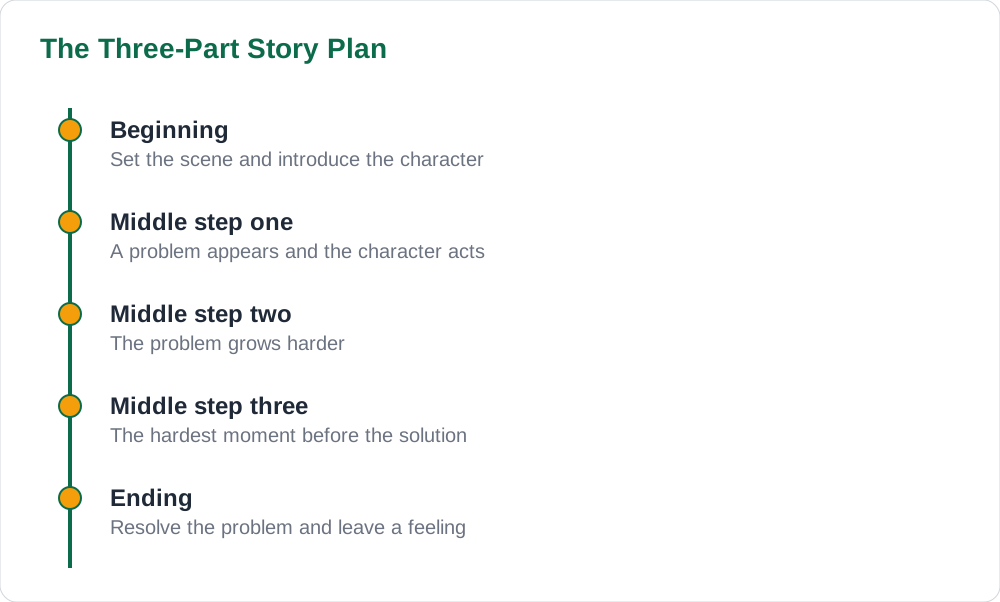
A good story is not a list of events; it is a shape with three parts that pull the reader forward. The beginning sets the scene and introduces the characters, the middle brings a problem that grows harder, and the ending resolves the problem and leaves a feeling behind. Pupils who plan these three parts before writing produce stories with direction, while pupils who start writing without a plan often wander and run out of space before the ending. This guide gives you a simple three-part plan, a worked example you can adapt, and the language tips that make a plain story lively.
The Beginning: Scene, Character, and a Hint of Trouble
A beginning has three jobs: tell the reader where and when the story happens, introduce the main character, and hint that something interesting is coming. "On a hot afternoon in June, twelve-year-old Bilal walked home from school along the canal road, kicking a small stone ahead of him" does all three in one sentence: the setting, the character, and a quiet, ordinary moment that can turn. Avoid openings that only state facts — "There was a boy named Bilal" — and openings that rush into action before the reader knows anyone. Give the reader one vivid detail to hold on to, such as the heat, the stone, or the canal, and the story will feel real from the first line.
Keep the beginning short: two or three sentences, or one short paragraph, is enough for a Class 7 story. Its purpose is to launch the story, not to describe everything. Choose details that will matter later — if the canal matters in the middle, mention it here; if it does not, leave it out. End the beginning with a small hook, a detail that makes the reader ask what happens next: a strange sound, an unexpected visitor, or a lost object. That hook is the bridge into the middle, and a story without one feels flat however well it is written.
The Middle: One Problem That Grows
The middle is the longest part of the story, and it should contain one clear problem that grows worse before it gets better. Bilal hears a faint cry from the canal and finds a small goat stuck in the mud; when he climbs down to help, his own foot sinks too, and the afternoon sun grows hotter. Each step raises the difficulty: a cry, a stuck animal, a stuck rescuer, rising heat. Stories with three rising steps feel satisfying because the reader feels the tension build; stories with ten random events feel scattered, and stories with no problem at all feel like a diary entry rather than a story.
Write the middle in the order things happen, and show the action through senses and feelings rather than only telling it. Instead of "Bilal was worried", write "Bilal's hands shook as he reached for the goat's rope." Instead of "It was hot", write "Sweat ran down his face and the mud smelled of the canal." One or two such sentences per paragraph are enough; the goal is colour, not decoration on every line. Keep the middle to two or three paragraphs, each covering one step of the problem, and end the middle at the hardest moment — the point where the reader most wants to know how it ends.
The Ending: Resolve It and Leave a Feeling
The ending resolves the problem and gives the story its meaning. Bilal ties his school belt to the goat's rope, pulls steadily, and frees the animal; a passing farmer helps him climb out, and Bilal walks home muddy, tired, and proud. Notice that the ending uses something from the beginning — the belt, an ordinary object — rather than a sudden rescue from nowhere. Endings that appear from nowhere feel like cheating; endings that grow out of the story's own details feel earned. After the rescue, add one closing line that states the feeling or lesson quietly: "He had never felt so proud of muddy shoes."
Keep the ending short and do not add a new problem after the resolution. One paragraph is usually enough: the rescue, the result, and the final feeling. Avoid moral lectures — "And so we learn that we should always help others" — because they preach where the story should speak for itself. A single quiet line about pride, relief, or friendship says the lesson better than a paragraph of advice. Read your ending aloud: if it answers the question raised by the middle and leaves a feeling behind, it is done. If it introduces new characters or events, cut them and close on the resolution.
A Worked Example You Can Adapt
Here is the whole Bilal story in plan form, ready to adapt to any topic. Beginning: Bilal walks home along the canal road on a hot afternoon and hears a faint cry. Middle, step one: he finds a goat stuck in the mud and climbs down to help. Middle, step two: his own foot sinks and the sun grows hotter. Middle, step three: he remembers his school belt, ties it to the rope, and pulls steadily. Ending: a passing farmer helps him out, the goat runs to its owner, and Bilal walks home muddy and proud. Five beats, three parts, one problem — that is the entire skeleton of a complete story.
To use this plan for your own topic, change the character, the place, and the problem, but keep the skeleton: one beginning, three middle steps, one ending. A lost key, a forgotten homework book, a kite caught in a tree, and a new student on the first day of school all fit the same shape. Write the five beats as notes before you write a single full sentence; if the beats make sense as notes, the story will make sense as prose. If a beat feels weak, fix it in the plan, where changes cost seconds, rather than in a finished draft, where they cost paragraphs.
Language That Makes a Story Lively
Three language habits lift a plain story into a lively one. First, vary your verbs: walked can become hurried, tiptoed, or stumbled depending on the moment, and said can become whispered, shouted, or murmured. Second, add one sense detail per paragraph — a sound, a smell, a touch — so the reader experiences the scene rather than only hearing about it. Third, mix short and long sentences: a short sentence after a long one creates punch, as in "He pulled with all his strength. The rope held." These habits cost little effort but change how the examiner experiences your story.
Watch for the usual story faults as you revise. Do not change tense halfway through: a story told in the past should stay in the past. Do not introduce characters who do nothing, and do not spend half the story on description before anything happens. Finally, read the finished story aloud from start to finish; your ear will catch repeated words, missing steps, and sentences that sound wrong far faster than your eye. A story that reads smoothly aloud is ready to hand in. For more writing guides, visit the book collection, the solved notes, and the blog from the [home page](/).
AI Help: Muse AI
Muse AI is Meta's personal AI assistant. You can ask it to explain a concept in simple words, summarise a lesson, or make practice questions for revision.
For this article's topic, you can ask Muse AI to help you plan a story in three parts, suggesting a problem for the middle and a closing feeling for the ending.
Join Muse with invite code LTGSWD — in the Muse app, go to Settings > Redeem token and enter the code.
Disclosure: LTGSWD is the author's Muse invite code.
Muse AI does not give official STBB answers — always verify against your Sindh Textbook Board book and your teacher.
5 key points you must know
- Plan three parts before writing: beginning, middle, and ending.
- The beginning sets the scene, introduces the character, and hints at trouble.
- The middle has one problem that grows in three steps.
- The ending resolves the problem using details already in the story.
- Vary verbs, add sense details, and read the story aloud to revise.
Frequently asked questions
How long should the beginning of a story be?
Two or three sentences, or one short paragraph, is enough. The beginning should set the scene, introduce the character, and hint at trouble, then hand over to the middle without delay.
How many problems should a Class 7 story have?
One main problem, growing in about three steps. Several unrelated problems scatter the story, while one problem that grows worse keeps the reader's attention and is easier to resolve.
What makes a good story ending?
An ending that resolves the problem using details already in the story, then leaves a feeling behind in one quiet line. Avoid new characters, new problems, and moral lectures at the end.
How can I make my story less boring?
Vary your verbs, add one sense detail per paragraph, and mix short and long sentences. Show feelings through actions, such as shaking hands, rather than only naming them.
Should I plan a story before writing it?
Yes. Write five beats as notes — beginning, three middle steps, ending — and check that they make sense before writing full sentences. Fixing a weak beat in the plan takes seconds; fixing it in a finished draft takes paragraphs.
Solved notes — preview free
These guides work best with the solved exercises. Preview the solved notes free on this website — 119 solved notes for Classes 6–10 in Sindhi, Urdu, English and Arabic medium. Or browse the full solved notes catalogue for your class and medium. New solved notes are added regularly — check the catalogue for coming-soon books.