Class 7 Prepositions: In, On and At Explained
In, on, and at are tiny words that cause big mistakes, because each one can describe both place and time, and the choice depends on size and precision. Pupils write "in Monday" or "at the table" when they mean something else entirely, and the error stands out to any examiner. The good news is that the rules follow a simple picture: at is a point, on is a surface, and in is a space you can be inside. Once that picture is fixed in your mind, most preposition questions answer themselves. This guide covers place and time separately, with picture examples and the fixed phrases you simply have to learn.
Place: At a Point, On a Surface, In a Space
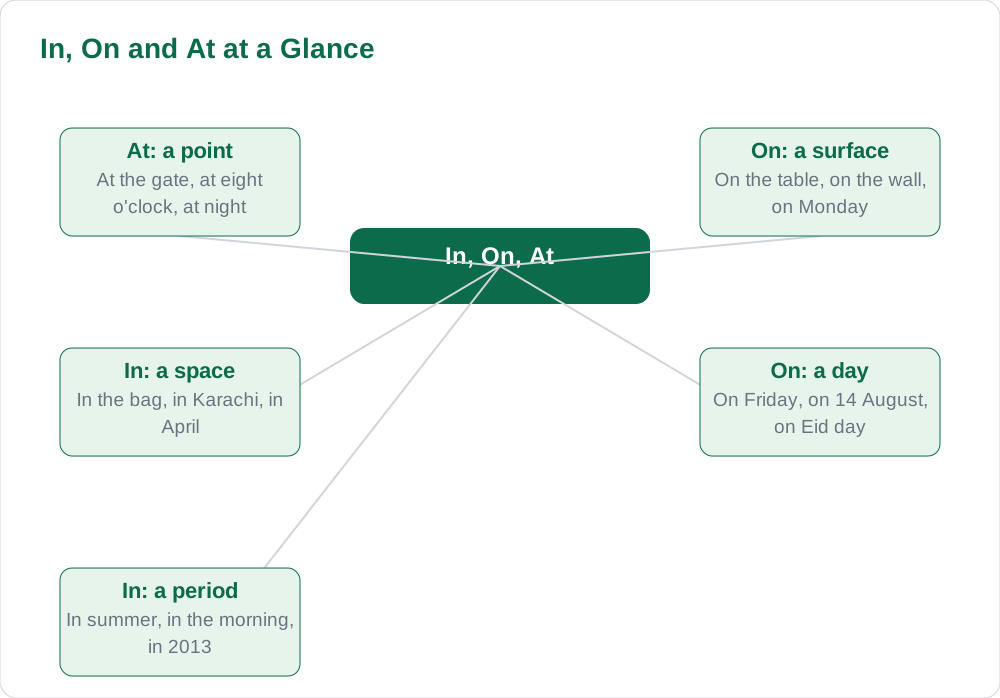
Picture the three prepositions as a target. At is the exact point: "We met at the gate." "She is waiting at the bus stop." Use at for small, specific places such as an address point, a station, or a corner. On is a surface something rests on: "The book is on the table." "The picture hangs on the wall." Use on whenever one thing touches the surface of another. In is an enclosed space: "The books are in the bag." "We live in Karachi." Use in for rooms, buildings, cities, and countries — any space with boundaries you can be inside.
The size rule helps with towns and addresses. We say "at the school gate" for the point, "on Main Street" for the street as a line, and "in Karachi" for the city as an area. The same building can take different prepositions depending on what you mean: "at school" for the point where you are, but "in the classroom" for the room you sit inside. Test yourself by picturing each sentence: point, surface, or enclosed space? If you can see the picture, the preposition usually follows. Draw the three pictures once in your notebook and the rule will stay with you far longer than a memorised list.
Time: At a Moment, On a Day, In a Period
Time works the same way, with at for a point in time, on for a day, and in for a longer period. At takes clock times and single moments: "The class starts at eight o'clock." "We eat dinner at night." On takes days and dates: "We have a test on Monday." "Her birthday is on 14 August." In takes months, years, seasons, and parts of the day: "School opens in April." "He was born in 2013." "It rains in summer." "We study in the morning." The pattern is point, day, period — and it mirrors the place rule exactly, which makes both rules easier to remember together.
Three fixed time phrases break the pattern and must be learned as they are: at night, at the weekend, and in the morning, afternoon, and evening. Notice that night takes at even though morning takes in — English is not perfectly logical here, and examiners know it, which is why these phrases are tested so often. Also note at noon and at midnight, both points in time. A useful drill is to write your whole weekly timetable with prepositions: "I have English on Monday at nine o'clock in the morning" practises all three in one sentence. Read such sentences aloud until the combinations sound right, because the ear catches preposition errors faster than the eye.
Picture Examples You Can Remember
Let us fix the rules with one picture you can replay in your head. Imagine a cat. The cat sits at the door when it waits at a point. The cat sleeps on the mat when it rests on a surface. The cat hides in the box when it is inside an enclosed space. Now imagine the same cat through a week: it visits the vet on Friday, it naps at noon, and it stays indoors in winter. Six sentences, and every preposition follows the point, surface, and space picture. When a test question confuses you, bring back the cat and ask which picture your sentence matches.
The same picture trick works for trickier sentences. "The keys are in the drawer" is a space, so in is right. "The keys are on the shelf" is a surface, so on is right. "Meet me at the library" is a point, so at is right — but "The books are in the library" is a space, so in is right, even for the same building. The building did not change; your way of picturing it did. That is the real secret of prepositions: they describe how you see the place or time, not the place or time itself. Practise by describing your own room with ten in, on, and at sentences, and check each one against its picture.
Fixed Phrases to Learn by Heart
Some prepositions cannot be worked out from rules and must be learned as fixed phrases. We say in the morning but at night, on foot but by bus, at home but in the house, interested in, good at, afraid of, and arrive at a small place but arrive in a big city. "She arrived at the station" and "She arrived in Karachi" show the small-point versus large-area rule again, but many phrases are simply customs of English. The only way to master them is to collect them: keep a notebook page headed "Preposition phrases" and add every new phrase your teacher or reader gives you, with a full example sentence beside it.
Reading is the fastest way to grow that collection, because fixed phrases appear naturally in stories and lessons. When you meet one, underline the whole phrase, not just the preposition — "good at mathematics" is the unit to learn, not "at" alone. Then use the phrase in a sentence of your own the same day, so it moves from your reading memory into your writing memory. Ten phrases learned this way beat fifty phrases copied from a list and never used. Before a test, read your phrase page aloud twice; hearing the correct combinations is what stops you writing "in Monday" under pressure.
Common Mistakes and a Quick Test
Here are the mistakes examiners see most often, with their corrections. "In Monday" should be "on Monday." "At the morning" should be "in the morning." "On Karachi" should be "in Karachi." "At the table" for a book resting on it should be "on the table." Each error comes from using the wrong picture — a day treated as a space, a morning treated as a point, a city treated as a surface. Run the picture test on every doubtful sentence and most errors vanish before you write them. Also watch for missing prepositions: "I go school" needs to: "I go to school."
Finish with this quick self-test, answering without looking back. Fill in the blanks: "We meet ___ the park ___ Sunday ___ five o'clock." "The cat is ___ the roof ___ the morning." "My birthday is ___ December." The answers are at, on, at; on, in; in. If you got them all, your picture sense is working. If any felt like a guess, return to the cat picture and the point, surface, and space rule. For more English guides, visit the book collection, the solved notes, and the blog from the [home page](/).
AI Help: Muse AI
Muse AI is Meta's personal AI assistant. You can ask it to explain a concept in simple words, summarise a lesson, or make practice questions for revision.
For this article's topic, you can ask Muse AI to check the prepositions in your sentences and explain each choice with the point, surface, and space picture.
Join Muse with invite code LTGSWD — in the Muse app, go to Settings > Redeem token and enter the code.
Disclosure: LTGSWD is the author's Muse invite code.
Muse AI does not give official STBB answers — always verify against your Sindh Textbook Board book and your teacher.
5 key points you must know
- At is a point, on is a surface, and in is an enclosed space.
- For time, at takes moments, on takes days and dates, and in takes longer periods.
- Learn fixed phrases as whole units, such as in the morning and at night.
- The same building can take at or in depending on how you picture it.
- Picture each sentence before choosing the preposition.
Frequently asked questions
Why do we say "on Monday" but "in April"?
On takes days and dates, while in takes longer periods such as months, years, and seasons. Monday is a single day, so it takes on; April is a whole month, so it takes in.
Is it "at school" or "in school"?
Both are possible with different meanings. "At school" treats school as a point where you are, while "in the classroom" treats the room as an enclosed space. The preposition follows how you picture the place.
Why is "at night" correct but "in the morning"?
These are fixed phrases of English custom, not logic. Night takes at, while morning, afternoon, and evening take in. Learn them as phrases and they stop causing errors.
Do we say "arrive at" or "arrive in"?
Arrive at takes a small, specific place, as in "arrive at the station", while arrive in takes a large area, as in "arrive in Karachi". The size rule decides.
How can I stop mixing up in, on, and at?
Use the picture test: point means at, surface means on, and enclosed space means in. Practise by describing your room and your week with all three, and keep a notebook page of fixed phrases you meet in reading.
Solved notes — preview free
These guides work best with the solved exercises. Preview the solved notes free on this website — 119 solved notes for Classes 6–10 in Sindhi, Urdu, English and Arabic medium. Or browse the full solved notes catalogue for your class and medium. New solved notes are added regularly — check the catalogue for coming-soon books.