Class 7 Letter Writing: The Format Examiners Want
Letter writing earns easy marks when the format is right, and loses them just as easily when it is wrong, because examiners check the layout before they read a single sentence. A letter has a fixed skeleton — address, date, greeting, body, and ending — and formal and informal letters differ mainly in how polite and distant their language is. Pupils who learn the skeleton once can write any letter the exam sets, from a letter to a friend to a letter to a headteacher. This guide gives you both formats, a clear body plan, and the errors to avoid, so your next letter starts with full format marks already secured.
The Skeleton Every Letter Shares
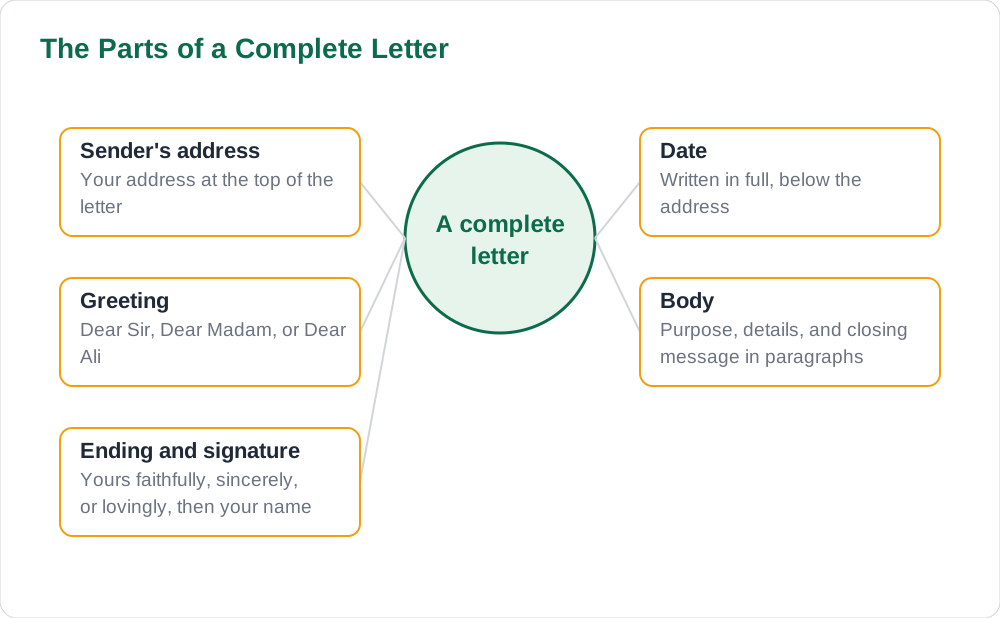
Every letter, formal or informal, follows the same order from top to bottom. First comes the sender's address at the top, then the date below it, then the greeting on the left, then the body in paragraphs, then the ending and signature. In a formal letter, the receiver's address also appears, placed after the date and before the greeting, along with a subject line that states the purpose in a few words. Learning this order as a picture — top to bottom, address to signature — means you never have to reconstruct it under exam pressure; you simply fill in the parts.
The date format matters: write it in full, such as "12 March 2026", rather than in figures alone, which can be misread. The greeting in a formal letter is "Dear Sir," or "Dear Madam," or "Dear Mr Ahmed," when you know the name, while an informal letter uses "Dear Ali," or "My dear Mother,". The ending matches the greeting in formality: formal letters close with "Yours faithfully," when you used Dear Sir or Madam, and "Yours sincerely," when you used the person's name. Informal letters close with "Yours lovingly," or "Your loving friend,". Matching greeting to ending is a small detail examiners notice at once.
Formal Letters: Polite, Clear, and to the Point
A formal letter is written to someone you do not know well — a headteacher, an editor, a manager — so its language is polite, direct, and free of slang. The body usually has three paragraphs. The first states the purpose plainly: "I am writing to request permission to visit the library during the holidays." The middle paragraph gives the reason and the necessary details, such as dates and names, in clear sentences. The last paragraph states what you hope will happen and thanks the reader: "I would be grateful if you could grant this permission. Thank you for your time." No paragraph should wander; every sentence should serve the purpose.
Formal language has its own habits. Use full forms, not contractions: "I am" rather than "I'm", and "I do not" rather than "don't". Avoid exclamation marks and chatty phrases such as "By the way". Keep sentences complete and respectful, even when you are complaining: "I wish to draw your attention to the broken fans in our classroom" is far stronger than an angry complaint. Remember that a formal letter is a piece of official communication; it should sound like something you would be comfortable having read aloud in an office. Practise by writing a formal letter requesting a school transfer certificate, and check every sentence for politeness and purpose.
Informal Letters: Warm, Natural, and Personal
An informal letter goes to family and friends, so it can be warm, relaxed, and full of personal news. The body still needs paragraphs, but the tone changes completely. Open with a friendly line: "I hope you are well. I was delighted to receive your letter." Then share your news in the middle paragraphs — your studies, a match you played, a visit you enjoyed — in the order that feels natural, as if you were talking. Close with a warm line: "Please convey my regards to everyone at home. I look forward to your reply." The reader should feel your personality in the letter, not a stiff template.
Informal does not mean careless. Contractions such as "I'm" and "don't" are fine here, but spelling, punctuation, and paragraphing still count, and slang should stay light. A common mistake is writing one giant paragraph of news with no breaks; instead, start a new paragraph for each topic — health and greetings, then your news, then questions about the reader, then the closing. Another mistake is copying a formal opening into a friendly letter: "I am writing to inform you" sounds absurd to a cousin. Match the voice to the reader, and the letter will feel genuine rather than memorised.
Building the Body Paragraph by Paragraph
The body is where most letter marks are won or lost, so plan it before you write. For any letter, jot down three points: the purpose, the details, and the closing request or message. Then give each point its own paragraph. A letter to a friend about a school trip might run: paragraph one, thanks for the last letter and the trip news; paragraph two, what you saw and enjoyed most; paragraph three, a question about your friend's own trip and a warm close. Three paragraphs, three jobs, no repetition — that structure works for almost every Class 7 letter topic.
Link your paragraphs with natural connectors rather than jumping between topics. Phrases such as "Besides this", "Another thing I enjoyed", and "Before I close" guide the reader smoothly from one point to the next. Keep each paragraph to four or five sentences; very long paragraphs tire the reader, while one-sentence paragraphs look unfinished. Read the finished letter aloud: if it sounds like a real person talking to a real reader, the body is working. If it sounds like a list of memorised lines, rewrite the stiffest sentences in your own words before handing it in.
Errors That Cost Format Marks
These errors appear in letter after letter, and avoiding them is worth several marks on its own. Missing the date or the address loses format marks before the body is even read. Using "Yours faithfully" with a named greeting, or "Yours sincerely" with Dear Sir, mixes the formal pairings. Forgetting the subject line in a formal letter leaves the reader guessing at the purpose. Writing the whole letter as one paragraph, or forgetting paragraphs entirely, makes even good content look unplanned. Signing with your full name in an informal letter to a friend looks odd; a first name is enough.
Other errors are about tone: slang in a formal letter, stiff official language in a friendly letter, and exclamation marks everywhere in both. Spelling of the receiver's name and title matters too — check them twice. Finally, never leave a letter unfinished: a letter without an ending and signature looks abandoned, however good its body was. Before you hand in any letter, run down the skeleton from top to bottom — address, date, greeting, body paragraphs, ending, signature — and tick each part off. For more writing guides, visit the book collection, the solved notes, and the blog from the [home page](/).
AI Help: Muse AI
Muse AI is Meta's personal AI assistant. You can ask it to explain a concept in simple words, summarise a lesson, or make practice questions for revision.
For this article's topic, you can ask Muse AI to outline a formal or informal letter for a topic you choose, showing the address, greeting, body paragraphs, and ending in order.
Join Muse with invite code LTGSWD — in the Muse app, go to Settings > Redeem token and enter the code.
Disclosure: LTGSWD is the author's Muse invite code.
Muse AI does not give official STBB answers — always verify against your Sindh Textbook Board book and your teacher.
5 key points you must know
- Every letter runs: address, date, greeting, body, ending, signature.
- Formal letters add the receiver's address and a subject line.
- Match greeting to ending: Dear Sir with faithfully, a named greeting with sincerely.
- Give the body three paragraphs: purpose, details, and closing message.
- Check the skeleton top to bottom before handing any letter in.
Frequently asked questions
Where does the date go in a letter?
The date goes below the sender's address at the top of the letter, written in full, such as "12 March 2026". In a formal letter, the receiver's address and subject line follow the date.
Should I end a formal letter with "Yours faithfully" or "Yours sincerely"?
Use "Yours faithfully," when you greeted with "Dear Sir," or "Dear Madam,", and "Yours sincerely," when you used the person's name, as in "Dear Mr Ahmed,". The ending matches the greeting.
How many paragraphs should a letter body have?
Three paragraphs suit most Class 7 letters: the first states the purpose, the middle gives details, and the last states the closing request or message. Start a new paragraph for each new topic.
Can I use contractions in a formal letter?
No. Formal letters use full forms such as "I am" and "I do not", and avoid slang and exclamation marks. Contractions are fine in informal letters to family and friends.
What is the subject line in a formal letter?
It is a short line after the receiver's address stating the purpose, such as "Subject: Request for a transfer certificate". It tells the reader at once what the letter is about.
Solved notes — preview free
These guides work best with the solved exercises. Preview the solved notes free on this website — 119 solved notes for Classes 6–10 in Sindhi, Urdu, English and Arabic medium. Or browse the full solved notes catalogue for your class and medium. New solved notes are added regularly — check the catalogue for coming-soon books.