Class 7 Direct and Indirect Speech Without Confusion

Direct speech repeats a person's exact words inside quotation marks: Sara said, "I am happy today." Indirect speech reports the same meaning without the exact words: Sara said that she was happy that day. The meaning stays the same, but three things shift — the tense, the pronouns, and the time words — and pupils who miss one of those shifts lose marks. The good news is that the shifts follow a simple rule: move everything one step back in time, as if you are reporting from a later point. This guide walks through that rule with reporting verbs, tense shifts, pronoun changes, questions, and commands, so reported speech stops feeling like guesswork.
Direct and Indirect: What Actually Changes
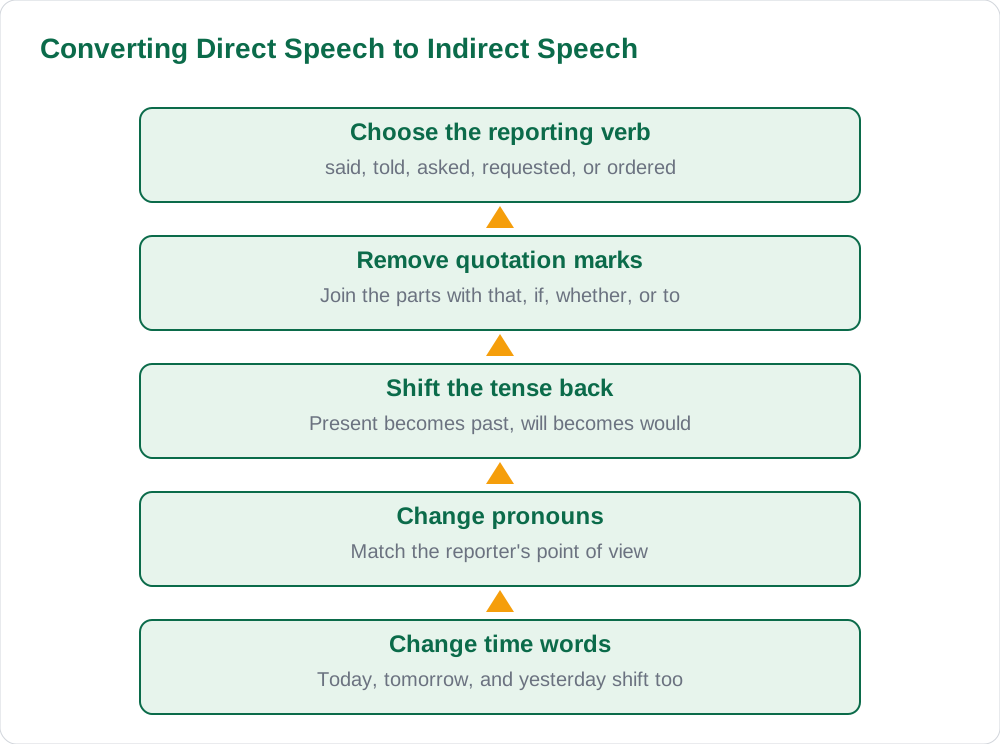
Direct speech shows the speaker's own words: Ali said, "I will come tomorrow." Indirect speech reports those words through a reporting verb: Ali said that he would come the next day. Four changes happened at once. The quotation marks and comma disappeared, the word that joined the two parts, the pronoun I became he, and the verbs shifted back — will became would and tomorrow became the next day. Once you can name those four changes, every reported-speech question becomes a checklist rather than a puzzle.
The reporting verb itself matters too. Said is the safe, neutral choice, but told needs an object: "She told me that she was busy" is correct, while "She told that she was busy" is incomplete. Other reporting verbs add meaning: asked for questions, requested for polite requests, and ordered for commands. Choosing the right reporting verb shows the examiner that you understood the speaker's intention, not just the words. Practise by taking five direct sentences from a storybook and reporting each one, checking off the four changes every time.
The Tense Shift: One Step Back
The main tense rule is simple: when the reporting verb is in the past, shift the reported verb one step back. Present simple becomes past simple: "I like mangoes" becomes "He said that he liked mangoes." Present continuous becomes past continuous: "I am reading" becomes "She said that she was reading." Present perfect becomes past perfect: "I have finished my work" becomes "He said that he had finished his work." Future with will becomes would: "I will help you" becomes "She said that she would help me." Learn these four shifts as a set and most Class 7 questions are already covered.
Two exceptions are worth knowing. If the reported statement is a universal truth, the tense often stays: "The teacher said that the sun rises in the east" keeps rises, because the fact is still true. Also, if the reporting verb is in the present — "She says that she is busy" — no backshift happens at all, because the report is happening in the same time frame as the speech. Watch out for the most common error: shifting only half the sentence, as in "He said that he is busy" when the original was present and the report is in the past. The correct backshift is "He said that he was busy."
Pronouns and Time Words Change Too
Pronouns change to match the new point of view, and this is where careless errors creep in. When Sara says, "I love my school," the report from someone else becomes "Sara said that she loved her school" — I becomes she and my becomes her. When Ali tells you, "I will help you," your report becomes "Ali said that he would help me" — you becomes me, because the report is now from your point of view. Always ask: who is speaking now, and who is being spoken about? The pronouns must answer from the reporter's position, not the original speaker's.
Time and place words shift as well, because the report happens later and usually somewhere else. Today becomes that day, tomorrow becomes the next day, yesterday becomes the previous day, now becomes then, here becomes there, and this becomes that. So "I am busy today" reported later becomes "She said that she was busy that day," and "I will come here tomorrow" becomes "He said that he would come there the next day." Pupils often shift the tense perfectly and then leave tomorrow unchanged, which breaks the logic of reporting from a later time. Check pronouns and time words as a pair at the end of every conversion.
Reporting Questions and Commands
Questions in indirect speech lose their question form: the word order returns to statement order and the question mark disappears. A yes-or-no question uses if or whether: "Are you ready?" asked by the teacher becomes "The teacher asked whether we were ready." A wh-question keeps its question word and takes statement order: "Where do you live?" becomes "She asked me where I lived" — not "where did I live," because the helping verb did disappears in the statement order. This return to statement order is the single most tested rule in reported questions, so drill it with ten examples until it feels natural.
Commands and requests use an infinitive with to, and the reporting verb tells the reader what kind of sentence it was. "Please sit down" becomes "The teacher asked us to sit down," while "Do not run" becomes "She told the boys not to run." Notice that not goes before to in a negative command. Requests with please usually take asked, while strict orders take ordered or told: "Open your books" becomes "The teacher told us to open our books." Keep the structure tight — reporting verb, object, to plus base verb — and commands become the easiest part of reported speech rather than the hardest.
A Five-Minute Daily Drill
Here is a drill that covers every rule in this guide in five minutes a day. Take one short dialogue from your English reader — even four lines is enough — and report the whole conversation in your notebook. Convert one statement, one question, one command, and one sentence with a time word, then check your work against the five-step list above. Do this for a week and you will have practised thirty-five conversions, which is more than most pupils do in a whole term. The goal is not speed but accuracy: a slow, correct conversion beats a fast, half-shifted one every time.
Before any test, run a final checklist over your reported sentences. Is the word order statement order in questions? Did the tense shift one step back? Do the pronouns match the reporter? Did today, tomorrow, and yesterday change? Did commands use to plus the base verb? If all five answers are yes, your reported speech is sound. For more grammar practice, visit the book collection, the solved notes, and the blog from the [home page](/).
AI Help: Muse AI
Muse AI is Meta's personal AI assistant. You can ask it to explain a concept in simple words, summarise a lesson, or make practice questions for revision.
For this article's topic, you can ask Muse AI to convert your direct speech sentences into indirect speech step by step, explaining each tense shift and pronoun change as it goes.
Join Muse with invite code LTGSWD — in the Muse app, go to Settings > Redeem token and enter the code.
Disclosure: LTGSWD is the author's Muse invite code.
Muse AI does not give official STBB answers — always verify against your Sindh Textbook Board book and your teacher.
5 key points you must know
- Indirect speech removes quotation marks and joins the report with that, if, whether, or to.
- With a past reporting verb, shift the reported tense one step back.
- Pronouns change to match the reporter's point of view.
- Time words shift too: today, tomorrow, and yesterday all move.
- Questions return to statement order, and commands use to plus the base verb.
Frequently asked questions
How do I report "I am happy today"?
Shift the tense, pronoun, and time word: "She said that she was happy that day." Present continuous becomes past continuous, I becomes she, and today becomes that day.
What is the difference between said and told?
Said does not need an object, as in "She said that she was busy", while told needs one: "She told me that she was busy". Using told without an object is incomplete.
How do I report a yes-or-no question?
Use if or whether and statement word order: "Are you ready?" becomes "The teacher asked whether we were ready." There is no question mark and no helping-verb inversion.
How do I report "Please sit down"?
Use asked plus an infinitive: "The teacher asked us to sit down." For a negative command, put not before to: "She told them not to run."
Does the tense always shift in indirect speech?
Not always. If the reporting verb is in the present, as in "She says that she is busy", no backshift happens. Universal truths also often keep their tense, as in "The teacher said that the sun rises in the east".
Solved notes — preview free
These guides work best with the solved exercises. Preview the solved notes free on this website — 119 solved notes for Classes 6–10 in Sindhi, Urdu, English and Arabic medium. Or browse the full solved notes catalogue for your class and medium. New solved notes are added regularly — check the catalogue for coming-soon books.