Class 7 Dialogue Writing: Conversations That Sound Real
Dialogue is writing that lets characters speak for themselves, and good dialogue sounds like real people talking — short, natural, and full of personality. Bad dialogue sounds like an essay with quotation marks, with long formal sentences nobody would ever say aloud. Class 7 dialogue questions usually ask for a short conversation in a familiar setting — a shop, a school, or a home — and they test two things at once: punctuation and natural speech. This guide covers both, with worked dialogues you can learn from and punctuation rules that prevent the most common mark losses.
The Punctuation Rules That Matter Most
Four punctuation rules carry most dialogue marks. First, put the spoken words inside inverted commas: "Good morning," said the shopkeeper. Second, start a new paragraph every time a new person speaks, even if they say only one word; this is the rule pupils forget most often, and examiners notice it immediately. Third, put commas and full stops inside the closing inverted comma when a reporting clause follows: "I want a notebook," said Ali. Fourth, start the spoken sentence with a capital letter, and use a question mark or exclamation mark for questions and exclamations: "How much is this?" asked Sara.
Reporting clauses — said Ali, asked Sara, replied the teacher — can sit before, after, or in the middle of the speech, and the punctuation changes with the position. Before the speech, use a comma: Ali said, "I want a notebook." After the speech, use a comma inside the quotes when the sentence continues: "I want a notebook," said Ali. In the middle, split carefully: "I want a notebook," said Ali, "and a pencil too." Note that the second half starts with a small letter because it continues the same sentence. Practise these three positions until each one feels automatic, because mixed positions appear in every dialogue question.
A Shop Dialogue: Polite and Practical
Shop dialogues test polite, practical language: greetings, requests, prices, and thanks. Here is a short model. Shopkeeper: "Good morning! How can I help you?" Customer: "Good morning. I want a geometry box, please." Shopkeeper: "Here you are. That will be three hundred rupees." Customer: "Here is the money. Thank you very much." Shopkeeper: "Thank you. Please visit again." Notice how short each turn is, how please and thank you appear naturally, and how the conversation has a clear purpose and a clear close. A shop dialogue that wanders into unrelated topics loses focus and marks.
Write your own shop dialogue by following the same shape: greeting, request, price or choice, payment, thanks, farewell. Six to eight turns are enough for a Class 7 answer; more turns usually mean repetition rather than extra marks. Give the speakers different voices if you can: the shopkeeper is brisk and helpful, the customer is polite and a little unsure. Avoid narrating inside the dialogue — "He went to the shop and he said" belongs in story writing, not in a dialogue answer, where the conversation itself should carry the scene. One line of scene-setting before the dialogue starts is enough.
School and Home Dialogues: Warm and Natural
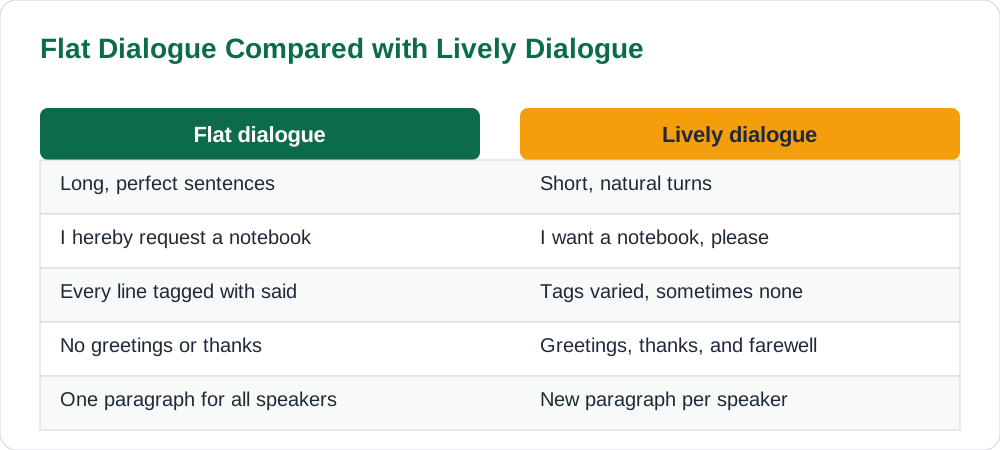
School dialogues often involve asking a teacher a question or discussing homework with a classmate. Keep the language respectful but natural: "Excuse me, Miss, may I ask a question about today's lesson?" "Of course, Ahmed. What would you like to know?" "I did not understand the last example. Could you explain it again, please?" "Certainly. Let us work through it together." The pupil is polite without being stiff, and the teacher is helpful without lecturing. Contrast this with an unnatural version — "Respected teacher, I hereby request you to kindly explain" — which no pupil would ever say and which examiners mark down for stiffness.
Home dialogues are the warmest of all, because family members speak freely. A dialogue between a mother and daughter about helping in the kitchen might run: "Ayesha, could you help me in the kitchen?" "Of course, Mother. What shall I do first?" "Please wash these vegetables while I prepare the rice." "I will do that right away." Short turns, everyday words, and small courtesies make it sound real. Read every dialogue you write aloud, ideally with a partner taking the other part; if a line feels awkward to say, rewrite it until it sounds like something a real person would say in that situation.
Making Dialogue Sound Like Real People
Real speech is shorter than written prose. People answer in fragments — "Really?" "Of course." "Not today." — and they interrupt, repeat, and use small words such as well, oh, and yes. Use these features sparingly and your dialogue comes alive: "Are you coming to the match?" "Well, I have homework, but I will try." "Good! We need you on the team." Avoid the opposite fault: giving every speaker long, perfect sentences that read like textbook paragraphs. A dialogue of perfect sentences is grammatically correct and completely lifeless, and examiners can tell the difference at a glance.
Give each speaker a recognisable voice by thinking about who they are. A young child asks short, direct questions; a teacher explains patiently; a grandparent speaks slowly and warmly. You do not need dialect or slang to show this — word choice and sentence length are enough. Also use dialogue tags beyond said where they fit: whispered, laughed, replied, exclaimed — but do not overuse them, since a tag on every single line becomes distracting. The best rule is variety: said most of the time, a stronger tag only when the feeling truly needs it, and sometimes no tag at all when the speaker is obvious from the paragraph change.
A Final Checklist Before You Hand In
Run this checklist over every dialogue answer before handing it in. Is there a new paragraph for each new speaker? Are all spoken words inside inverted commas? Are commas and full stops placed correctly before the closing quotes? Does each spoken sentence start with a capital letter? Do the speakers sound like real people in this situation, with short turns and natural courtesies? Does the conversation have a beginning, a purpose, and a close, rather than stopping halfway? Six yes answers mean the dialogue is ready; any no points to a fix that takes seconds and saves marks.
Practise one dialogue a week in rotation — shop, school, home — and read each one aloud with a partner. Keep a notebook page of useful dialogue phrases: greetings, polite requests, thanks, and farewells, collected from your reading and lessons. Over a term, that page becomes a toolkit you can draw on for any dialogue topic the exam sets. For more writing guides, visit the book collection, the solved notes, and the blog from the [home page](/).
AI Help: Muse AI
Muse AI is Meta's personal AI assistant. You can ask it to explain a concept in simple words, summarise a lesson, or make practice questions for revision.
For this article's topic, you can ask Muse AI to turn a plain paragraph into a short dialogue between two speakers, and to explain the punctuation choices it made.
Join Muse with invite code LTGSWD — in the Muse app, go to Settings > Redeem token and enter the code.
Disclosure: LTGSWD is the author's Muse invite code.
Muse AI does not give official STBB answers — always verify against your Sindh Textbook Board book and your teacher.
5 key points you must know
- Put spoken words in inverted commas and start a new paragraph per speaker.
- Place commas and full stops inside the closing inverted comma when a tag follows.
- Keep turns short and natural, like real speech, not textbook paragraphs.
- Give each speaker a voice through word choice and sentence length.
- Every dialogue needs a greeting, a purpose, and a close.
Frequently asked questions
Do I start a new paragraph when a new person speaks?
Yes, always, even if the person says only one word. This is the most commonly forgotten dialogue rule, and examiners notice it immediately.
Where does the comma go in "I want a notebook," said Ali?
The comma goes inside the closing inverted comma, because the sentence continues with the reporting clause said Ali. If the speech stood alone, it would end with a full stop inside the quotes.
Can I use said for every line of dialogue?
You can, but variety is better: whispered, replied, asked, and exclaimed add feeling where it fits. Use stronger tags sparingly, and sometimes use no tag at all when the speaker is obvious.
How long should a Class 7 dialogue be?
Six to eight turns are usually enough. More turns tend to repeat the same points rather than earn extra marks, so aim for a complete conversation with a greeting, a purpose, and a close.
How do I make dialogue sound natural?
Read it aloud with a partner and rewrite any line that feels awkward to say. Real speech uses short turns, fragments, and small courtesies such as please and thank you.
Solved notes — preview free
These guides work best with the solved exercises. Preview the solved notes free on this website — 119 solved notes for Classes 6–10 in Sindhi, Urdu, English and Arabic medium. Or browse the full solved notes catalogue for your class and medium. New solved notes are added regularly — check the catalogue for coming-soon books.