Class 7 Comprehension: How to Answer Passage Questions
Comprehension questions look easy because the answers are sitting in the passage, yet pupils lose marks on them every term. The usual causes are rushing the first read, copying whole lines instead of answering the question, and missing what the question actually asks. A steady method fixes all three: read twice, underline as you go, and answer in your own words. This guide teaches that method question type by question type — factual, vocabulary, inference, and title questions — so that the next unseen passage becomes a chance to score full marks rather than a source of worry.
Read Twice: First for Sense, Then for Answers
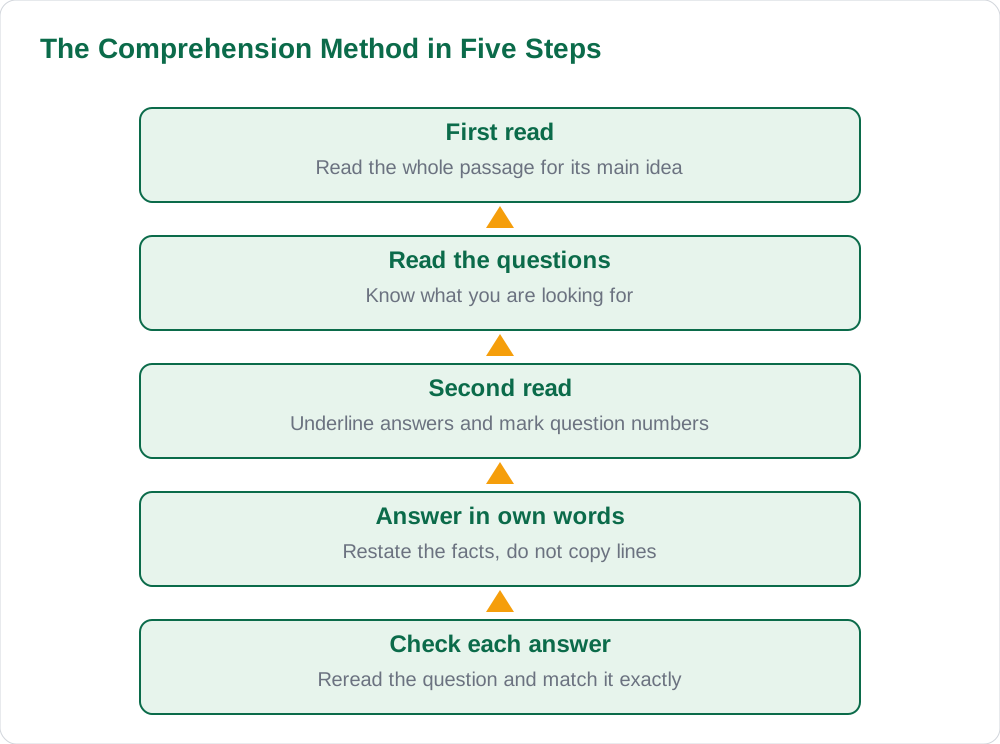
Read the passage once all the way through without stopping to answer anything, just to understand what it is about and how it is organised. Ask yourself after this first read: who or what is this passage about, and what is the main idea? Then read the questions before your second read, so you know what to look for. On the second read, move slowly and underline the parts that answer each question, writing the question number in the margin beside the underlined lines. This two-read habit takes only a few extra minutes and prevents the most common error: answering from a half-remembered first impression.
Do not skip the second read even when the passage looks simple, because easy-looking passages hide detail questions — dates, names, reasons, and sequences — that a fast first read misses. If a sentence confuses you, read it twice before moving on; comprehension passages are written to be understood, and a sentence that seems unclear usually becomes clear when read slowly and in full. Note the passage's structure as you read: an opening that introduces a person or place, a middle that gives events or reasons, and an ending that draws a conclusion. Knowing the structure tells you where each kind of answer is likely to live.
Underline Answers and Answer in Your Own Words
Underlining is the bridge between reading and answering. When a question asks why the farmer was happy, underline the sentence that gives the reason, then write your answer from that sentence without copying it word for word. Examiners reward answers in your own words because they prove understanding; a copied sentence may earn a mark for the fact but loses the credit for comprehension. Change the sentence structure as you write: turn "The farmer was happy because the rain had saved his crops" into "The rain had saved his crops, which made the farmer happy." Same fact, your words, full credit.
Keep answers complete but tight. A good comprehension answer is usually one or two sentences that directly address the question, with no extra story added. If the question asks when something happened, give the time; if it asks why, give the reason; if it asks how, give the method. Avoid the two opposite mistakes: a one-word answer that leaves the examiner guessing, and a paragraph that buries the answer in copied text. After writing each answer, read the question again and check that your answer matches it exactly — a correct fact answering the wrong question still earns no mark.
Factual, Vocabulary, and Inference Questions
Factual questions ask for something stated directly: who, what, when, where. Their answers are in the underlined lines, and your job is to restate them clearly and completely. Vocabulary questions ask for the meaning of a word as used in the passage, or for a word similar or opposite in meaning. Guess from the sentence first — the words around an unknown word usually hint at its meaning — then check that your answer fits the sentence when substituted back. For example, if a passage says "The weary traveller rested under a tree", weary must mean tired, because resting follows tiredness.
Inference questions ask for something the passage suggests but does not state outright, such as how a character feels or what might happen next. These need evidence plus reasoning: quote the clue briefly, then state what it shows. For example, "The boy clenched his fists and turned away" suggests anger, because clenched fists are a sign of it. Never answer an inference question with a pure guess; always tie your answer to a detail from the passage, and use cautious language such as "This suggests" or "This shows". Inference answers with evidence earn full marks, while unsupported guesses earn none, however plausible they sound.
Title, Summary, and True-or-False Questions
Title questions ask for a suitable heading for the passage, and the best title names the main idea, not one small detail. A passage about a boy who learns honesty after returning a lost wallet could be titled "The Honest Boy" or "A Lesson in Honesty", but not "The Wallet", which misses the point. Choose a short title of two to five words that covers the whole passage, and test it: does every paragraph fit under this title? If a paragraph falls outside it, the title is too narrow. A good title is a summary in miniature, and choosing one well shows the examiner you grasped the passage as a whole.
Summary questions ask you to retell the passage briefly, usually in a set number of sentences or words. Pick one main point from each paragraph, drop examples and repeated details, and join the points in your own words in the passage's order. True-or-false questions need a passage check for every statement: find the line that confirms or contradicts it, and do not mark true for a statement that is only partly right. If a statement says "The farmer grew wheat and rice" but the passage mentions only wheat, it is false. Precision beats speed on every one of these question types.
Time Management and Final Checks
Spend your comprehension time in proportion to the marks. Read the passage and questions first, answer the factual questions quickly, and save extra time for inference and summary questions, which need thinking. If one question resists you, move on and return to it after the easier ones; a stuck question should never eat the time meant for five answerable ones. Keep an eye on the clock, but do not rush the second read — it is the step that makes all the answers reliable, and skipping it to save two minutes usually costs more marks than it saves.
Before you move on, run three final checks. First, is every question answered, with no blank left? Second, does each answer match its question — when, why, how, or what? Third, are the answers in your own words, with copied phrases kept short and only where the exact wording matters, such as a name or a quoted phrase? A blank answer can never earn a mark, so even an uncertain attempt is better than nothing: write your best understanding and move on. For more reading and writing guides, visit the book collection, the solved notes, and the blog from the [home page](/).
AI Help: Muse AI
Muse AI is Meta's personal AI assistant. You can ask it to explain a concept in simple words, summarise a lesson, or make practice questions for revision.
For this article's topic, you can ask Muse AI to make short practice passages with questions, and then explain why a particular answer fits the passage while another does not.
Join Muse with invite code LTGSWD — in the Muse app, go to Settings > Redeem token and enter the code.
Disclosure: LTGSWD is the author's Muse invite code.
Muse AI does not give official STBB answers — always verify against your Sindh Textbook Board book and your teacher.
5 key points you must know
- Read the passage twice: once for sense, once with the questions in mind.
- Underline answers during the second read and mark question numbers in the margin.
- Answer in your own words, restating facts instead of copying whole lines.
- Support inference answers with a detail from the passage.
- Check every answer against its question before moving on.
Frequently asked questions
Why should I read the passage twice?
The first read gives you the main idea and structure, while the second read, done after reading the questions, lets you find and underline exact answers. A single fast read misses details that detail questions test.
Is it wrong to copy a sentence from the passage as my answer?
Copying proves little understanding, so examiners prefer answers in your own words. Restate the fact in a new sentence structure, keeping exact wording only for names or short quoted phrases.
How do I answer an inference question?
Find the clue in the passage, then state what it suggests, using words like "This suggests" or "This shows". Always tie the answer to a passage detail rather than guessing from general knowledge.
How do I choose a good title for a passage?
Pick a short title of two to five words that names the main idea of the whole passage, not one small detail. Test it by checking that every paragraph fits under it.
What should I do if I cannot answer a question?
Move on to the easier questions and return to it later, so one hard question does not eat your time. Never leave a blank: write your best understanding, since a blank answer can never earn a mark.
Solved notes — preview free
These guides work best with the solved exercises. Preview the solved notes free on this website — 119 solved notes for Classes 6–10 in Sindhi, Urdu, English and Arabic medium. Or browse the full solved notes catalogue for your class and medium. New solved notes are added regularly — check the catalogue for coming-soon books.