Class 7 Articles: A, An and The Rules That Stick
A, an, and the are the smallest words in English and some of the most tested, because a missing or wrong article makes a sentence feel off even when every other word is right. The whole system rests on one idea: a and an introduce something new or any one of a kind, while the points to something already known or the only one of its kind. Add one sound rule for choosing between a and an, and a short list of no-article cases, and you have the complete Class 7 article system. This guide explains each rule with short drills you can do in your notebook tonight.
A and An: First Mention of Something New
Use a or an when you mention something for the first time, or when you mean any one of a kind rather than a particular one. "I saw a dog in the street" introduces a dog the reader has not met before. "She wants to be a teacher" means any teacher, not one specific teacher. "He bought an umbrella" introduces one umbrella out of many. In each case, the reader cannot yet point to which one you mean, and that newness is exactly what a and an signal. Once the thing has been introduced, you switch to the, as the next section explains.
The choice between a and an depends on sound, not spelling. Use an before a vowel sound: "an apple", "an egg", "an hour" — hour starts with the letter h but its first sound is a vowel, so it takes an. Use a before a consonant sound: "a book", "a university" — university starts with the letter u but its first sound is the consonant y, so it takes a. Say the word aloud and listen to its first sound; that sound decides. Practise with a list of tricky words — hour, honest, university, European, one — and the sound rule will replace the spelling guess that causes most errors.
The: Known Things and Only Ones
Use the when the reader already knows which thing you mean. The most common way a thing becomes known is that you mentioned it before: "I saw a dog in the street. The dog was chasing a cat." The first mention takes a, and every later mention takes the, because now both writer and reader are thinking of the same dog. The also points to things known from the situation: "Please close the door" works because there is one obvious door in the room, and "The teacher asked us to sit down" works because the class knows which teacher is meant.
The also goes with things that are the only one of their kind: the sun, the moon, the earth, the sky. There is only one sun in our sky, so it is always the sun, never a sun, in ordinary writing. The same logic covers superlatives and firsts: "the best student", "the tallest boy", "the first chapter" — each one points to a single, identified thing. A useful test is to ask: can my reader point to exactly which one I mean? If yes, use the. If the reader would ask "which one?", you probably need a or an, or no article at all.
When to Use No Article
Some nouns take no article at all, and this is where many pupils add a or the by mistake. General plural and uncountable nouns take no article when you mean them in general: "Dogs are loyal animals" speaks about dogs in general, not particular dogs, so it needs no article. "Water is precious" and "Honesty is the best policy" work the same way. School subjects, languages, and most sports also take no article: "She studies mathematics", "He speaks Sindhi", "They play cricket." Meals follow the same pattern in general statements: "We eat breakfast at seven."
Names of most places take no article too: "She lives in Karachi", "He visited Pakistan", "We went to Murree." Exceptions with the include rivers, seas, and groups of islands — the Indus, the Arabian Sea — and country names that are plural or contain a common noun, such as the United States. Do not add the to a person's name or to a single mountain: "Ali", "Mount Everest". When you are unsure, ask whether you mean the thing in general or one particular thing. General meaning usually means no article, while particular meaning usually means the.
Short Drills That Fix the Rules
Drill one: first mention versus known things. Read this paragraph and fill in the articles: "Ali found ___ old key in ___ garden. ___ key opened ___ small box." The answers are an, the, The, a — an old key is a first mention, the garden is known from the situation, The key is now known, and a small box is newly introduced. Cover the answers and repeat the paragraph until the pattern feels obvious. Then write your own four-sentence paragraph that introduces two new things and mentions them again, checking that every first mention takes a or an and every repeat takes the.
Drill two: sound, not spelling. Sort these words into a and an columns: apple, university, hour, egg, European, honest man, one rupee, orange. The an column holds apple, hour, egg, honest man, and orange, because each begins with a vowel sound. The a column holds university, European, and one rupee, because each begins with a consonant sound despite its spelling. Do this sorting aloud, listening to the first sound of each word, and the rule will hold under test pressure far better than a memorised spelling list ever could.
Common Mistakes Before the Test
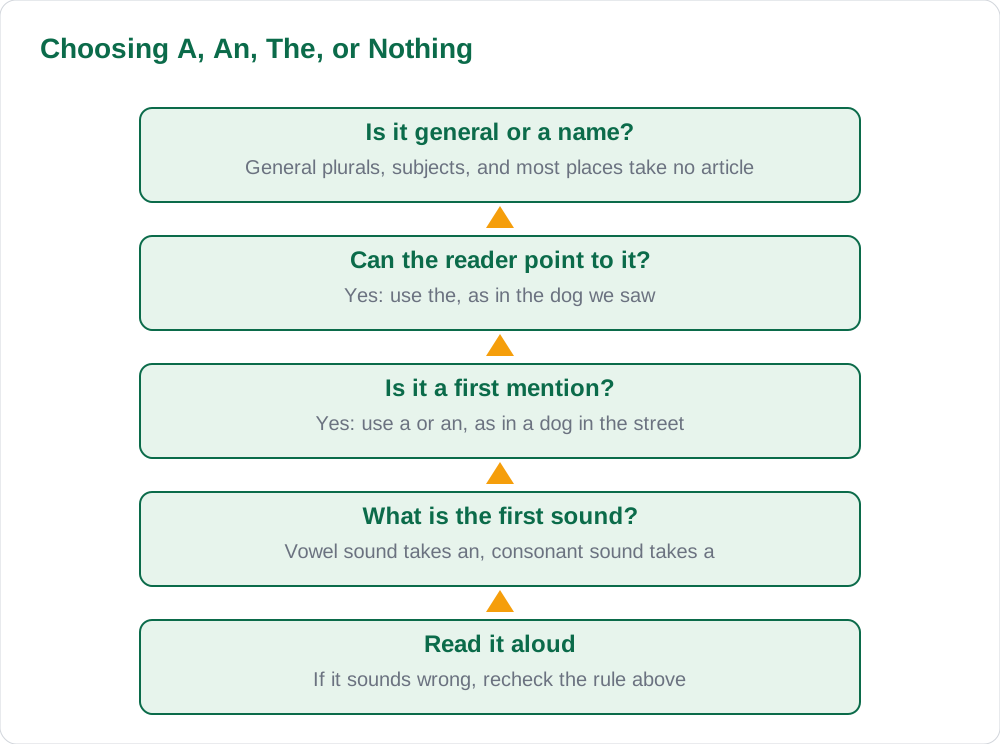
The most frequent article mistakes in Class 7 are easy to list and easy to fix. Using the for a first mention: "I saw the dog" when no dog has been mentioned is wrong unless the situation makes the dog obvious. Using a before a vowel sound: "a apple" should be "an apple." Adding the to a general statement: "The honesty is the best policy" should be "Honesty is the best policy." Adding the to school subjects: "the mathematics" should be "mathematics" in "She likes mathematics." Each of these errors comes from skipping one question in the flowchart above, so run the flowchart mentally on every doubtful noun.
Build a final checking habit for written work: read each paragraph once only for articles, underlining every a, an, and the and every bare noun. For each one, ask whether the thing is new, known, or general. This single slow read catches more article errors than any amount of fast re-reading, because articles are small and the eye skips them at normal speed. Keep a notebook page of your own article mistakes, with the corrected sentence beside each one, and review it before every test. For more grammar guides, visit the book collection, the solved notes, and the blog from the [home page](/).
AI Help: Muse AI
Muse AI is Meta's personal AI assistant. You can ask it to explain a concept in simple words, summarise a lesson, or make practice questions for revision.
For this article's topic, you can ask Muse AI to check the articles in a paragraph you wrote and explain why each noun takes a, an, the, or no article.
Join Muse with invite code LTGSWD — in the Muse app, go to Settings > Redeem token and enter the code.
Disclosure: LTGSWD is the author's Muse invite code.
Muse AI does not give official STBB answers — always verify against your Sindh Textbook Board book and your teacher.
5 key points you must know
- A and an introduce something new or any one of a kind.
- The points to something already known, mentioned before, or the only one of its kind.
- Choose a or an by the first sound, not the first letter.
- General plurals, subjects, languages, and most place names take no article.
- Run the first-mention versus known-thing test on every doubtful noun.
Frequently asked questions
Why is it "an hour" but "a university"?
The choice follows sound, not spelling. Hour begins with a vowel sound, so it takes an, while university begins with a consonant y sound, so it takes a. Say the word aloud and listen to its first sound.
When do I switch from a to the?
Use a or an for the first mention of something new, then the for every later mention, because the thing is now known to the reader. For example: "I saw a dog. The dog was friendly."
Why is there no article in "She studies mathematics"?
School subjects take no article when named in general. Mathematics here means the subject in general, not a particular book or class, so no article is used.
Is it "the sun" or "a sun"?
It is the sun, because there is only one sun in our sky and it is known to everyone. Unique things take the.
Should I write "the honesty is the best policy"?
No. Honesty in general takes no article, so the sentence is "Honesty is the best policy". Adding the would suggest one particular honesty, which is not the meaning.
Solved notes — preview free
These guides work best with the solved exercises. Preview the solved notes free on this website — 119 solved notes for Classes 6–10 in Sindhi, Urdu, English and Arabic medium. Or browse the full solved notes catalogue for your class and medium. New solved notes are added regularly — check the catalogue for coming-soon books.