Class 7 Active and Passive Voice: A Simple Switch

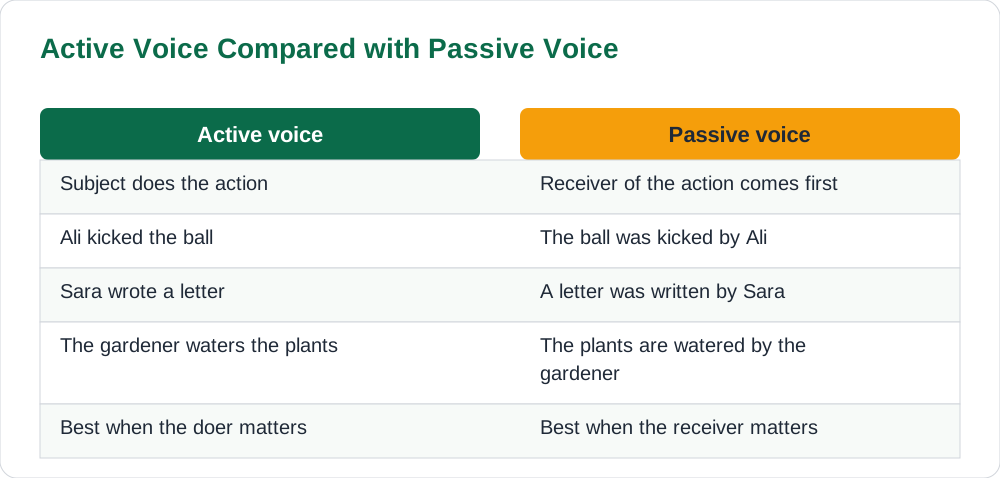
In an active sentence, the doer of the action comes first: "Ali kicked the ball." In a passive sentence, the action's receiver comes first: "The ball was kicked by Ali." Both sentences describe the same event, but they shine the light on different parts of it. Class 7 pupils often find the passive confusing because the verb changes shape and the subject and object seem to swap places. In fact, the switch follows one steady pattern — be plus the past participle — and once you can see that pattern, you can change sentences in both directions without fear. This guide shows the switch step by step, tense by tense.
Seeing the Switch: Subject and Object Change Places
Start with a simple active sentence and name its three parts: subject, verb, and object. In "Sara wrote a letter", Sara is the subject who does the action, wrote is the verb, and a letter is the object that receives the action. To make it passive, move the object to the front, change the verb to be plus the past participle, and move the old subject to the end after by: "A letter was written by Sara." Nothing about the event has changed — only the spotlight has moved from Sara to the letter.
Try the same switch on other sentences and watch the pattern repeat. "The gardener waters the plants" becomes "The plants are watered by the gardener." "My father bought a new bicycle" becomes "A new bicycle was bought by my father." "The teacher praised the class" becomes "The class was praised by the teacher." In each case, the object moves to the front, the verb becomes a form of be plus the past participle, and the old subject follows by. Practise by taking five active sentences from your own notebook and switching each one, checking that the new subject agrees with its new verb.
The Key Formula: Be Plus Past Participle
The heart of the passive is be plus the past participle, and the be verb changes with the tense while the past participle stays the same. In the present simple it is am, is, or are plus the past participle: "The room is cleaned every day." In the past simple it is was or were plus the past participle: "The room was cleaned yesterday." In the present continuous it is am, is, or are plus being plus the past participle: "The room is being cleaned now." The past participle is the third form of the verb — written, cleaned, bought, made — and learning it is the same work as learning irregular past forms.
The most common passive mistake is forgetting the be verb or using the wrong participle. "The letter written by Sara" is not a complete passive sentence; it needs was: "The letter was written by Sara." Likewise, "The plants are water" is wrong because water is not a past participle; the correct form is "The plants are watered." Build a habit of checking two things in every passive sentence: is there a form of be, and is the main verb in its past participle form? If both answers are yes, the skeleton of your passive is sound, and only the tense and agreement remain to check.
When the Passive Sounds Better
The passive is not just a grammar exercise; writers choose it when the receiver of the action matters more than the doer, or when the doer is unknown or unimportant. News reports use it for this reason: "The road was repaired last week" matters because of the road, not because of who repaired it. Science writing does the same: "The solution was heated slowly" focuses on the experiment, not on the person holding the burner. In your own writing, use the passive when the result is the news, and keep the active when the person matters, as in "Our teacher announced the result."
The passive also lets you leave the doer out entirely when it is unknown. "My bicycle was stolen last night" is natural because you do not know who stole it, and adding by someone would add nothing. But do not hide behind the passive to avoid naming a doer who matters: "Mistakes were made" sounds evasive beside "I made a mistake." Good writers switch voices on purpose. As a rule for Class 7, use the active as your default voice, and choose the passive when the receiver deserves the spotlight or the doer is unknown. That choice, made deliberately, is what examiners reward.
Changing Tenses into the Passive
Each tense has its own passive form, but the pattern never changes: keep the tense in the be verb and keep the past participle fixed. Present simple: "She cleans the classroom" becomes "The classroom is cleaned by her." Past simple: "She cleaned the classroom" becomes "The classroom was cleaned by her." Present continuous: "She is cleaning the classroom" becomes "The classroom is being cleaned by her." Future with will: "She will clean the classroom" becomes "The classroom will be cleaned by her." Notice how the tense lives in is, was, is being, and will be, while cleaned never changes.
Pronouns also change their form when they move. The subject I becomes by me, he becomes by him, she becomes by her, we becomes by us, and they becomes by them: "They painted the hall" becomes "The hall was painted by them." Keep the new subject and verb in agreement too: "The books were collected" is correct, while "The books was collected" is wrong, because books is plural and needs were. Work through one tense at a time, writing five conversions for each, and the whole system will feel like one rule with different be verbs rather than four separate rules to memorise.
Practice and Common Mistakes to Avoid
Now put the whole switch into practice with a short drill. Take the paragraph of your day — "I opened my books. My mother packed my lunch. The teacher checked our homework" — and rewrite it in the passive: "My books were opened by me. My lunch was packed by my mother. Our homework was checked by the teacher." The passive version sounds odd for a diary, and that oddness is itself a lesson: the active is usually better for personal writing, while the passive suits reports and descriptions. Being able to convert is the skill; knowing when to convert is the judgement.
Watch for three mistakes that appear again and again. First, a missing be verb: "The work completed yesterday" needs was. Second, a wrong participle: "The door was broke" should be "The door was broken." Third, a subject-verb mismatch after the switch: "The letters was posted" should be "The letters were posted." Read every passive sentence backwards if you are unsure: find the past participle, check the be verb before it, and check that the new subject agrees with that be verb. For more grammar guides, browse the book collection, the solved notes, and the blog from the [home page](/).
AI Help: Muse AI
Muse AI is Meta's personal AI assistant. You can ask it to explain a concept in simple words, summarise a lesson, or make practice questions for revision.
For this article's topic, you can ask Muse AI to convert your active sentences into passive ones step by step, and to explain why a particular be verb and past participle were chosen.
Join Muse with invite code LTGSWD — in the Muse app, go to Settings > Redeem token and enter the code.
Disclosure: LTGSWD is the author's Muse invite code.
Muse AI does not give official STBB answers — always verify against your Sindh Textbook Board book and your teacher.
5 key points you must know
- Passive moves the object to the front and the old subject after by.
- The passive verb is always a form of be plus the past participle.
- The tense lives in the be verb; the past participle never changes.
- Use the passive when the receiver matters more or the doer is unknown.
- Check every passive for a be verb, a correct participle, and subject-verb agreement.
Frequently asked questions
How do I change "Ali kicked the ball" into the passive?
Move the object to the front, use be plus the past participle, and put the old subject after by: "The ball was kicked by Ali." The past tense stays in was, and kicked becomes the participle kicked.
What is the past participle?
It is the third form of the verb, used after be in the passive and after have in perfect tenses: written, cleaned, bought, broken, made. For regular verbs it ends in -ed, while irregular ones must be learned, such as write, wrote, written.
Can I leave out "by Ali" in a passive sentence?
Yes, when the doer is unknown or unimportant, as in "My bicycle was stolen last night". Keep the by-phrase when the doer is important information, as in "The prize was won by Sara".
Why is "The plants are water" wrong?
Because the passive needs a past participle after be, and water is the base form. The correct sentence is "The plants are watered", with the participle watered.
Should I write everything in the passive?
No. Use the active as your default voice and choose the passive on purpose, when the receiver matters more than the doer or the doer is unknown. A paragraph of only passive sentences sounds heavy and dull.
Solved notes — preview free
These guides work best with the solved exercises. Preview the solved notes free on this website — 119 solved notes for Classes 6–10 in Sindhi, Urdu, English and Arabic medium. Or browse the full solved notes catalogue for your class and medium. New solved notes are added regularly — check the catalogue for coming-soon books.