Class 6 Whole Numbers: Place Value Made Simple

Every digit in a number has two values: its own face value and its place value, which depends on where it stands. In the number 45,678, the digit 4 is not just 4, because it stands in the ten-thousands place, so its value is 40,000. Pupils who understand this idea stop guessing at large numbers and start reading them with confidence. Place value is the key to adding, subtracting, multiplying and dividing large numbers correctly, because every written method lines digits up by their places. This guide explains place value with charts, expanded form, comparing and ordering, so that numbers up to lakhs feel as friendly as numbers up to hundreds. You can find more Class 6 help in the [book collection](/books.html) and the [solved notes](/solved.html).
What Place Value Really Means
Place value means that the same digit is worth a different amount depending on its position in a number. In 45,678, the digits from the right are ones, tens, hundreds, thousands and ten-thousands, so 8 means 8 ones, 7 means 7 tens or 70, 6 means 6 hundreds or 600, 5 means 5 thousands or 5,000, and 4 means 4 ten-thousands or 40,000. Adding these values together, 40,000 + 5,000 + 600 + 70 + 8, gives back 45,678, which proves the breakdown is correct. This is why a zero matters so much: in 405, the zero in the tens place holds the place, so the 4 means 400, not 45. Without place value, we could not write large numbers at all.
A place-value chart is the best tool for seeing this clearly, because it puts each digit in its own labelled column. Write the number into the chart from the right, one digit per column, starting with ones, and read across to name the value of each digit. Try it with 304,050: the chart shows 3 in the hundred-thousands place, 0 in ten-thousands, 4 in thousands, 0 in hundreds, 5 in tens and 0 in ones, so the value of 3 is 300,000 and the value of 4 is 4,000. Practise with your own numbers every day, such as house numbers, page numbers and prices, and soon you will read the value of any digit at a glance. More maths guides are on the blog.
Reading and Writing Large Numbers
Large numbers are read in groups of three digits, counted from the right, and commas mark these groups to make reading easier. The number 304,050 is read as three hundred four thousand and fifty, because the group 304 stands for thousands and the group 050 stands for the rest. Read the thousands group first, say the word thousand, then read the last three digits as an ordinary three-digit number. The number 1,250,000 is read as one million two hundred fifty thousand, following the same grouping rule. Saying numbers aloud in this grouped way stops the common mistake of reading 304,050 as thirty thousand or three million.
Writing numbers from words needs the same grouping skill in reverse, and a chart helps again. To write fifty-six thousand three hundred twenty, first put 56 in the thousands group and 320 in the ones group, giving 56,320. Watch out for missing places: seventy thousand and four is written as 70,004, because the hundreds and tens places both need a zero to hold them. A useful check is to count the digits: thousands numbers have four to six digits, and hundred-thousands numbers have six digits. If your written number has the wrong number of digits, a place has been missed. Practise by writing the numbers you hear in class, then checking them with a chart.
- Group digits in threes from the right before reading a large number.
- Read the thousands group first, say thousand, then read the last three digits.
- Use a zero to hold any empty place when writing numbers from words.
- Count the digits as a final check: four digits means thousands, five or six means ten-thousands and above.
Expanded Form: Breaking Numbers Apart
Expanded form writes a number as the sum of the place values of its digits, and it is the clearest proof that you understand place value. The expanded form of 45,678 is 40,000 + 5,000 + 600 + 70 + 8, and adding those parts gives back the original number. Expanded form also explains written addition and subtraction: when we add 45,678 and 12,345, we really add ones with ones, tens with tens, hundreds with hundreds, and so on. Try the expanded form of 70,409, which is 70,000 + 0 + 400 + 0 + 9, or simply 70,000 + 400 + 9, since zero places add nothing. Leaving the zero places out is fine, as long as you know they were there.
Expanded form helps with mental maths too, because breaking a number apart makes it easier to work with. To add 300 + 45,678, think of 45,678 as 45,000 + 678, add 300 to the hundreds part to get 45,000 + 978, and the answer is 45,978. To subtract 5,000 from 45,678, take it from the thousands part: 5,000 minus 5,000 leaves 40,678. These tricks only work when you can see the place values inside a number, which is why teachers ask for expanded form so often. Make it a habit to expand any new large number before you calculate with it, and written methods will feel much more natural. See the [home page](/) for more study resources.
Comparing and Ordering Numbers
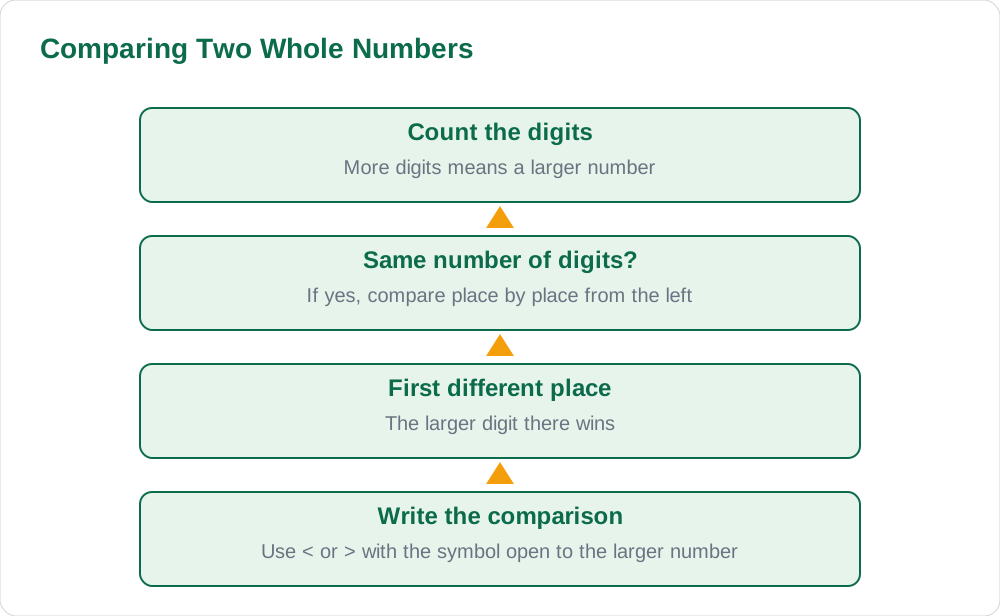
To compare two numbers, first count the digits: the number with more digits is always larger, because it reaches a higher place. So 10,234 is larger than 9,876, even though 9,876 starts with a bigger digit, because 10,234 has five digits and reaches ten-thousands while 9,876 has only four. When both numbers have the same number of digits, compare them place by place from the left until the digits differ, and the number with the larger digit at that first different place is larger. Compare 45,678 and 45,768: the ten-thousands are both 4 and the thousands are both 5, but the hundreds differ, 6 against 7, so 45,768 is larger. The first place where digits differ decides the whole comparison.
Ordering means arranging numbers from smallest to largest or largest to smallest, and the same two rules do all the work. Order 9,876, 10,234 and 9,999 from smallest to largest: first count digits, so 10,234 with five digits must be the largest, then compare the two four-digit numbers, where 9,876 is smaller than 9,999 because at the hundreds place 8 is less than 9, giving 9,876, 9,999, 10,234. The symbols help record this: 9,876 < 9,999 < 10,234, where the symbol opens towards the larger number. Always check your order by reading it back: each step from left to right should genuinely increase, or your ordering has a mistake hiding in it.
Rounding to the Nearest Thousand
Rounding gives a nearby round number that is easier to use for estimates, and place value tells us which digit decides the rounding. To round 45,678 to the nearest thousand, look at the hundreds digit, which is 6, and since 6 is 5 or more, round the thousands digit up: 45,678 rounds to 46,000. To round 45,321 to the nearest thousand, the hundreds digit is 3, which is less than 5, so round down and keep the thousands digit as it is: 45,321 rounds to 45,000. The simple rule is to look at the digit just right of the place you are rounding to: 5 or more rounds up, 4 or less rounds down, and every digit to the right becomes zero.
Rounding is useful for checking answers and for quick estimates in daily life, such as estimating the total cost of shopping. If a school collects 45,678 rupees and 12,345 rupees in two terms, rounding both to the nearest thousand gives 46,000 and 12,000, whose sum is 58,000, close to the exact total of 58,023. If your exact answer is far from your rounded estimate, you probably made a place-value slip, so go back and check. Never round in the middle of a calculation that needs an exact answer, though: round only for estimates and checks, and keep exact digits for the real working. That habit keeps both your estimates and your exact answers trustworthy.
AI Help: Muse AI
Muse AI is Meta's personal AI assistant. You can ask it to explain a concept in simple words, summarise a lesson, or make practice questions for revision.
For this topic, ask Muse AI to make ten place-value practice questions, such as writing numbers in expanded form or ordering sets of large numbers, and then check your answers against a place-value chart.
Join Muse with invite code LTGSWD — in the Muse app, go to Settings > Redeem token and enter the code.
Disclosure: LTGSWD is the author's Muse invite code.
Muse AI does not give official STBB answers — always verify against your Sindh Textbook Board book and your teacher.
5 key points you must know
- A digit's value depends on its place: ones, tens, hundreds, thousands and ten-thousands from the right.
- Read large numbers in groups of three digits from the right, using commas as guides.
- Expanded form writes a number as the sum of its digits' place values, for example 45,678 = 40,000 + 5,000 + 600 + 70 + 8.
- Compare by counting digits first, then comparing place by place from the left.
- Round to the nearest thousand by looking at the hundreds digit: 5 or more rounds up, 4 or less rounds down.
Frequently asked questions
What is the place value of 5 in 45,678?
The 5 stands in the thousands place, so its place value is 5,000. Its face value is 5, but its place value is 5 multiplied by 1,000.
How do I read 304,050?
Group it as 304 and 050 from the right, then read it as three hundred four thousand and fifty. The group 304 gives the thousands part and 050 gives the rest.
Why do we write zero in 70,004?
The zeros hold the hundreds and tens places, which are empty. Without them, 70,004 would collapse into 7,4, which is a different number entirely.
Which is larger, 9,876 or 10,234?
10,234 is larger, because it has five digits and reaches the ten-thousands place, while 9,876 has only four digits. More digits always means a larger whole number.
How do I round 45,678 to the nearest thousand?
Look at the hundreds digit, which is 6. Since 6 is 5 or more, round the thousands digit up, giving 46,000.
Solved notes — preview free
These guides work best with the solved exercises. Preview the solved notes free on this website — 119 solved notes for Classes 6–10 in Sindhi, Urdu, English and Arabic medium. Or browse the full solved notes catalogue for your class and medium. New solved notes are added regularly — check the catalogue for coming-soon books.