Class 6 Ratio and Proportion in Simple Words

A ratio compares two quantities of the same kind, and it tells you how many times one fits into the other. If a class has 24 boys and 16 girls, the ratio of boys to girls is 24 to 16, which simplifies to 3 to 2. Ratios appear in recipes, in maps, in mixing paint, and in sharing money fairly, and they are the doorway to proportion, which says that two ratios are equal. This guide explains ratios with recipes and class strength, shows how to simplify them, and teaches the unitary method, which solves a huge family of daily-life problems. More Class 6 maths is in the [book collection](/books.html) and the [solved notes](/solved.html).
What a Ratio Is
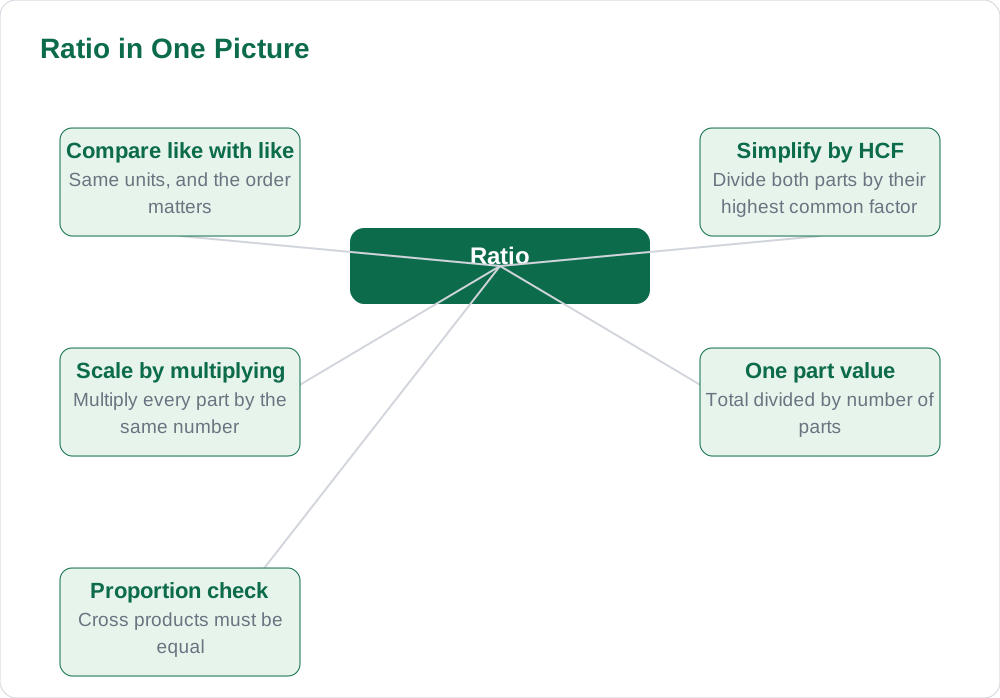
A ratio is written with a colon, like 3:2, and it compares two quantities measured in the same unit. The order matters: the ratio of boys to girls in a class of 24 boys and 16 girls is 24:16, but the ratio of girls to boys is 16:24, which is a different comparison. Ratios have no units, because the units cancel when you compare like with like, and a ratio only makes sense when both quantities are in the same unit: comparing 2 metres with 50 centimetres needs a conversion first, giving 200 centimetres to 50 centimetres, or 4:1. Always check the units and the order before you write a ratio, because both mistakes are common and both change the answer.
A ratio is not a fraction of a whole, though the two ideas are related, and keeping them apart avoids confusion. In a class with 24 boys and 16 girls, the ratio of boys to girls is 24:16, but the fraction of the class that is boys is 24 out of 40, or 3/5, because the whole class is 40 pupils. The ratio compares one part with another part, while the fraction compares one part with the whole. Both are useful: the ratio tells you the mixture, and the fraction tells you the share. When a question asks for a ratio, give it with a colon and simplified; when it asks for a fraction, give it out of the total. Reading the question's exact words is the key to choosing correctly.
Simplifying Ratios
A ratio is simplified by dividing both parts by their highest common factor, just like simplifying a fraction. The ratio 24:16 simplifies by dividing both parts by 8, giving 3:2, because 24 divided by 8 is 3 and 16 divided by 8 is 2. The ratio 15:25 simplifies by dividing by 5, giving 3:5, and the ratio 12:18 simplifies by dividing by 6, giving 2:3. A simplified ratio is the standard answer, and it also makes the comparison easier to understand: 3:2 is clearer than 24:16, because it says that for every 3 boys there are 2 girls. If the two parts share no common factor except 1, the ratio is already in simplest form.
Simplifying also works when a ratio has more than two parts, which happens in recipes and mixtures. A mixture of 12 spoons of flour, 6 spoons of sugar and 3 spoons of cocoa simplifies by dividing all three parts by 3, giving 4:2:1. Decimal ratios should be converted to whole numbers first: the ratio 1.5:2.5 becomes 15:25 by multiplying both parts by 10, and then simplifies to 3:5 by dividing by 5. Always divide by the highest common factor in one step when you can, but dividing step by step also works if you keep going until no common factor remains. Check your simplified ratio by confirming that both parts divided by the same number give your answer, and that no further common factor exists.
Ratios in Recipes and Mixtures
Recipes are ratios in disguise, because they fix the proportions of ingredients whatever the batch size. A recipe that uses 2 cups of flour to 1 cup of sugar has the ratio 2:1, so doubling the recipe needs 4 cups of flour and 2 cups of sugar, keeping the same ratio, and halving it needs 1 cup of flour and half a cup of sugar. If a recipe for 4 people uses 3 cups of rice, then the same recipe for 8 people needs 6 cups, because the number of people has doubled and so must the rice. Scaling a recipe means multiplying every ingredient by the same number, which keeps the taste the same; changing only one ingredient changes the ratio and changes the dish.
Mixtures follow the same rule, from paint to squash to cement. A paint mixture in the ratio 3:1 of white to red paint means that for every 3 parts of white paint there is 1 part of red, so a batch of 12 litres contains 9 litres of white and 3 litres of red, because the mixture has 4 parts in total and each part is 3 litres. Finding the value of one part, by dividing the total by the number of parts, is the key step in mixture questions. A squash mixture in the ratio 1:4 of squash to water means 1 part squash and 4 parts water, so a 500 ml jug holds 100 ml of squash and 400 ml of water. Practise with your own kitchen: the ratio of rice to water in cooking is a ratio you already use every day. More guides are on the blog.
Proportion: When Two Ratios Are Equal
Two ratios are in proportion when they are equal, even though their numbers look different. The ratios 2:3 and 4:6 are in proportion, because 4:6 simplifies to 2:3, and the ratios 3:5 and 6:10 are in proportion for the same reason. Proportion is written as 2:3 :: 4:6, and it can be checked by cross-multiplication: 2 times 6 is 12, and 3 times 4 is 12, and since both products are equal, the ratios are in proportion. If the cross products differ, the ratios are not in proportion: 2:3 and 3:5 give 2 times 5 is 10 and 3 times 3 is 9, which differ, so they are not in proportion. Cross-multiplication is the quickest proportion check, and it also finds missing values.
To find a missing value in a proportion, cross-multiply and solve the small equation that results. If 3 pencils cost Rs 30, how much do 7 pencils cost? The ratio of pencils to cost must stay in proportion, so 3:30 :: 7:x, cross-multiplying gives 3 times x is 210, so x is 210 divided by 3, which is 70, and 7 pencils cost Rs 70. This method works whenever two quantities grow together at a steady rate, which is called direct proportion: more pencils cost more money, more workers take more food, and more hours of work earn more pay. If the quantities move in opposite directions, such as more workers finishing a job faster, the proportion is inverse, and Class 6 questions usually stick to direct proportion, so check which kind you have before calculating.
The Unitary Method: Find One, Then Find Many
The unitary method solves rate problems in two steps: first find the value of one unit, then multiply to find the value of many. If 5 pencils cost Rs 50, one pencil costs 50 divided by 5, which is Rs 10, and 8 pencils cost 8 times 10, which is Rs 80. If a car travels 180 km in 3 hours, it travels 180 divided by 3, which is 60 km in one hour, and in 5 hours it travels 5 times 60, which is 300 km. The method is called unitary because it goes through the unit, the value of one, and it works for any steady rate: price per item, speed per hour, or food per person. Always label the one-unit value clearly, because it is the bridge to every other answer.
The unitary method also handles division problems, where you need the value of one share. If 6 friends share Rs 720 equally, one friend gets 720 divided by 6, which is Rs 120. If 4 kg of rice costs Rs 480, one kilogram costs 480 divided by 4, which is Rs 120, and 7 kg costs 7 times 120, which is Rs 840. A common mistake is multiplying when you should divide in the first step: to find the value of one, you divide the total by the number of units, and only then do you multiply. Write both steps out, even when the numbers look easy, because the written steps earn method marks and make errors easy to find. The [home page](/) has more maths guides.
AI Help: Muse AI
Muse AI is Meta's personal AI assistant. You can ask it to explain a concept in simple words, summarise a lesson, or make practice questions for revision.
For this topic, ask Muse AI to explain ratio with a recipe example, then give you a recipe ratio to scale up for twice as many people and check your scaled amounts.
Join Muse with invite code LTGSWD — in the Muse app, go to Settings > Redeem token and enter the code.
Disclosure: LTGSWD is the author's Muse invite code.
Muse AI does not give official STBB answers — always verify against your Sindh Textbook Board book and your teacher.
5 key points you must know
- A ratio compares two quantities in the same unit, written with a colon, and order matters: 24:16 is not 16:24.
- Simplify ratios by dividing both parts by their highest common factor: 24:16 becomes 3:2.
- Scale a recipe by multiplying every ingredient by the same number, keeping the ratio unchanged.
- Two ratios are in proportion when their cross products are equal: 2:3 :: 4:6 because 12 = 12.
- The unitary method finds the value of one unit first, then multiplies: 5 pencils at Rs 50 means 8 pencils cost Rs 80.
Frequently asked questions
What is the ratio of 24 boys to 16 girls?
It is 24:16, which simplifies by dividing both parts by 8 to give 3:2. The order matters: boys to girls is 3:2, while girls to boys is 2:3.
How do I simplify 15:25?
Divide both parts by their highest common factor, which is 5: 15 divided by 5 is 3, and 25 divided by 5 is 5, so the simplified ratio is 3:5.
How do I check if 2:3 and 4:6 are in proportion?
Cross-multiply: 2 times 6 is 12, and 3 times 4 is 12. Since both products are equal, the ratios are in proportion.
If 5 pencils cost Rs 50, how much do 8 pencils cost?
Use the unitary method: one pencil costs 50 divided by 5, which is Rs 10, so 8 pencils cost 8 times 10, which is Rs 80.
A paint mixture is 3:1 white to red. How much of each in 12 litres?
The mixture has 4 parts in total, so each part is 12 divided by 4, which is 3 litres. That gives 9 litres of white paint and 3 litres of red paint.
Solved notes — preview free
These guides work best with the solved exercises. Preview the solved notes free on this website — 119 solved notes for Classes 6–10 in Sindhi, Urdu, English and Arabic medium. Or browse the full solved notes catalogue for your class and medium. New solved notes are added regularly — check the catalogue for coming-soon books.