Class 6 Perimeter and Area of Rectangles and Squares
Perimeter is the distance around a shape, and area is the space inside it, and confusing the two is one of the most common Class 6 errors. A farmer fencing a field needs the perimeter, because fencing runs around the edge, while a farmer planting the field needs the area, because seeds cover the inside. Both are found from the same two measurements of a rectangle, its length and its width, but they use different formulas and different units: perimeter is measured in metres, while area is measured in square metres. This guide explains both formulas with fencing and flooring examples, so you always know which one a question is asking for. More Class 6 maths is in the [book collection](/books.html) and the [solved notes](/solved.html).
Perimeter: The Distance Around
The perimeter of a shape is the total length of its boundary, found by adding the lengths of all its sides. A rectangle has two lengths and two widths, so its perimeter is length plus width plus length plus width, which shortens to 2 times (length + width). For a rectangle 12 m long and 8 m wide, the perimeter is 2 times (12 + 8), which is 2 times 20, giving 40 m. A square has four equal sides, so its perimeter is 4 times the side: a square with side 9 m has a perimeter of 4 times 9, which is 36 m. The brackets matter in the rectangle formula: 2 times (12 + 8) is 40, but 2 times 12 plus 8, without brackets, is 32, which is wrong, so always add length and width first.
Perimeter questions usually hide the sides in a story, and the first job is to find them. If a rectangular garden is 15 m long and its perimeter is 50 m, the width is found by working backwards: half the perimeter is 25 m, because 50 divided by 2 is 25, and half the perimeter equals length plus width, so the width is 25 minus 15, which is 10 m. Check it: 2 times (15 + 10) is 50 m, which matches. Perimeter is always measured in ordinary length units, metres, centimetres or kilometres, never in square units, because it is a length, not a surface. When a question mentions fencing, a border, a frame or walking around a field, it is asking for perimeter, and that word picture is your best clue.
Area: The Space Inside
The area of a rectangle is length times width, which counts how many unit squares fit inside it. A rectangle 12 m long and 8 m wide has an area of 12 times 8, which is 96 square metres, written as 96 m squared, because it holds 96 squares of 1 m by 1 m. A square with side 9 m has an area of 9 times 9, which is 81 square metres, because its length and width are both 9 m. Area units are always square units: square centimetres, square metres or square kilometres, and writing plain metres for an area is a unit error that loses marks. The picture behind the formula is simple: area counts squares, so its unit must be a square.
Area questions also hide in stories, and the clue words are covering, painting, tiling and planting. If a floor is 12 m by 8 m, its area is 96 square metres, and if each floor tile covers 1 square metre, the floor needs 96 tiles. If a wall 10 m long and 3 m high is to be painted, its area is 10 times 3, which is 30 square metres, and paint bought by the square metre can then be worked out. When the sides are in different units, convert first: a rectangle 2 m long and 50 cm wide must become 200 cm by 50 cm, giving 10,000 square centimetres, or 2 m by 0.5 m, giving 1 square metre, and both answers describe the same area. Converting before multiplying is the step pupils most often forget. More guides are on the blog.
Fencing a Field: A Worked Example
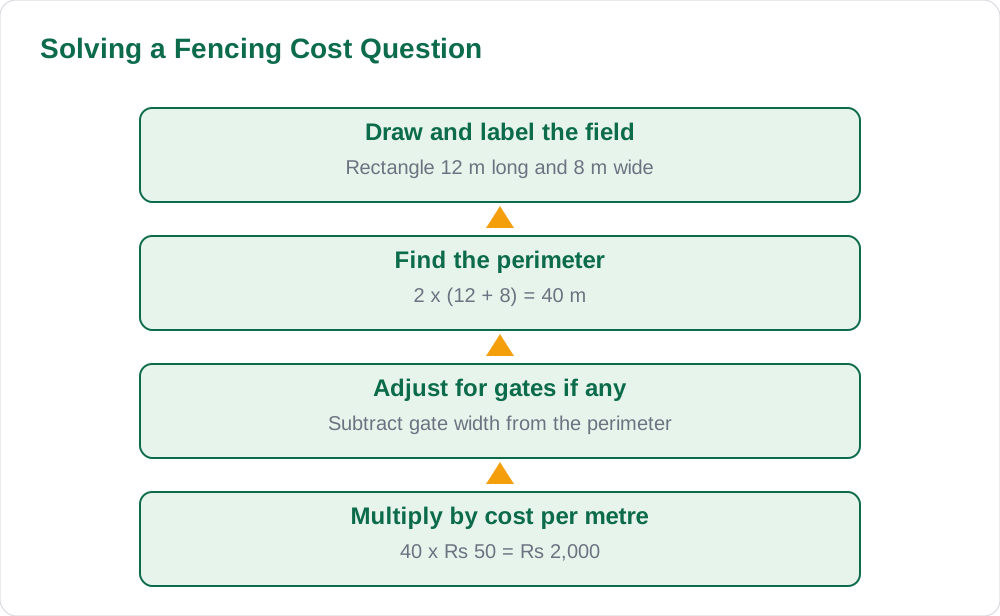
A farmer wants to fence a rectangular field 12 m long and 8 m wide, with fencing that costs Rs 50 per metre, and the question asks for the total cost. First find the perimeter, because fencing runs around the edge: the perimeter is 2 times (12 + 8), which is 2 times 20, giving 40 m. Then multiply the perimeter by the cost per metre: 40 times 50 is Rs 2,000, so the fencing costs Rs 2,000. The two steps must stay in order: finding the area here would give 96 square metres, which cannot be multiplied by a per-metre price, and the units would not match. Checking units is a powerful habit: metres times rupees per metre gives rupees, which is the answer the question wants.
Fencing questions sometimes add a gate, which changes the length to be fenced. If the same field has a gate 2 m wide that needs no fencing, the length to fence is 40 minus 2, which is 38 m, and the cost is 38 times 50, which is Rs 1,900. If the field is fenced twice around, with a double row of wire, the length doubles to 80 m and the cost doubles to Rs 4,000. Read the story twice before calculating: does it mention a gate, a double row, or more than one field? Each detail changes the perimeter before the cost step, and catching it early saves redoing the whole question. A sketch of the field with its sides labelled makes these details visible instead of hiding them in words.
Flooring a Room: A Worked Example
A room floor 12 m long and 8 m wide is to be covered with square tiles, each 1 m by 1 m, and the question asks how many tiles are needed. First find the area, because tiles cover the inside: the area is 12 times 8, which is 96 square metres. Each tile covers 1 times 1, which is 1 square metre, so the number of tiles is 96 divided by 1, which is 96 tiles. If the tiles were 2 m by 2 m instead, each would cover 4 square metres, and the room would need 96 divided by 4, which is 24 tiles. The method never changes: find the floor area, find one tile's area, and divide the first by the second.
Flooring questions sometimes ask for cost as well, which adds one more multiplication. If each 1-square-metre tile costs Rs 120, then 96 tiles cost 96 times 120, which is Rs 11,520, because 100 times 120 is 12,000 and 4 times 120 is 480, so 12,000 minus 480 is 11,520. Always allow a few spare tiles in real life for cutting and breakage, though exam questions usually ask for the exact count. A common error is dividing the perimeter by the tile size instead of the area, which gives 40 tiles for this room, a meaningless number, because tiles cover a surface, not a boundary. Asking yourself whether the question is about the edge or the inside, before choosing a formula, prevents this error every time. The [home page](/) has more study help.
Squares, Units and Checking Your Answers
Squares are rectangles with all sides equal, so both formulas simplify: perimeter is 4 times the side, and area is side times side. A square garden with side 9 m has a perimeter of 36 m and an area of 81 square metres, and a square with side 15 cm has a perimeter of 60 cm and an area of 225 square centimetres, because 15 times 15 is 225. When a question gives only the area of a square, the side is found by asking which number multiplied by itself gives the area: an area of 81 square metres means a side of 9 m, because 9 times 9 is 81. This reverse skill, finding a square root for small perfect squares, appears often in perimeter and area questions.
Checking answers means checking numbers and units together. A perimeter answer in square metres is wrong, an area answer in plain metres is wrong, and an area smaller than the perimeter is possible but worth a second look, since area and perimeter measure different things. A quick estimate also helps: a 12 m by 8 m rectangle has an area near 100 square metres, because 12 times 8 is close to 10 times 10, so an answer of 960 or 9.6 signals a decimal or multiplication slip. Finally, remember that doubling the side of a square doubles its perimeter but quadruples its area: a 9 m square has area 81 square metres, while an 18 m square has area 324 square metres, which is 4 times 81. This is why area grows faster than perimeter, and why unit checks matter so much. See the solved notes for more practice.
AI Help: Muse AI
Muse AI is Meta's personal AI assistant. You can ask it to explain a concept in simple words, summarise a lesson, or make practice questions for revision.
For this topic, ask Muse AI to explain the difference between perimeter and area with a fencing example and a flooring example, then practise deciding which formula each new question needs.
Join Muse with invite code LTGSWD — in the Muse app, go to Settings > Redeem token and enter the code.
Disclosure: LTGSWD is the author's Muse invite code.
Muse AI does not give official STBB answers — always verify against your Sindh Textbook Board book and your teacher.
5 key points you must know
- Perimeter is the distance around a shape: a 12 m by 8 m rectangle has a perimeter of 40 m.
- Area is the space inside: the same rectangle has an area of 96 square metres.
- Fencing uses perimeter: 40 m at Rs 50 per metre costs Rs 2,000.
- Flooring uses area: a 96-square-metre floor needs 96 tiles of 1 square metre each.
- Perimeter uses length units (m) and area uses square units (m squared) — never mix them up.
Frequently asked questions
What is the perimeter of a rectangle 12 m by 8 m?
It is 2 times (12 + 8), which is 2 times 20, giving 40 m.
What is the area of a rectangle 12 m by 8 m?
It is 12 times 8, which is 96 square metres.
What is the perimeter and area of a square with side 9 m?
The perimeter is 4 times 9, which is 36 m, and the area is 9 times 9, which is 81 square metres.
How much does fencing cost for a 40 m boundary at Rs 50 per metre?
Multiply 40 by 50, which is Rs 2,000.
How do I know whether a question wants perimeter or area?
Fencing, borders, frames and walking around mean perimeter. Covering, painting, tiling and planting mean area.
Solved notes — preview free
These guides work best with the solved exercises. Preview the solved notes free on this website — 119 solved notes for Classes 6–10 in Sindhi, Urdu, English and Arabic medium. Or browse the full solved notes catalogue for your class and medium. New solved notes are added regularly — check the catalogue for coming-soon books.