Class 6 Percentages: A First Introduction With Shop Examples

Percent means per hundred, and the symbol % is simply a short way of writing out of 100. When a shop says 25% off, it means 25 rupees off for every 100 rupees of price, and when a pupil scores 75%, it means 75 marks out of every 100. Percentages turn fractions and decimals into a single common scale, which is why shops, banks, exams and news reports all use them. This guide explains percentages from the beginning, with shop discounts and school marks as the main examples, so that the idea feels useful rather than abstract. More Class 6 maths guides are in the [book collection](/books.html) and the [solved notes](/solved.html).
Percent Means Per Hundred
The word percent comes from per centum, meaning per hundred, so 25% is simply another way of writing the fraction 25/100 and the decimal 0.25. This is why percentages are so easy to compare: every percentage is measured on the same scale of 100, so 60% is always larger than 45%, whatever the original totals were. Converting a fraction to a percentage means making its denominator 100: 1/2 becomes 50/100, which is 50%, and 3/4 becomes 75/100, which is 75%. Converting a decimal is even quicker: move the decimal point two places to the right and add the % sign, so 0.6 becomes 60% and 0.05 becomes 5%.
Percentages above 100 are possible too, and they simply mean more than the whole: 150% of Rs 200 is Rs 300, because 100% is Rs 200 and another 50% is Rs 100. Percentages below 1% are rare in Class 6 work, but the idea is the same: 1% means 1 out of every 100. A useful picture is a 10 by 10 grid of 100 small squares: shading 25 squares shows 25%, shading half the grid shows 50%, and shading the whole grid shows 100%. Drawing this grid for a few percentages makes the per-hundred idea concrete, and it also shows why 25% is the same as one quarter and 50% is the same as one half. Keep this grid picture in mind whenever a percentage question feels confusing.
Finding a Percentage of a Number
To find a percentage of a number, turn the percentage into a fraction over 100 and multiply. To find 25% of 200, write 25/100 times 200, which is 25 times 200 divided by 100, giving 5,000 divided by 100, which is 50. A shorter method is to find 1% first and then multiply: 1% of 200 is 2, so 25% is 25 times 2, which is 50. Both methods agree, and the 1% method is especially handy for percentages like 30% or 45%, where the fraction method involves larger numbers. Try 20% of 500: 1% of 500 is 5, so 20% is 20 times 5, which is 100.
Some percentages have quick mental shortcuts worth memorising, because they appear constantly in shops and exams. Ten percent means divide by 10, so 10% of 800 is 80. Fifty percent means halve the number, so 50% of 800 is 400. Twenty-five percent means divide by 4, so 25% of 800 is 200. Seventy-five percent means three quarters, so 75% of 800 is 600. Combining shortcuts handles other percentages: 30% of 800 is three times 10%, which is 3 times 80, giving 240. Practise these shortcuts until they are instant, because they make discount and marks questions much faster, and they also give you a quick check on longer written methods. More guides are on the blog.
Shop Discounts: Percentages That Save Money
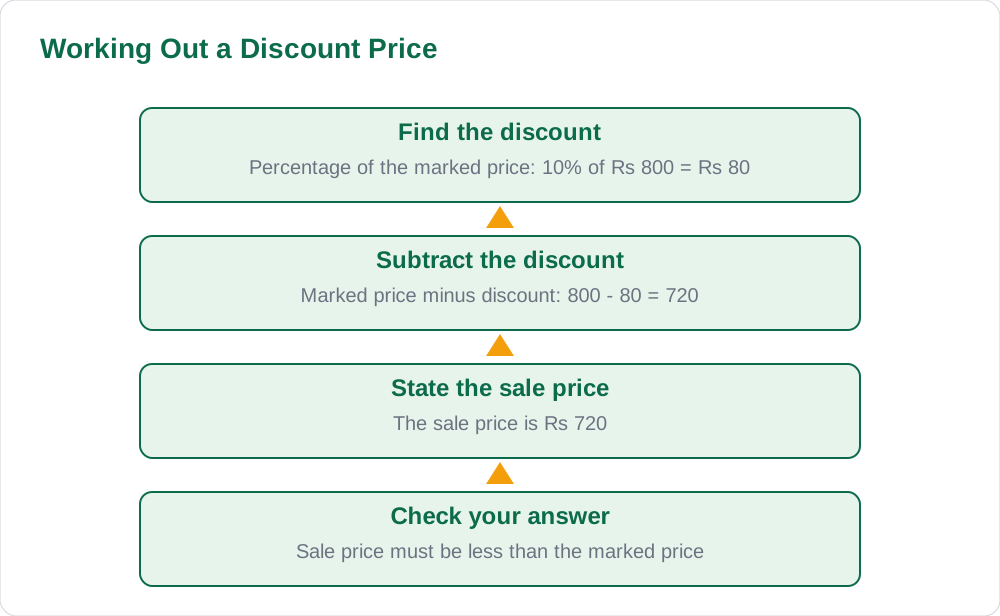
A discount is a percentage taken off the marked price, and the steps are always the same: find the discount amount, then subtract it from the price. A shirt marked Rs 800 with 10% off has a discount of 10% of 800, which is 80, so the sale price is 800 minus 80, which is Rs 720. A school bag marked Rs 1,200 with 25% off has a discount of 25% of 1,200, which is 300, so the sale price is 1,200 minus 300, which is Rs 900. Always check that the sale price is less than the marked price and that the discount is a sensible fraction of it: a 10% discount on Rs 800 cannot be Rs 400, because that would be half the price, not a tenth.
Some shops show two discounts in words, such as 20% off plus an extra 10% off, and pupils often add them to get 30% off, which is wrong. The second discount applies to the already-reduced price, not the original price, so a Rs 1,000 item at 20% off costs Rs 800, and a further 10% off Rs 800 saves Rs 80, giving a final price of Rs 720, which is a total saving of Rs 280, or 28%, not 30%. This is a good example of why percentages need care: they always act on a particular amount, and changing the amount changes the result. When a question says percent off, first ask: percent of what? Answering that question correctly is half the problem solved.
Percentages From Marks and Tests
Exam percentages are found by dividing the marks obtained by the total marks and multiplying by 100. A pupil who scores 45 out of 60 has a percentage of 45 divided by 60 times 100, which is 0.75 times 100, giving 75%. A pupil who scores 36 out of 50 has 36 divided by 50 times 100, which is 0.72 times 100, giving 72%. The method never changes, whatever the total: divide by the total, multiply by 100, and add the % sign. Simplifying the fraction first often makes the division easier: 45/60 simplifies to 3/4, and 3/4 of 100 is 75, which matches the first answer.
Percentages let you compare results from tests with different totals, which raw marks cannot do fairly. Scoring 36 out of 50 beats scoring 45 out of 60 in percentage terms? No: 36 out of 50 is 72%, while 45 out of 60 is 75%, so the 45 out of 60 result is actually better, even though 45 is only 9 marks more than 36. This is the real power of percentages: they put different totals on the same 100-point scale. When you work out your own test percentages, always write the fraction first, then the division, then the multiplication by 100, so that a small arithmetic slip is easy to spot. A percentage above 100 in a test would mean scoring more than the total, which is impossible, so such an answer signals an error.
Common Percentage Mistakes to Avoid
The most common percentage mistake is forgetting what the percentage is a percentage of, especially when a price changes twice. If a Rs 400 item rises by 25%, the increase is 25% of 400, which is 100, giving a new price of Rs 500. If it then falls by 25%, the decrease is 25% of 500, which is 125, giving Rs 375, not the original Rs 400, because the second percentage acted on a larger amount. Equal percentage rises and falls do not cancel out, and remembering this saves many marks. Another common slip is writing 0.5 as 5% instead of 50%: moving the decimal point two places, not one, is the rule for converting decimals to percentages.
A second mistake is confusing percentage points with percentages, though Class 6 pupils mainly need to avoid mixing up the percentage and the amount it produces. In the discount example, 10% is the rate and Rs 80 is the amount: the question may ask for either, so read it twice. If it asks how much you save, the answer is Rs 80; if it asks the sale price, the answer is Rs 720. Labelling your working helps: write discount = Rs 80 and sale price = Rs 720 as separate lines, so you can pick the one the question asked for. Finally, always finish with a sense check: a 10% discount should be a small part of the price, a 50% discount should be half, and a percentage of a number should never exceed the number itself unless the percentage exceeds 100%. The [home page](/) has more study help.
AI Help: Muse AI
Muse AI is Meta's personal AI assistant. You can ask it to explain a concept in simple words, summarise a lesson, or make practice questions for revision.
For this topic, ask Muse AI to make five shop-discount questions with different percentages, then work out each sale price yourself before checking your answers.
Join Muse with invite code LTGSWD — in the Muse app, go to Settings > Redeem token and enter the code.
Disclosure: LTGSWD is the author's Muse invite code.
Muse AI does not give official STBB answers — always verify against your Sindh Textbook Board book and your teacher.
5 key points you must know
- Percent means per hundred: 25% = 25/100 = 0.25.
- Find a percentage by multiplying by the fraction over 100, or by finding 1% first.
- A discount is found first, then subtracted: 10% off Rs 800 gives a sale price of Rs 720.
- Test percentage = marks obtained divided by total marks, multiplied by 100: 45 out of 60 is 75%.
- Percentages always act on a particular amount: a rise and fall by the same percentage do not cancel out.
Frequently asked questions
What does 25% mean?
It means 25 out of every 100. As a fraction it is 25/100, which simplifies to 1/4, and as a decimal it is 0.25.
How do I find 25% of 200?
Multiply 25/100 by 200, which is 5,000 divided by 100, giving 50. Or find 1% of 200, which is 2, and multiply by 25 to get 50.
A shirt costs Rs 800 with 10% off. What is the sale price?
The discount is 10% of 800, which is 80. Subtract it from the price: 800 minus 80 is 720, so the sale price is Rs 720.
How do I turn 45 out of 60 into a percentage?
Divide 45 by 60 to get 0.75, then multiply by 100 to get 75%. So 45 out of 60 is 75%.
Why is 20% off then 10% off not 30% off?
The second discount applies to the reduced price, not the original. On Rs 1,000, 20% off gives Rs 800, and 10% off Rs 800 gives Rs 720, a total saving of 28%, not 30%.
Solved notes — preview free
These guides work best with the solved exercises. Preview the solved notes free on this website — 119 solved notes for Classes 6–10 in Sindhi, Urdu, English and Arabic medium. Or browse the full solved notes catalogue for your class and medium. New solved notes are added regularly — check the catalogue for coming-soon books.