Class 6 Maths Word Problems From Daily Life
Word problems feel hard because the maths is hidden inside a story, but every word problem is really an ordinary sum wearing a disguise. A market story about buying 3 kg of onions hides a multiplication, a pocket-money story about saving hides another, and a sharing story hides a division. The skill is not harder arithmetic: it is translating the story into numbers, choosing the right operation, and checking that the answer makes sense in the story. This guide teaches a four-step method and applies it to market, pocket-money, sharing and travel stories, so that word problems become the most satisfying questions on the paper. More Class 6 maths is in the [book collection](/books.html) and the [solved notes](/solved.html).
The Four-Step Method
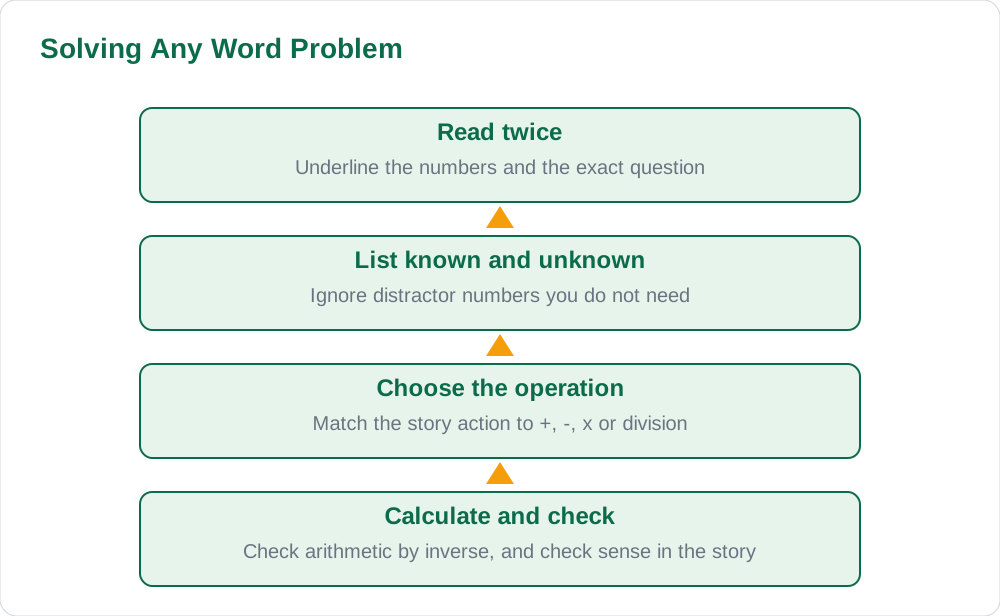
Step one is to read the problem twice, slowly, and underline the numbers and the question being asked. Many errors come from answering a different question than the one asked, such as giving the cost of the onions when the question asked for the change. Step two is to list what you know and what you need: the known numbers, the unknown, and any extra numbers that are not needed, because word problems sometimes include distractors. Step three is to choose the operation by the story's action: buying more of the same thing means multiplication, sharing equally means division, combining amounts means addition, and finding what is left means subtraction. Step four is to calculate carefully and then check the answer against the story.
Checking is a real step, not an optional extra, and it has two parts: checking the arithmetic and checking the sense. Check the arithmetic by redoing the calculation or by using the inverse operation: if you multiplied to get the cost, divide the cost by the quantity to recover the price. Check the sense by asking whether the answer fits the story: change cannot be larger than the money paid, a share cannot be larger than the whole, and a total cannot be smaller than any of its parts. Pupils who check both ways catch most of their own errors before the teacher ever sees them, and the four-step method, practised on easy problems, becomes fast enough to use under exam pressure. Find more guides on the blog.
Market Problems: Buying and Change
Market problems combine multiplication for the cost and subtraction for the change, and doing them in order matters. A pupil buys 3 kg of onions at Rs 60 per kg and pays with a Rs 500 note: first find the cost, 3 times 60, which is Rs 180, then find the change, 500 minus 180, which is Rs 320. The two-step structure is the whole problem, and writing both steps as separate lines, cost = Rs 180 and change = Rs 320, makes the working easy to follow and easy to mark. A common error is subtracting before multiplying, such as 500 minus 60 times 3 worked left to right without brackets, so always finish the multiplication before the subtraction, or use brackets to show the order clearly.
Market problems with several items need a small table or a list before calculating, so that no item is forgotten. A shopping list of 2 kg of rice at Rs 120 per kg, 1 kg of sugar at Rs 90 per kg and 4 eggs at Rs 15 each costs 2 times 120, which is 240, plus 90, plus 4 times 15, which is 60, giving a total of 240 plus 90 plus 60, which is Rs 390. Paying with Rs 500 leaves change of 500 minus 390, which is Rs 110. Listing each item's cost on its own line, then adding the column, is slower than mental arithmetic but far more reliable, especially when the list grows. In a real shop, the shopkeeper's bill works exactly this way, line by line, and your school working should imitate a real bill.
Pocket-Money Problems: Saving and Spending
Pocket-money problems are usually about saving the same amount repeatedly, which means multiplication, or about spending part of a total, which means subtraction or fractions. A pupil who saves Rs 20 every week will have 20 times 4, which is Rs 80, after 4 weeks, and 20 times 10, which is Rs 200, after 10 weeks, because saving steadily is repeated addition, which is multiplication. A pupil with Rs 500 who spends Rs 150 on a book and Rs 80 on a geometry set has spent 150 plus 80, which is Rs 230, and has 500 minus 230, which is Rs 270, left. Writing the spent total first, then subtracting once, is cleaner than subtracting twice, though both give the same answer.
Some pocket-money problems ask how long saving will take, which means division. If a bat costs Rs 600 and a pupil saves Rs 50 a week, the weeks needed are 600 divided by 50, which is 12 weeks. If the division leaves a remainder, the answer needs thought: saving Rs 50 a week towards a Rs 625 bat gives 625 divided by 50, which is 12 remainder 25, so 12 weeks give Rs 600, which is not enough, and a 13th week is needed, with Rs 25 to spare. Remainder problems are common in word problems, and the story decides whether to round up, round down or keep the remainder: weeks needed round up, full boxes round down, and money left over stays as a remainder. Always read the final question to see which kind of remainder answer it wants. The [home page](/) has more study help.
Sharing Problems: Equal Parts and Leftovers
Sharing problems divide a total into equal parts, and the key question is whether the division is exact or leaves a remainder. Twenty-four sweets shared equally among 6 friends give 24 divided by 6, which is 4 sweets each, with nothing left over, because 6 times 4 is exactly 24. Thirty sweets shared among 7 friends give 30 divided by 7, which is 4 remainder 2, so each friend gets 4 sweets and 2 are left over, which might be kept by the host or shared differently. The multiplication check, 7 times 4 plus 2 is 30, confirms the division, and writing the remainder as part of the answer, not hiding it, earns full marks. Sharing money works the same way: Rs 720 shared among 6 friends gives Rs 120 each, because 6 times 120 is 720.
Sharing problems sometimes work backwards: given the share and the number of people, find the total, which means multiplication. If each of 8 pupils gets 5 pencils, the total is 8 times 5, which is 40 pencils, and if each of 12 guests gets 3 samosas, the total is 36 samosas. Another type shares by ratio rather than equally, which connects to the ratio chapter: Rs 300 shared in the ratio 2:1 gives 3 parts of Rs 100 each, so the shares are Rs 200 and Rs 100. The habit that unites all sharing problems is asking first whether the shares are equal or in a ratio, and second whether a remainder is possible, because those two answers choose the operation and the form of the answer. See the solved notes for more practice.
Travel and Time Problems
Travel problems use speed, distance and time, and in Class 6 they usually give two of these and ask for the third with simple numbers. A car travelling 60 km in one hour travels 60 times 3, which is 180 km, in 3 hours at the same speed, because equal hours cover equal distances. A cyclist who covers 120 km in 4 hours travels 120 divided by 4, which is 30 km, in one hour, which is the speed. Time problems also use timetables: a bus leaving at 9:15 and arriving at 11:45 travels for 2 hours and 30 minutes, found by counting from 9:15 to 11:15, which is 2 hours, and then 30 more minutes to 11:45. Drawing a small timeline for time problems prevents the common error of subtracting the clock readings as if they were ordinary numbers.
Mixed problems combine two operations, and the four-step method keeps them manageable. A pupil walks 2 km to school in 30 minutes and returns by bus in 10 minutes: the total travel time is 30 plus 10, which is 40 minutes, a simple addition hiding inside a travel story. A family drives 150 km in the morning and 90 km in the afternoon, covering 240 km in total, and if the car uses 1 litre of petrol for every 20 km, the petrol used is 240 divided by 20, which is 12 litres. The second example needs addition first and division second, and the order comes from the story: total distance first, then petrol from that total. When a problem has two steps, label each step's result before moving on, so the second step uses the right number and the examiner can follow your thinking.
AI Help: Muse AI
Muse AI is Meta's personal AI assistant. You can ask it to explain a concept in simple words, summarise a lesson, or make practice questions for revision.
For this topic, ask Muse AI to make three short daily-life word problems, one about shopping, one about saving and one about sharing, then solve each one with the four-step method.
Join Muse with invite code LTGSWD — in the Muse app, go to Settings > Redeem token and enter the code.
Disclosure: LTGSWD is the author's Muse invite code.
Muse AI does not give official STBB answers — always verify against your Sindh Textbook Board book and your teacher.
5 key points you must know
- Read every word problem twice and underline the numbers and the exact question asked.
- Choose the operation from the story action: buying more means multiply, sharing equally means divide.
- Market change needs two steps: cost first by multiplication, then change by subtraction.
- Saving steadily is multiplication, and finding how long saving takes is division, rounding up for weeks needed.
- Always check by inverse operation and by sense: change cannot exceed money paid, shares cannot exceed the whole.
Frequently asked questions
A pupil buys 3 kg of onions at Rs 60 per kg and pays Rs 500. What is the change?
The cost is 3 times 60, which is Rs 180. The change is 500 minus 180, which is Rs 320.
How long does saving Rs 50 a week take to reach Rs 600?
Divide 600 by 50, which is 12, so it takes 12 weeks.
How are 30 sweets shared among 7 friends?
Each friend gets 30 divided by 7, which is 4 sweets, with 2 left over, because 7 times 4 plus 2 is 30.
What should I do if a word problem has a number I do not need?
Ignore it. List only the numbers the question actually uses, and be careful not to drag a distractor number into your calculation.
How do I check a word-problem answer?
Check the arithmetic with the inverse operation, and check the sense against the story: change must be less than money paid, and shares must not exceed the total.
Solved notes — preview free
These guides work best with the solved exercises. Preview the solved notes free on this website — 119 solved notes for Classes 6–10 in Sindhi, Urdu, English and Arabic medium. Or browse the full solved notes catalogue for your class and medium. New solved notes are added regularly — check the catalogue for coming-soon books.