Class 6 Integers on the Number Line

Integers are the whole numbers plus their negatives: ..., -3, -2, -1, 0, 1, 2, 3, ... Positive numbers sit to the right of zero on the number line, negative numbers sit to the left, and zero sits in the middle, neither positive nor negative. Negative numbers describe real things: temperatures below zero, floors below ground level, money owed, and depths below sea level. This guide shows how to place integers on the number line, order them, find their opposites, and add and subtract them with jumps, so that negative numbers stop feeling strange and start feeling useful. More Class 6 maths is in the [book collection](/books.html) and the [solved notes](/solved.html).
The Number Line and Where Integers Live
A number line is a straight line marked with numbers at equal gaps, with zero in the middle, positive numbers marching to the right and negative numbers marching to the left. Moving right increases a number by one at each step, and moving left decreases it by one, so the number line is really a picture of counting in both directions. The integer -3 sits three steps left of zero, and the integer 4 sits four steps right of zero, and the distance of a number from zero is called its absolute value: the absolute value of -3 is 3, and the absolute value of 4 is 4. Drawing a number line is the first step for almost every integers question, because seeing the positions makes ordering and adding far easier than trying to do them in your head.
Equal gaps are essential on a number line, because the gaps are what make the picture honest: if the gap between 0 and 1 is wider than the gap between 1 and 2, the line lies about the numbers. Always mark zero first, then mark equal steps on both sides, and label at least the numbers you need for the question. A number line also shows why negative numbers behave as they do: -1 is greater than -5, even though 5 is greater than 1, because -1 sits closer to zero on the right side of the negative region. Pupils who draw the line rarely make this mistake, while pupils who guess from the digits alone often do. Keep a ruler handy and draw the line for every integers question until the picture lives in your head. More guides are on the blog.
Ordering Integers and Finding Opposites
On the number line, a number is larger when it sits further to the right, whatever its sign. So -5 is smaller than -2, because -5 sits further left, and -2 is smaller than 0, and 0 is smaller than 3, giving the order -5 < -2 < 0 < 3. A useful rule for negatives is that the larger the digits, the smaller the number: -8 is smaller than -3, because 8 is further from zero on the left. To order a mixed set like 4, -1, 0, -6 and 2, first separate the negatives and positives, order the negatives by closeness to zero in reverse, giving -6 then -1, then put zero, then the positives in order, giving -6, -1, 0, 2, 4. Checking your order by reading it left to right on a drawn number line catches most errors.
The opposite of a number is the number the same distance from zero on the other side, so the opposite of 5 is -5, the opposite of -3 is 3, and the opposite of 0 is 0. Opposites add to zero, which is why they are also called additive inverses: 5 plus -5 is 0, and -3 plus 3 is 0. Opposites appear in daily life as pairs that cancel: a lift that goes up 3 floors and then down 3 floors returns to its start, and a temperature that rises 4 degrees and then falls 4 degrees returns to its start. When a question asks for the opposite of an integer, simply change its sign, and leave zero unchanged. The symbol for the opposite of a number is a minus sign in front of it, so the opposite of -7 is written as -(-7), which equals 7.
Adding Integers With Jumps
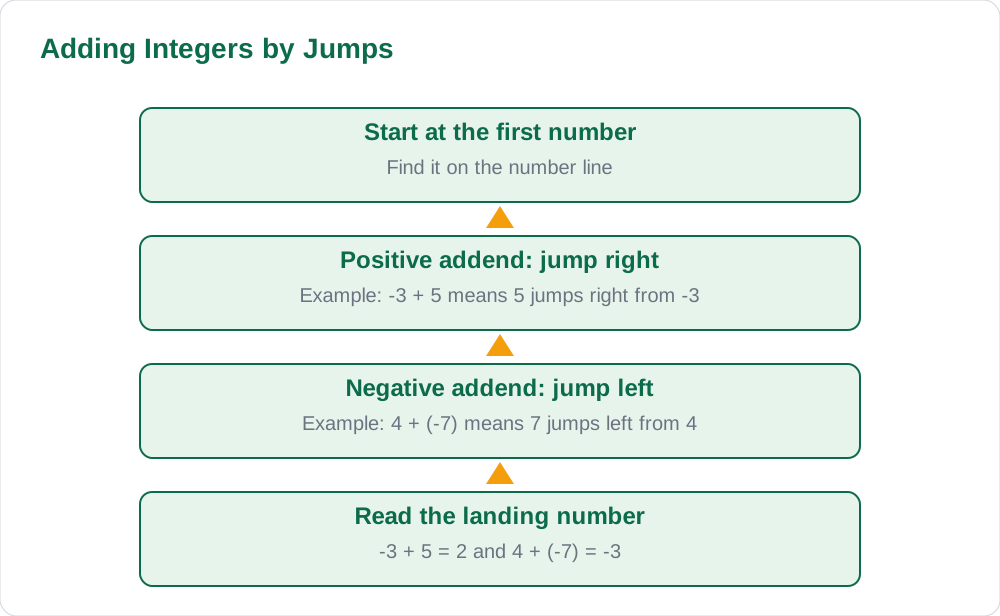
Adding an integer means jumping on the number line: a positive addend means jump right, and a negative addend means jump left. To work out -3 + 5, start at -3 and jump 5 steps right: -2, -1, 0, 1, 2, landing on 2, so -3 + 5 = 2. To work out 4 + (-7), start at 4 and jump 7 steps left: 3, 2, 1, 0, -1, -2, -3, landing on -3, so 4 + (-7) = -3. The jump method never fails, and it explains the shortcut rules: when the signs are the same, add the absolute values and keep the sign, so (-2) + (-3) = -5, and when the signs differ, subtract the smaller absolute value from the larger and keep the sign of the larger, so -3 + 5 = 2 because 5 minus 3 is 2 and 5 is positive.
Adding integers is also how temperature and money problems work, which makes the jumps easy to picture. If the morning temperature is -2 degrees and it rises by 6 degrees, the new temperature is -2 + 6 = 4 degrees, found by jumping 6 steps right from -2. If a shopkeeper has Rs 100 and owes Rs 150, his balance is 100 + (-150) = -50, meaning he is Rs 50 short, found by jumping 150 steps left from 100, or more simply by the different-signs rule: 150 minus 100 is 50, and the larger absolute value belongs to the negative side. Practise jumps with small numbers first, saying each landing point aloud, and the shortcut rules will soon feel obvious rather than memorised. The [home page](/) has more study material.
Subtracting Integers
Subtracting an integer means jumping in the opposite direction to adding it: subtracting a positive number means jumping left, and subtracting a negative number means jumping right. To work out 3 - 5, start at 3 and jump 5 steps left, landing on -2, so 3 - 5 = -2. To work out -1 - 4, start at -1 and jump 4 steps left, landing on -5, so -1 - 4 = -5. The trickiest case is subtracting a negative: 5 - (-2) means jumping 2 steps right from 5, landing on 7, so 5 - (-2) = 7. This matches the rule that subtracting a negative is the same as adding its opposite: 5 - (-2) = 5 + 2 = 7, because taking away a debt is like gaining money.
A reliable shortcut turns every subtraction into an addition: keep the first number, change the minus to a plus, and change the sign of the second number, then use the addition rules. So 3 - 5 becomes 3 + (-5), which is -2, and -1 - 4 becomes -1 + (-4), which is -5, and 5 - (-2) becomes 5 + 2, which is 7. Write this conversion out for every subtraction until it is automatic, because skipping it is how sign errors creep in. Check each answer by adding back: if 5 - (-2) = 7, then 7 + (-2) should equal 5, and indeed it does, because 7 minus 2 is 5. This inverse check, adding the subtracted number back to the answer to recover the first number, works for every subtraction question. See the solved notes for more practice.
Integers in Daily Life
Integers describe any situation with two opposite directions, and recognising them is the first step to solving such problems. Temperatures use integers naturally: -4 degrees is 4 degrees below zero, and a rise from -4 degrees by 10 degrees gives -4 + 10 = 6 degrees. Buildings use integers too: ground floor is 0, floors above are positive, and basement floors are negative, so going from basement 2 up 5 floors reaches floor 3, because -2 + 5 = 3. Bank balances use integers: a balance of -Rs 500 means Rs 500 owed, and depositing Rs 800 gives -500 + 800 = Rs 300 in credit. Sea level works the same way: a submarine at -200 metres that rises 50 metres reaches -150 metres, because -200 + 50 = -150.
Sports and games also use integers, from golf scores below par to points lost in a quiz. A quiz team that scores 10 points, loses 4 points and then gains 7 points finishes on 10 - 4 + 7 = 13 points, worked left to right: 10 minus 4 is 6, and 6 plus 7 is 13. When a problem mixes gains and losses, write each gain as a positive number and each loss as a negative number, then add them in order on a number line. This turns a confusing story into a plain addition problem, which the jump method solves reliably. The habit of translating words into signed numbers, up as positive and down as negative, in as positive and out as negative, is the real skill of this chapter, and it transfers to every later topic that uses negative numbers.
AI Help: Muse AI
Muse AI is Meta's personal AI assistant. You can ask it to explain a concept in simple words, summarise a lesson, or make practice questions for revision.
For this topic, ask Muse AI to explain adding negative numbers with a temperature example, then give you five integer additions to solve by drawing jumps on a number line.
Join Muse with invite code LTGSWD — in the Muse app, go to Settings > Redeem token and enter the code.
Disclosure: LTGSWD is the author's Muse invite code.
Muse AI does not give official STBB answers — always verify against your Sindh Textbook Board book and your teacher.
5 key points you must know
- Integers are whole numbers and their negatives: positives sit right of zero, negatives sit left, and zero is neither.
- A number further right on the number line is larger: -5 < -2 < 0 < 3.
- Add by jumping: positive addends jump right, negative addends jump left, so -3 + 5 = 2.
- Subtract by converting to addition: change the sign of the second number, so 5 - (-2) = 5 + 2 = 7.
- The opposite of a number is the same distance from zero on the other side: the opposite of -3 is 3.
Frequently asked questions
Is -5 larger or smaller than -2?
Smaller, because -5 sits further left on the number line. For negative numbers, the larger the digits, the smaller the number.
How do I work out -3 + 5?
Start at -3 on the number line and jump 5 steps right: -2, -1, 0, 1, 2. You land on 2, so -3 + 5 = 2.
How do I work out 5 - (-2)?
Subtracting a negative is the same as adding its opposite, so 5 - (-2) = 5 + 2 = 7. On the number line, jump 2 steps right from 5.
What is the opposite of -7?
It is 7, because 7 is the same distance from zero on the opposite side. Opposites add to zero: -7 + 7 = 0.
Is zero positive or negative?
Neither. Zero sits between the positives and the negatives on the number line, and it is its own opposite.
Solved notes — preview free
These guides work best with the solved exercises. Preview the solved notes free on this website — 119 solved notes for Classes 6–10 in Sindhi, Urdu, English and Arabic medium. Or browse the full solved notes catalogue for your class and medium. New solved notes are added regularly — check the catalogue for coming-soon books.