Class 6 Geometry: Lines, Angles and Triangles
Geometry is the maths of shapes, and it starts with two simple ideas: lines and angles. Lines can run side by side forever without meeting, cross each other, or meet at a square corner, and the angle between two lines tells you how much one has turned from the other. Triangles, the simplest closed shape, are built entirely from three lines and three angles, and their names come straight from those angles and sides. This guide explains lines, angle types, triangle names, and how to use a protractor, with examples you can draw yourself. More Class 6 help is in the [book collection](/books.html) and the [solved notes](/solved.html).
Lines: Parallel, Intersecting and Perpendicular
A line goes on forever in both directions, while a line segment has two endpoints and a ray has one endpoint and goes on in one direction. The edges of your notebook page are line segments, a sunbeam is like a ray, and a road stretching to the horizon is like a line. Parallel lines are lines in the same plane that never meet, however far they are extended, like the two long edges of a ruler or railway tracks. Intersecting lines are lines that cross at a point, like the diagonals of a square, and perpendicular lines are intersecting lines that meet at a right angle of 90 degrees, like the corner of a page where its edges meet.
Spotting these lines in daily life makes the definitions stick. The lines of a ruled notebook page are parallel, the hands of a clock at 3 o'clock are perpendicular, and the letter X is made of two intersecting lines. In a rectangle, opposite sides are parallel and neighbouring sides are perpendicular, which is why rectangles look so neat. When you draw parallel lines, use a ruler and keep the distance between them the same all along; when you draw perpendicular lines, check the corner with the square corner of a book or a set square. Naming the lines you see around you, in doors, windows and floor tiles, turns the whole classroom into a geometry lesson. Find more guides on the blog.
Types of Angles by Size
An angle is formed when two rays meet at a point called the vertex, and its size is measured in degrees. An acute angle is smaller than 90 degrees, like the angle of a partly opened book or the hands of a clock at 2 o'clock, which show about 60 degrees. A right angle is exactly 90 degrees, like the corner of a page, and it is usually marked with a small square at the vertex. An obtuse angle is larger than 90 degrees but smaller than 180 degrees, like the hands of a clock at 4 o'clock, which show about 120 degrees. A straight angle is exactly 180 degrees, a flat line, like the hands of a clock at 6 o'clock.
A reflex angle is larger than 180 degrees but smaller than 360 degrees, and a full turn is 360 degrees, which brings a ray back to where it started. Pupils often confuse obtuse and reflex angles, so remember the boundary: anything under 180 degrees that is not acute or right is obtuse, while anything over 180 degrees is reflex. Estimating angles before measuring them is a good habit: look at the angle and guess whether it is acute, right or obtuse, then measure to check. If your guess and your measurement disagree wildly, you have probably read the wrong scale on the protractor, which is the most common measuring mistake. Practise estimating the angles of clock hands, open doors and roof slopes until your guesses are close.
Measuring and Drawing With a Protractor
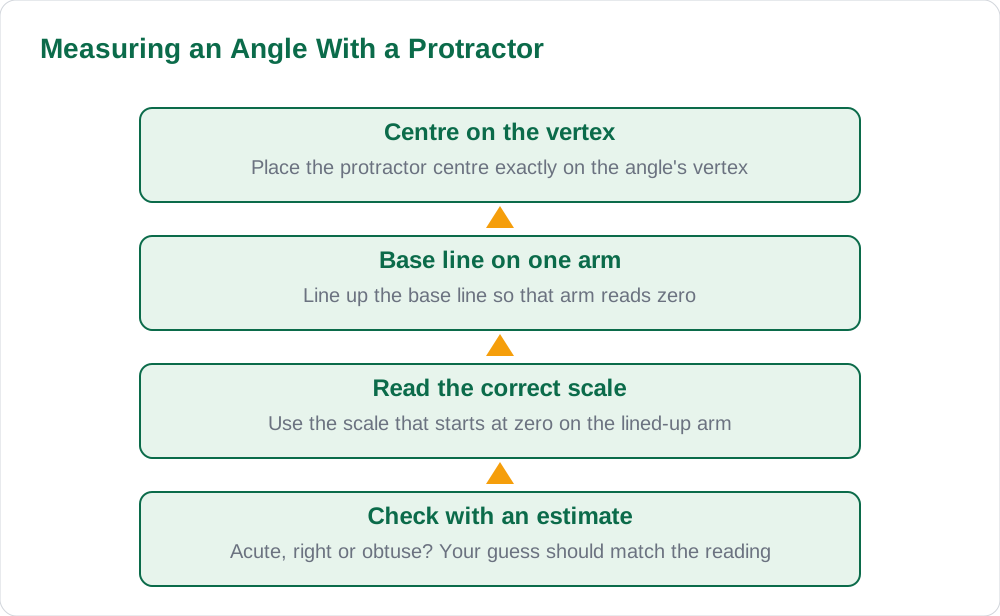
A protractor measures angles up to 180 degrees, and using it correctly needs three careful steps. First, place the centre mark of the protractor exactly on the vertex of the angle, so the protractor cannot slide. Second, line up the base line of the protractor with one arm of the angle, so that arm reads zero. Third, read the scale where the other arm crosses the protractor, choosing the scale that starts at zero on the arm you lined up: if the first arm is on the right, read the inner scale, and if it is on the left, read the outer scale. Reading the wrong scale gives the supplement of the angle, for example 120 degrees instead of 60 degrees, so your earlier estimate is your best protection.
Drawing an angle is the reverse process, and it also needs care. To draw a 60-degree angle, draw one arm with a ruler, place the protractor's centre on the endpoint and its base line on the arm, mark a small dot at 60 degrees on the correct scale, remove the protractor, and join the endpoint to the dot with a ruler. Check your drawing by measuring it back: the measured angle should match the angle you intended. Use a sharp pencil, because a thick pencil line can hide a few degrees of error, and draw arms long enough to read clearly. Pupils who rush protractor work usually lose marks on the scale choice, not on the drawing itself, so slow down at the reading step. The [home page](/) has more study resources.
Triangles by Their Angles and Sides
Triangles are named by their angles and by their sides, and both naming systems are used together. By angles, a triangle with one right angle is right-angled, a triangle with one obtuse angle is obtuse-angled, and a triangle with all three angles acute is acute-angled. By sides, a triangle with all three sides equal is equilateral, a triangle with two sides equal is isosceles, and a triangle with no sides equal is scalene. An equilateral triangle is also acute-angled, because each of its angles is 60 degrees, and an isosceles triangle has two equal angles opposite its two equal sides. Learning both systems means you can describe any triangle fully, such as a right-angled isosceles triangle.
The angles of any triangle add up to 180 degrees, which is one of the most useful facts in geometry. If a triangle has angles of 60 degrees and 70 degrees, the third angle must be 180 minus 60 minus 70, which is 50 degrees, because 60 plus 70 is 130 and 180 minus 130 is 50. This rule lets you find a missing angle whenever you know the other two, and it also checks your protractor work: if your three measured angles add to much more or less than 180 degrees, at least one measurement is wrong. Try tearing the three corners off a paper triangle and placing them together: they form a straight line of 180 degrees, which is a convincing proof you can do at your desk. Triangles also appear in bridges and roofs because they are rigid shapes that do not wobble.
Drawing Triangles and Checking Your Work
Drawing a triangle from given sides needs a ruler and a pair of compasses, and the method is satisfying once you practise it. To draw a triangle with sides 5 cm, 6 cm and 7 cm, first draw the 7 cm base with a ruler, then open the compasses to 5 cm, place the point on one end of the base and draw an arc, then open them to 6 cm, place the point on the other end and draw a second arc. The point where the arcs cross is the third vertex: join it to both ends of the base, and the triangle is complete. If the arcs do not cross, the three lengths cannot form a triangle, which happens when the longest side is longer than the other two sides added together.
Always check a drawn triangle by measuring its sides and angles back against the question. The sides should match the given lengths within a millimetre or two, and the angles should add to 180 degrees. Label the vertices with capital letters, usually A, B and C, and label the sides with their lengths, so that anyone reading your drawing can check it without asking. Neat construction lines, the light arcs left by the compasses, show your method and earn marks, so do not rub them out. Geometry rewards patience: a slow, careful drawing beats a quick, rough one every time, and the checking step is what turns a good drawing into a reliable one. See the solved notes for more practice.
AI Help: Muse AI
Muse AI is Meta's personal AI assistant. You can ask it to explain a concept in simple words, summarise a lesson, or make practice questions for revision.
For this topic, ask Muse AI to explain the difference between acute, right and obtuse angles with one daily-life example of each, then practise spotting those angles around your home.
Join Muse with invite code LTGSWD — in the Muse app, go to Settings > Redeem token and enter the code.
Disclosure: LTGSWD is the author's Muse invite code.
Muse AI does not give official STBB answers — always verify against your Sindh Textbook Board book and your teacher.
5 key points you must know
- Parallel lines never meet; perpendicular lines meet at a right angle of 90 degrees.
- Acute angles are under 90 degrees, right angles are exactly 90, obtuse angles are between 90 and 180, and straight angles are 180.
- Measure with a protractor by centring it on the vertex, lining up the base line, and reading the scale that starts at zero.
- The three angles of any triangle add up to 180 degrees: 60 plus 70 leaves a third angle of 50 degrees.
- Triangles are named by angles (acute, right, obtuse) and by sides (equilateral, isosceles, scalene).
Frequently asked questions
What is the difference between parallel and perpendicular lines?
Parallel lines never meet, however far they are extended, like railway tracks. Perpendicular lines meet at a right angle of 90 degrees, like the corner of a page.
Is a 120-degree angle acute or obtuse?
It is obtuse, because obtuse angles are larger than 90 degrees and smaller than 180 degrees. Acute angles are smaller than 90 degrees.
Why do I sometimes read 120 degrees instead of 60 degrees on a protractor?
You read the wrong scale. Use the scale that starts at zero on the arm you lined up with the base line, and check your reading against your estimate of acute or obtuse.
A triangle has angles of 60 and 70 degrees. What is the third angle?
The angles of a triangle add to 180 degrees, so the third angle is 180 minus 60 minus 70, which is 50 degrees.
What is an isosceles triangle?
It is a triangle with two equal sides. The two angles opposite those equal sides are also equal.
Solved notes — preview free
These guides work best with the solved exercises. Preview the solved notes free on this website — 119 solved notes for Classes 6–10 in Sindhi, Urdu, English and Arabic medium. Or browse the full solved notes catalogue for your class and medium. New solved notes are added regularly — check the catalogue for coming-soon books.