Class 6 Fractions and Decimals: From Halves to Hundredths
Fractions and decimals are two ways of writing the same idea: a part of a whole. One half can be written as the fraction 1/2 or as the decimal 0.5, and three quarters can be written as 3/4 or 0.75. Pupils often treat them as two separate topics, but once you see how they convert into each other, both become much easier. This guide starts with simple fractions, shows how to compare them, converts them into decimals, and finishes with everyday examples like money and measuring, where decimals appear all the time. More Class 6 maths help is in the [book collection](/books.html) and the [solved notes](/solved.html).
What a Fraction Means
A fraction has a numerator on top and a denominator below, and the denominator tells you how many equal parts the whole is split into, while the numerator tells you how many of those parts you have. In 3/4, the whole is split into 4 equal parts and you have 3 of them, so 3/4 is three quarters of the whole. In 1/2, the whole is split into 2 parts and you have 1, which is one half. Equal parts matter: if the parts are not equal, the fraction does not describe them properly, which is why fraction diagrams always show pieces of the same size. A fraction like 5/5 means the whole thing, because you have all 5 of the 5 parts.
Fractions also appear as parts of a group, not just parts of a shape. If a class has 20 pupils and 12 of them walk to school, the fraction that walks is 12/20, which simplifies to 3/5 by dividing numerator and denominator by 4. Simplifying means dividing both parts by their common factor, and a fraction is in simplest form when numerator and denominator share no common factor except 1. So 12/20 simplifies to 3/5, and 6/8 simplifies to 3/4 by dividing by 2. Always simplify your final answer unless the question asks otherwise, because simplest form is the standard way to present a fraction. Practise simplifying 10/15, which becomes 2/3, and 9/12, which becomes 3/4.
Comparing Fractions the Easy Way
When fractions share the same denominator, comparing them is easy: the one with the larger numerator is larger, so 3/8 is larger than 2/8 because 3 parts out of 8 beat 2 parts out of 8. When the denominators differ, cross-multiplication gives a reliable comparison without finding a common denominator. To compare 2/3 and 3/5, multiply the numerator of each by the denominator of the other: 2 times 5 is 10, and 3 times 3 is 9, and since 10 is larger than 9, 2/3 is larger than 3/5. Write the products above the fractions they belong to, so you never mix up which product goes with which fraction, and the larger product marks the larger fraction.
Another way to compare is to convert both fractions to a common denominator, which works well when the denominators are small. To compare 1/2 and 3/4, convert 1/2 to 2/4, and then 3/4 is clearly larger than 2/4. For 2/3 and 3/4, the common denominator 12 gives 8/12 and 9/12, so 3/4 is larger. A quick sense check helps too: any fraction larger than 1/2 has a numerator more than half its denominator, so 5/8 is larger than 1/2 while 3/8 is smaller. Use whichever method you find clearest, but always show your working, because a bare answer to a comparison question earns little credit. Find more guides on the blog.
Turning Fractions Into Decimals
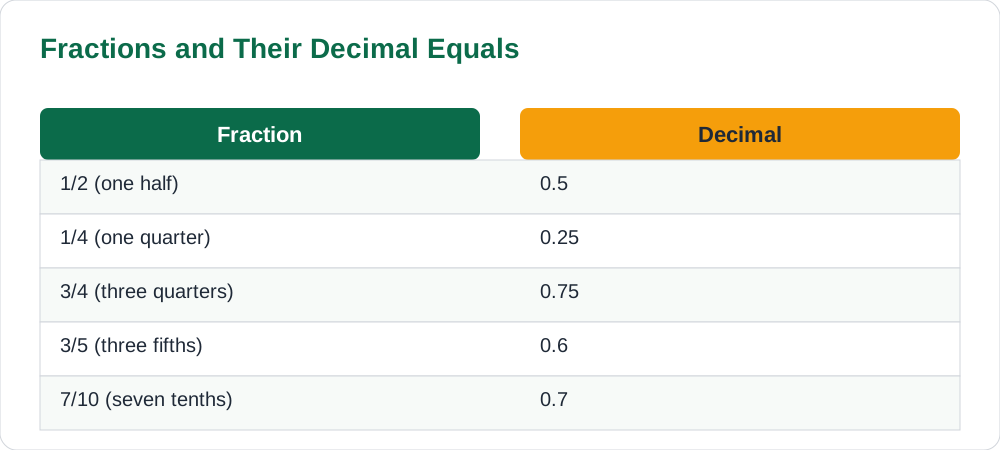
A fraction means division: 3/4 means 3 divided by 4, so dividing gives the decimal form. Three divided by 4 is 0.75, so 3/4 = 0.75, and one divided by 2 is 0.5, so 1/2 = 0.5. Fractions with denominator 10 or 100 convert by place value alone: 7/10 = 0.7, because the 7 sits in the tenths place, and 45/100 = 0.45, because 4 is in tenths and 5 is in hundredths. For other denominators, first convert to tenths or hundredths if you can: 3/5 becomes 6/10 by multiplying numerator and denominator by 2, so 3/5 = 0.6. The fractions worth memorising are 1/2 = 0.5, 1/4 = 0.25, 3/4 = 0.75, 1/5 = 0.2 and 1/10 = 0.1, because they appear constantly.
Decimals can also be turned back into fractions, which is useful for simplifying and comparing. The decimal 0.45 means 45 hundredths, so it equals 45/100, which simplifies to 9/20 by dividing by 5. The decimal 0.6 means 6 tenths, so it equals 6/10, which simplifies to 3/5. Read the decimal aloud to find its fraction: 0.25 is twenty-five hundredths, giving 25/100, which simplifies to 1/4. This two-way skill means you can always switch to whichever form makes a question easier: use decimals for money and measuring, and fractions for exact parts and sharing. Try converting 0.8, which is 8/10 or 4/5, and 0.35, which is 35/100 or 7/20.
Comparing Decimals Without Confusion
Comparing decimals is easy once you line up the decimal points and compare place by place, just like whole numbers. To compare 0.45 and 0.5, first write 0.5 as 0.50 so both numbers have two decimal places, then compare the hundredths: 45 hundredths is less than 50 hundredths, so 0.45 is smaller than 0.5. The common mistake is to think 0.45 is larger because 45 is a bigger number than 5, but the place values decide, not the digits alone. Comparing 0.6 and 0.65 works the same way: write 0.6 as 0.60, and 60 hundredths is less than 65 hundredths, so 0.6 is smaller than 0.65. Padding with zeros never changes a decimal's value, so use it freely.
Ordering decimals follows the same method: pad them to the same number of decimal places, then order them like whole numbers. Order 0.5, 0.45 and 0.75: padded, they are 0.50, 0.45 and 0.75, so from smallest to largest they are 0.45, 0.5, 0.75. In money, this skill is used daily: Rs 12.50 is more than Rs 12.05, because at the tenths place both have 5, but at the hundredths place 0 is less than 5, so Rs 12.05 is the smaller amount. Always write decimals with their points lined up in a column when you compare them on paper, because a misaligned point is the usual cause of a wrong comparison. The [home page](/) has more study material.
Fractions and Decimals in Daily Life
Fractions and decimals are everywhere once you start looking, especially in shopping, cooking and measuring. A shopkeeper who sells half a litre of milk sells 0.5 litres, and a bottle marked 0.25 litres holds one quarter of a litre. A discount of one quarter off a Rs 400 shirt saves Rs 100, because 1/4 of 400 is 100, leaving Rs 300 to pay. In cooking, half a cup is 0.5 cups, and three quarters of a cup is 0.75 cups, so recipes written either way describe the same amounts. Cricket fans meet decimals in run rates, and petrol is sold by the litre with two decimal places, so reading decimals correctly saves real money.
Marks and test scores use both forms too, and converting between them helps you understand your results. Scoring 15 out of 20 is the fraction 15/20, which simplifies to 3/4, which as a decimal is 0.75, which as a percentage is 75 percent. A pupil who scored 0.8 on a quiz scored 4/5, or 80 percent, which is a strong result. When you see a decimal in daily life, try naming its fraction: 0.5 litres is half a litre, 2.5 kilograms is two and a half kilograms, and Rs 7.25 is seven rupees and twenty-five paisa. This habit turns every price tag and measuring jug into fraction practice, and soon converting between the two forms will feel automatic rather than like a school exercise.
AI Help: Muse AI
Muse AI is Meta's personal AI assistant. You can ask it to explain a concept in simple words, summarise a lesson, or make practice questions for revision.
For this topic, ask Muse AI to give you five fractions to convert into decimals and five decimals to convert back into fractions, then check each answer by dividing the numerator by the denominator.
Join Muse with invite code LTGSWD — in the Muse app, go to Settings > Redeem token and enter the code.
Disclosure: LTGSWD is the author's Muse invite code.
Muse AI does not give official STBB answers — always verify against your Sindh Textbook Board book and your teacher.
5 key points you must know
- A fraction shows equal parts: in 3/4, the whole is split into 4 parts and you have 3.
- Compare fractions with the same denominator by numerator, or use cross-multiplication: 2/3 beats 3/5 because 10 beats 9.
- Convert fractions to decimals by dividing: 3/4 = 0.75, 3/5 = 0.6, 7/10 = 0.7.
- Compare decimals by lining up decimal points and padding with zeros: 0.45 is smaller than 0.50.
- Simplify fractions by dividing numerator and denominator by their common factor: 12/20 = 3/5.
Frequently asked questions
How do I convert 3/4 into a decimal?
Divide the numerator by the denominator: 3 divided by 4 is 0.75, so 3/4 = 0.75. You can also write 3/4 as 75/100, which is 0.75 by place value.
Which is larger, 2/3 or 3/5?
Cross-multiply: 2 times 5 is 10, and 3 times 3 is 9. Since 10 is larger than 9, 2/3 is larger than 3/5.
Is 0.45 larger than 0.5?
No. Write 0.5 as 0.50, then compare: 45 hundredths is less than 50 hundredths, so 0.45 is smaller than 0.5.
How do I simplify 12/20?
Divide numerator and denominator by their common factor 4: 12 divided by 4 is 3, and 20 divided by 4 is 5, so 12/20 simplifies to 3/5.
What is 0.25 as a fraction?
0.25 means 25 hundredths, so it is 25/100, which simplifies to 1/4 by dividing numerator and denominator by 25.
Solved notes — preview free
These guides work best with the solved exercises. Preview the solved notes free on this website — 119 solved notes for Classes 6–10 in Sindhi, Urdu, English and Arabic medium. Or browse the full solved notes catalogue for your class and medium. New solved notes are added regularly — check the catalogue for coming-soon books.