Class 6 Factors and Multiples: HCF and LCM Without Fear

Factors and multiples sound alike, but they point in opposite directions, and mixing them up is the most common Class 6 maths mistake. Factors divide into a number exactly, while multiples are what you get when you multiply a number by 1, 2, 3 and so on. From these two ideas come HCF, the highest common factor, and LCM, the lowest common multiple, which solve real problems like sharing things equally and finding when two repeating events happen together. This guide builds the ideas slowly, with short worked examples for the numbers 12 and 18, so that HCF and LCM stop feeling like tricks and start feeling like tools. Find more Class 6 guides in the [book collection](/books.html) and on the [blog](/blog/).
Factors: Numbers That Divide Exactly
A factor of a number is a whole number that divides it exactly, leaving no remainder. The factors of 12 are 1, 2, 3, 4, 6 and 12, because each of these divides 12 exactly: 12 divided by 3 is 4, 12 divided by 4 is 3, and so on. A quick way to find all factors is to test numbers in pairs: 1 times 12 is 12, 2 times 6 is 12, and 3 times 4 is 12, and once the pairs start repeating, you have found them all. Every number has 1 and itself as factors, and every number except 1 has at least those two. A number with exactly two factors is called a prime number, like 7, whose only factors are 1 and 7, while a number with more than two factors, like 12, is composite.
Factors are useful whenever things must be shared equally, because the factors of a number are exactly the group sizes that share it with nothing left over. Twelve pencils can be shared equally among 1, 2, 3, 4, 6 or 12 pupils, but not among 5 pupils, because 5 is not a factor of 12 and 12 divided by 5 leaves a remainder of 2. When you list factors, always work in pairs and write both members of each pair, or you will miss one. A neat trick for checking your list is to count the pairs: if the number is not a perfect square, its factors come in an even count of pairs, and a missing partner means the list is incomplete. Practise with 18, 20 and 30 until listing factors feels automatic.
Multiples: The Times Table Going On Forever
A multiple of a number is the result of multiplying that number by a whole number, so the multiples of 6 are 6, 12, 18, 24, 30, 36 and so on, without end. Unlike factors, which are limited, multiples never stop, which is why questions always ask for the first few multiples or for multiples within a range. The first five multiples of 8 are 8, 16, 24, 32 and 40, found by multiplying 8 by 1, 2, 3, 4 and 5. A number is always a multiple of itself and of 1, and every multiple of a number is at least as large as the number itself. If you know your times tables, you already know multiples: the 6 times table is simply the multiples of 6.
Multiples appear in daily life whenever something repeats at regular steps, such as bus times, packet sizes and calendar patterns. If one shop sells pens in packs of 6 and another in packs of 8, the numbers of pens you could buy equally from either shop are the common multiples of 6 and 8, which are 24, 48, 72 and so on. Spotting multiples quickly comes from times-table fluency, so a few minutes of times-table practice each day pays off directly here. When a question asks for multiples up to a limit, write them in order and stop at the limit, rather than writing an endless list. That discipline keeps your work tidy and your answers complete. More study help is in the solved notes.
Prime Factors: Breaking Numbers to Their Bones
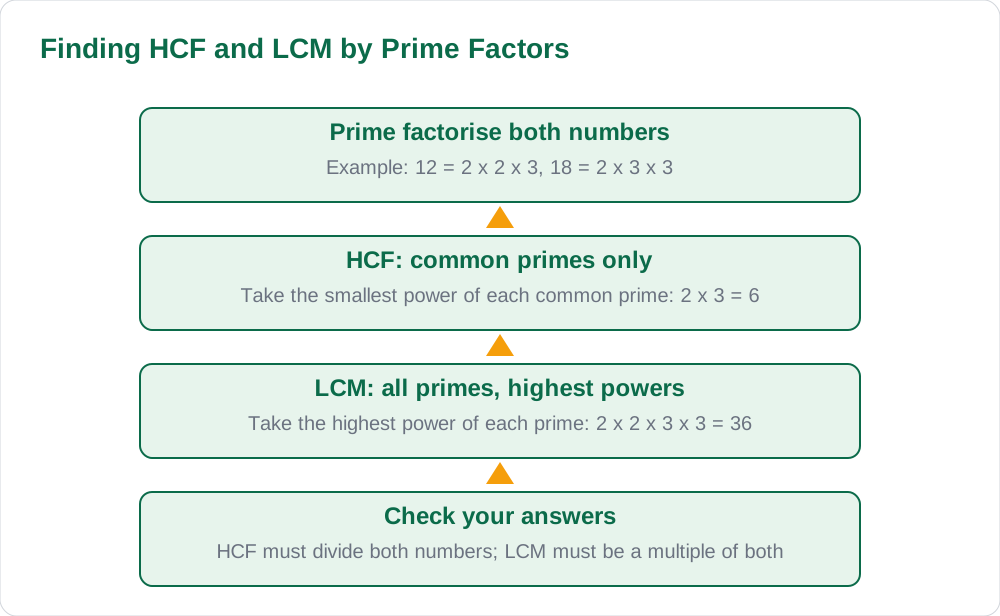
Every composite number can be broken down into prime factors, which are prime numbers that multiply to give the original number. The prime factors of 12 are 2, 2 and 3, because 2 times 2 times 3 is 12, written as 2 squared times 3. To find them, divide by the smallest prime that divides exactly, and keep dividing the result until only primes remain: 12 divided by 2 is 6, 6 divided by 2 is 3, and 3 is prime, so the work stops. The prime factors of 18 are 2, 3 and 3, because 18 divided by 2 is 9, and 9 divided by 3 is 3. Writing prime factors as a product, 12 = 2 x 2 x 3 and 18 = 2 x 3 x 3, is called prime factorisation.
Prime factorisation is worth learning because it makes HCF and LCM almost mechanical, as the next sections show. It also settles questions like whether a number is prime: try dividing it by primes in order, and if no prime up to its square root divides it, it is prime. For Class 6, the practical skill is a factor tree: write the number, split it into any factor pair, then keep splitting every composite branch until only primes are left at the ends. The primes at the ends are your prime factors, whatever pair you started with, which is a good check: if two pupils start with different pairs, they must still finish with the same prime factors. Try factor trees for 20, 30 and 36 and compare your endings with a friend.
HCF: The Biggest Number That Divides Both
The highest common factor of two numbers is the largest number that divides both of them exactly. To find the HCF of 12 and 18, list their factors: the factors of 12 are 1, 2, 3, 4, 6 and 12, and the factors of 18 are 1, 2, 3, 6, 9 and 18. The common factors are 1, 2, 3 and 6, and the highest of these is 6, so the HCF of 12 and 18 is 6. Using prime factors gives the same answer faster: 12 = 2 x 2 x 3 and 18 = 2 x 3 x 3, and the primes common to both, taking the smallest power of each, are 2 and 3, whose product is 6. Both methods agree, which is a useful way to check your work.
HCF solves sharing problems where the groups must be as large as possible. Suppose a teacher has 12 red pens and 18 blue pens and wants identical packets with no pens left over: the largest possible packet size is the HCF, 6, so she can make packets of 6 pens, using 2 red packets and 3 blue packets in each mixed set, or more simply, the greatest equal group size is 6. Another example: the HCF of 15 and 20 is 5, because the factors of 15 are 1, 3, 5 and 15, the factors of 20 are 1, 2, 4, 5, 10 and 20, and the highest common factor is 5. Always finish by checking that your HCF divides both original numbers exactly, or it is not a common factor at all. See the [home page](/) for more guides.
LCM: The Smallest Number Both Divide Into
The lowest common multiple of two numbers is the smallest number that is a multiple of both. To find the LCM of 12 and 18 by listing, write the multiples of 12, which are 12, 24, 36, 48, and the multiples of 18, which are 18, 36, 54, and the first number appearing in both lists is 36, so the LCM is 36. By prime factors, take the highest power of every prime that appears: 12 = 2 x 2 x 3 and 18 = 2 x 3 x 3, so the LCM is 2 x 2 x 3 x 3 = 36. Both methods agree again, and the prime-factor method is faster when the numbers are large. As a check, note that the LCM is never smaller than either number, and the HCF is never larger than either number.
LCM answers questions about things happening together again. If one bell rings every 12 minutes and another every 18 minutes, and they ring together now, they will ring together again after the LCM of 12 and 18 minutes, which is 36 minutes. Similarly, the LCM of 15 and 20 is 60, because 15 = 3 x 5 and 20 = 2 x 2 x 5, so the LCM is 2 x 2 x 3 x 5 = 60, and indeed 60 is the first number in both times tables. A quick check is that HCF times LCM equals the product of the two numbers: for 12 and 18, 6 times 36 is 216, and 12 times 18 is also 216. If your HCF and LCM fail this check, one of them is wrong, so redo the factorisation.
AI Help: Muse AI
Muse AI is Meta's personal AI assistant. You can ask it to explain a concept in simple words, summarise a lesson, or make practice questions for revision.
For this topic, ask Muse AI to explain the difference between HCF and LCM in one short paragraph, then give you two new pairs of numbers to practise finding both values for.
Join Muse with invite code LTGSWD — in the Muse app, go to Settings > Redeem token and enter the code.
Disclosure: LTGSWD is the author's Muse invite code.
Muse AI does not give official STBB answers — always verify against your Sindh Textbook Board book and your teacher.
5 key points you must know
- Factors divide a number exactly; the factors of 12 are 1, 2, 3, 4, 6 and 12.
- Multiples go on forever: the multiples of 6 are 6, 12, 18, 24, 30 and so on.
- Prime factorisation breaks a number into primes: 12 = 2 x 2 x 3 and 18 = 2 x 3 x 3.
- The HCF of 12 and 18 is 6, the largest number dividing both exactly.
- The LCM of 12 and 18 is 36, the smallest number that is a multiple of both.
Frequently asked questions
What is the difference between a factor and a multiple?
A factor divides into a number exactly, while a multiple is made by multiplying the number. Factors of 12 are limited, but multiples of 12 go on forever: 12, 24, 36, 48 and so on.
How do I find the HCF of 12 and 18?
List the factors of 12 (1, 2, 3, 4, 6, 12) and of 18 (1, 2, 3, 6, 9, 18). The common factors are 1, 2, 3 and 6, and the highest is 6, so the HCF is 6.
How do I find the LCM of 12 and 18?
List multiples of 12 (12, 24, 36) and of 18 (18, 36). The first number in both lists is 36, so the LCM is 36. By prime factors it is 2 x 2 x 3 x 3 = 36.
What is prime factorisation?
It is breaking a number into prime numbers that multiply to give it. For example, 12 = 2 x 2 x 3, because 2, 2 and 3 are all prime and their product is 12.
How can I check my HCF and LCM answers?
Multiply them: HCF times LCM should equal the product of the two numbers. For 12 and 18, 6 times 36 is 216, and 12 times 18 is also 216, so both answers check out.
Solved notes — preview free
These guides work best with the solved exercises. Preview the solved notes free on this website — 119 solved notes for Classes 6–10 in Sindhi, Urdu, English and Arabic medium. Or browse the full solved notes catalogue for your class and medium. New solved notes are added regularly — check the catalogue for coming-soon books.