Teaching Daily Duas and Manners to Class 3 and 4 Pupils

Class 3 4 duas manners learning works best when it is gentle, short, and tied to real moments in the child's day. A dua learned at the table, before sleep, or on leaving the house stays because the moment reminds the child of the words. A long list of duas copied in a notebook and tested on Friday does not stay, because it is never connected to life. This guide shows a simple method: one short dua at a time, paired with its daily moment, taught with meaning, repeated kindly, and practised until it becomes a habit the child loves.
One Dua at a Time, Tied to Its Moment
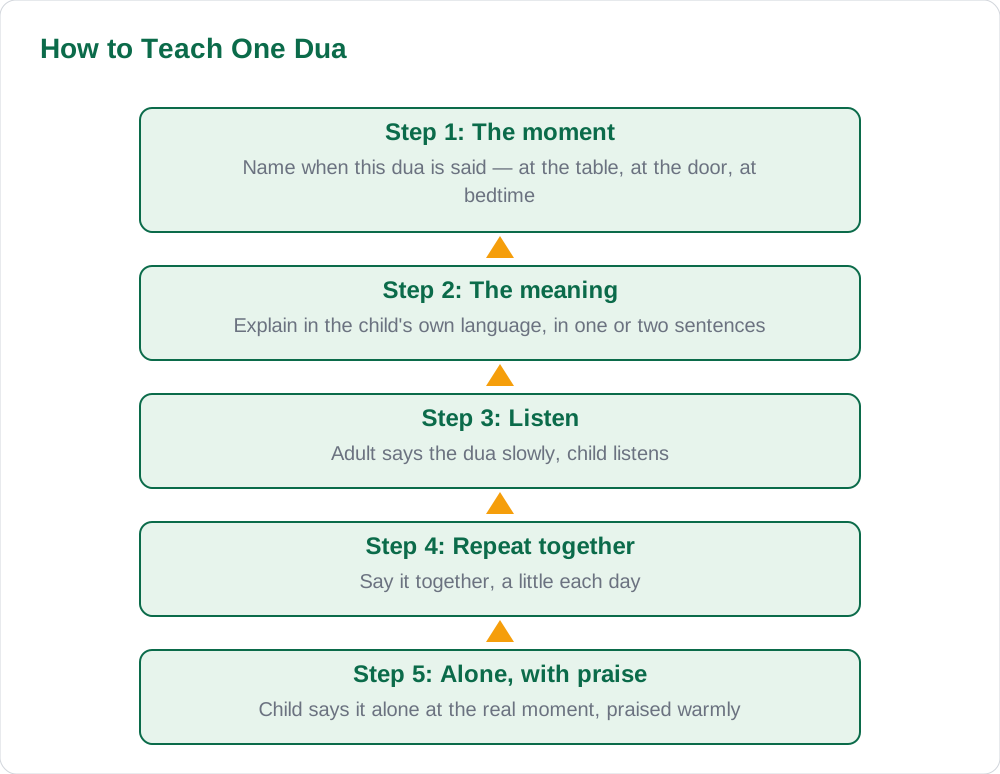
The heart of this method is pairing: every dua belongs to a moment. The dua before eating belongs to the table. The dua before sleeping belongs to the bed. The dua for entering the house belongs to the door. When the child reaches the moment, the moment itself reminds them of the dua — no test, no fear, just a habit growing in the right place.
Teach only one new dua until it is firm, then add the next. A Class 3 pupil who knows three duas deeply — before eating, before sleeping, and on waking — has learned more than a pupil who has half-memorised twelve. Parents and teachers should agree on which dua comes first so the child hears the same dua at home and at school. That agreement doubles the practice without adding a minute of study time.
Teach the Meaning Before the Words
Children remember words they understand. Before asking a child to memorise a dua, explain its meaning in the child's own language in one or two simple sentences. A dua before eating is a thank-you for food. A dua before sleeping asks for safety through the night. When the child knows the meaning, the Arabic words carry feeling, and feeling is what makes memory last.
Keep the meaning simple and warm. There is no need for a long lecture — two sentences, said kindly, are enough. Then let the child say the meaning back in their own words. If they can say what the dua means, they are ready to learn the words. If they cannot, explain once more and wait. Rushing past meaning is the most common reason duas are forgotten.
Repetition That Feels Like Love, Not Pressure
Repetition is how duas are learned, but the kind of repetition matters. A child who repeats a dua five times with a smiling parent learns it with love. A child who repeats it fifty times as a punishment learns to resent it. Keep repetitions short — three to five times together is plenty — and spread them across the day: once in the morning, once at the moment itself, once before bed. Short, happy repetition beats long, forced repetition every time.
Use the same gentle cue every time. At the table, the cue can be: let us say our dua. At the door: let us say our dua before we go. The cue becomes part of the routine, and soon the child says the dua before the cue is even given. That is the moment a dua stops being homework and becomes a habit.
- Repeat three to five times together, spread across the day.
- Use the same gentle cue each time — let us say our dua.
- Never use dua repetition as a punishment or a test.
Manners Grow Beside the Duas
Duas and manners belong together, because both are about how a child treats others and the world. The dua before eating pairs naturally with eating manners: sit calmly, eat with the right hand, do not waste food, thank the person who cooked. The dua on leaving the house pairs with greeting manners: say salaam, speak politely, walk calmly. Teaching the pair together makes both stronger, because the child sees that good words and good behaviour are two parts of one habit.
Model the manners yourself. Children copy what adults do far more than what adults say. A parent who says the dua at the table and eats calmly teaches more in one meal than a week of lectures. A teacher who greets pupils warmly and speaks gently teaches manners without a single lesson plan. When adults live the manners, children absorb them. For more on steady Islamiat study, see how to study Islamiat effectively.
Gentle Practice, No Long Lists
Resist the temptation to hand a child a long list of duas to memorise by Friday. Long lists create anxiety, and anxious children memorise nothing. Instead, keep a small chart — three duas this month, with a star beside each one the child can say alone. The chart makes progress visible, and visible progress motivates. When all three stars are earned, celebrate simply: a kind word, a note home, a place of honour on the class chart.
If a child forgets a dua they once knew, do not scold. Forgetting is normal, and a gentle reminder at the moment itself — let us say it together — brings it back faster than any test. The goal is not a child who can perform under pressure, but a child who carries these words into life with love. Parents looking for class-wise solved material can explore the solved notes and the books collection.
AI Help: Muse AI
Muse AI is Meta's personal AI assistant. It can explain concepts simply, summarise a lesson, or make practice questions for your child's level.
For duas and manners, you can ask Muse AI to explain the meaning of a short daily dua in simple words a Class 3 pupil can understand, or to suggest a gentle weekly plan for teaching one dua at a time.
Join Muse with invite code LTGSWD — in the Muse app, go to Settings > Redeem token and enter the code.
Disclosure: LTGSWD is the author's Muse invite code.
Muse AI does not give official Sindh Textbook Board answers — always verify against your Sindh Textbook Board book and your teacher.
5 key points you must know
- Teach one short dua at a time, paired with its real daily moment.
- Explain the meaning in the child's own language before memorising the words.
- Repeat three to five times, spread across the day, with love — never as punishment.
- Teach manners beside each dua: good words and good behaviour grow together.
- Track progress with a small star chart, not a long memorisation list.
Frequently asked questions
How many duas should a Class 3 or 4 pupil learn?
Three to five short daily duas learned deeply is a good target for the year — before eating, before sleeping, on waking, and on entering and leaving the house. Depth matters far more than a long list.
What if my child keeps forgetting a dua?
Forgetting is normal. Gently say it together at the real moment — at the table, at the door, at bedtime. The moment itself is the best reminder, and a calm reminder brings the dua back faster than any test.
Should children learn duas by reading or by listening?
Listening first. The child should hear the dua said slowly and correctly many times before reading it. Once the sound is familiar, reading the words in the book becomes much easier.
How do I correct a child's pronunciation of a dua?
Say the word correctly yourself, warmly, and let the child repeat it after you. Never mock a mistake. If a word is consistently hard, practise just that word for a few days rather than the whole dua.
Can manners be taught at home without a textbook?
Yes — manners are taught by example and gentle routine. Greeting with salaam, eating calmly, thanking the cook, and speaking politely are daily practices. The textbook supports the habit; the home builds it.
Solved notes — preview free
These guides work best with the solved exercises. Preview the solved notes free on this website — 119 solved notes for Classes 6–10 in Sindhi, Urdu, English and Arabic medium. Or browse the full solved notes catalogue for your class and medium. New solved notes are added regularly — check the catalogue for coming-soon books.